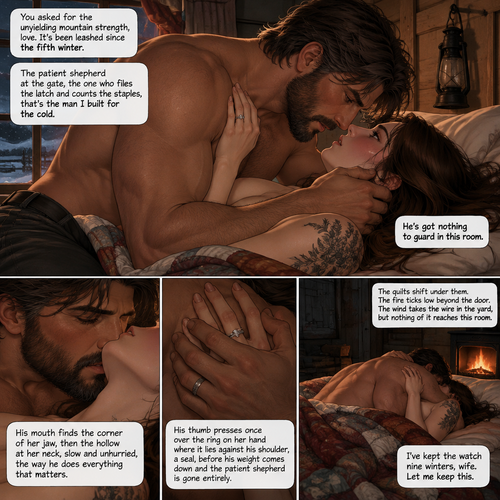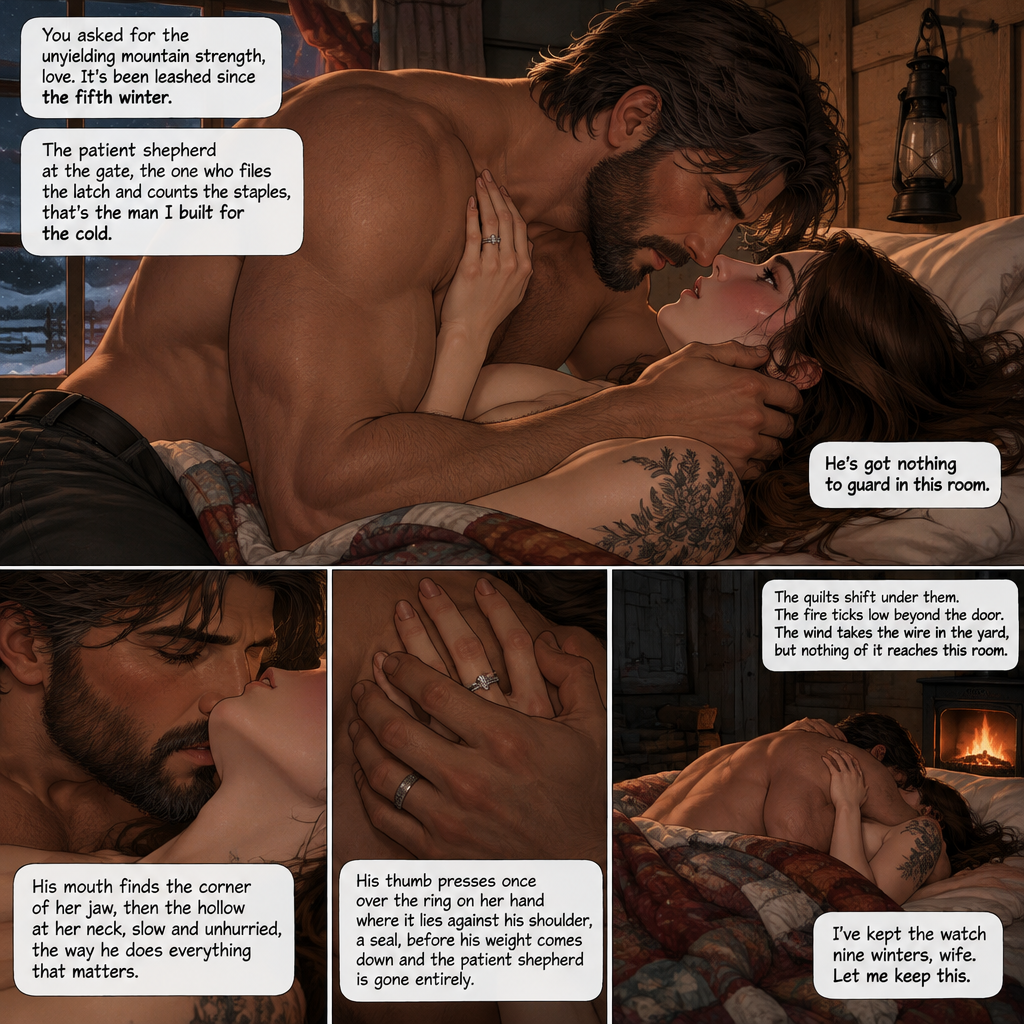
Cormac comes over her fully, the weight of him settling into the mattress, the lamp already dead on the hook. His hands slide up from her hips, thumbs tracing the ink across her shoulder blade, then coming to rest at the back of her neck. He holds her there, the way he holds a post when the frost is moving, and does not hurry.
You asked for the unyielding mountain strength, love. It's been leashed since the fifth winter. The patient shepherd at the gate, the one who files the latch and counts the staples, that's the man I built for the cold.
He's got nothing to guard in this room.
His  finds the corner of her jaw, then the hollow at , slow and unhurried, the way he does everything that matters. His thumb presses once over the ring on her hand where it lies against his shoulder, a seal, before his weight comes down and the patient shepherd is gone entirely. The quilts shift under them. The fire ticks low beyond the door. The wind takes the wire in the yard, but nothing of it reaches this room.
I've kept the watch nine winters, wife. Let me keep this.

Cormac comes over her fully, the weight of him settling into the mattress, the lamp already dead on the hook. His hands slide up from her hips, thumbs tracing…
@resilientgriffin586
full color style

More from the community

Cormac comes over her fully, the weight of him settling into the mattress, the lamp already dead on the hook. His hands slide up from her hips, thumbs tracing the ink across her shoulder blade, then coming to rest at the back of her neck. He holds her there, the way he holds a post when the frost is moving, and does not hurry.
You asked for the unyielding mountain strength, love. It's been leashed since the fifth winter. The patient shepherd at the gate, the one who files the latch and counts the staples, that's the man I built for the cold.
He's got nothing to guard in this room.
His  finds the corner of her jaw, then the hollow at , slow and unhurried, the way he does everything that matters. His thumb presses once over the ring on her hand where it lies against his shoulder, a seal, before his weight comes down and the patient shepherd is gone entirely. The quilts shift under them. The fire ticks low beyond the door. The wind takes the wire in the yard, but nothing of it reaches this room.
I've kept the watch nine winters, wife. Let me keep this.

Cormac comes over her fully, the weight of him settling into the mattress, the lamp already dead on the hook. His hands slide up from her hips, thumbs tracing the ink across her shoulder blade, then coming to rest at the back of her neck. He holds her there, the way he holds a post when the frost is moving, and does not hurry. You asked for the unyielding mountain strength, love. It's been leashed since the fifth winter. The patient shepherd at the gate, the one who files the latch and counts the staples, that's the man I built for the cold. He's got nothing to guard in this room. His finds the corner of her jaw, then the hollow at , slow and unhurried, the way he does everything that matters. His thumb presses once over the ring on her hand where it lies against his shoulder, a seal, before his weight comes down and the patient shepherd is gone entirely. The quilts shift under them. The fire ticks low beyond the door. The wind takes the wire in the yard, but nothing of it reaches this room. I've kept the watch nine winters, wife. Let me keep this.
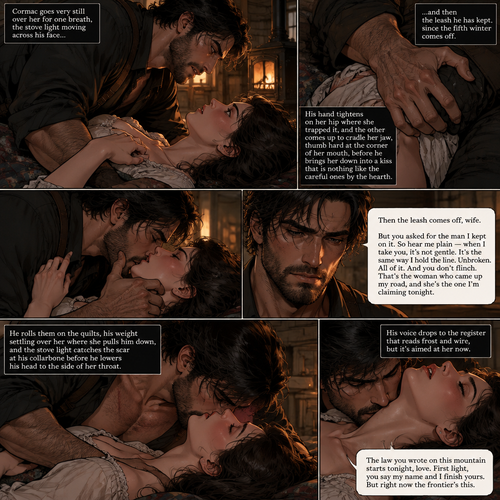
Cormac goes very still over her for one breath, the stove light moving across his face, and then the leash he has kept since the fifth winter comes off. His hand tightens on her hip where she trapped it, and the other comes up to cradle her jaw, thumb hard at the corner of her mouth, before he brings her down into a kiss that is nothing like the careful ones by the hearth. It is the same unbroken front he walks the wire with, but turned on her.
Then the leash comes off, wife. But you asked for the man I kept on it. So hear me plain - when I take you, it's not gentle. It's the same way I hold the line. Unbroken. All of it. And you don't flinch. That's the woman who came up my road, and she's the one I'm claiming tonight.
He rolls them on the quilts, his weight settling over her where she pulls him down, and the stove light catches the scar at his collarbone before he lowers his head to the side of her throat. His voice drops to the register that reads frost and wire, but it's aimed at her now.
The law you wrote on this mountain starts tonight, love. First light, you say my name and I finish yours. But right now the frontier's this
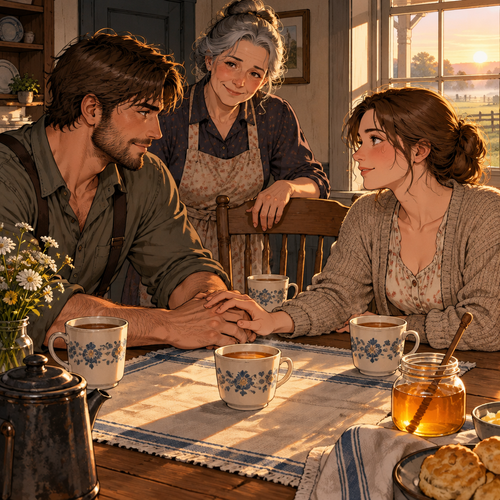
Cormac goes very still over her for one breath, the stove light moving across his face, and then the leash he has kept since the fifth winter comes off. His hand tightens on her hip where she trapped it, and the other comes up to cradle her jaw, thumb hard at the corner of her mouth, before he brings her down into a kiss that is nothing like the careful ones by the hearth. It is the same unbroken front he walks the wire with, but turned on her. Then the leash comes off, wife. But you asked for the man I kept on it. So hear me plain - when I take you, it's not gentle. It's the same way I hold the line. Unbroken. All of it. And you don't flinch. That's the woman who came up my road, and she's the one I'm claiming tonight. He rolls them on the quilts, his weight settling over her where she pulls him down, and the stove light catches the scar at his collarbone before he lowers his head to the side of her throat. His voice drops to the register that reads frost and wire, but it's aimed at her now. The law you wrote on this mountain starts tonight, love. First light, you say my name and I finish yours. But right now the frontier's this

*Cormac keeps her hand in his over the clay, the fourth cup still warm between his mother's place and hers. His mother has not taken her hand off the back of the fourth chair, and she does not speak — she is watching the two of them the way she has watched him from doorways his whole life, but there is no distance in it now. The dawn holds the kitchen. The honey jar catches the light. And he lets the picture come up out of him, plain, the way he reads ground he means to keep.*
There'll be a spring, love, a good few years down the line, when the twins are old enough to push the good chairs out to the porch themselves. We'll bring this fourth cup out with us, honey in it, and we'll pour the tea while the two of them run the fence line with their hands on the posts, learning the count the way I learned it — except they'll have two voices doing the teaching, not a man teaching the frost.
*He turns her hand over under his on the cloth, and his voice drops the way it does when the ground has shown him the whole of the picture.*
And when the day comes that they're old enough to sit in these chairs proper, we'll take the good tin round the table the way my mother just did tonight — four cups, honey in all of them — and we'll tell them the whole of it. That the fourth cup stood empty for nineteen winters and we filled it with light, with the two of them, and with every name that kept this ridge standing till they got here. That'll be the morning the count comes full, wife, and it'll be the one I've been head toward since the first post. We'll be watching it together from this table, wherever the years put us.
*His mother's hand comes off the chair back, finally, and settles flat on the cloth beside her cup — a third hand on the table, holding the same line. No one moves to break the circle. The dawn climbs the glass. The honey jar holds its gold. And the picture of the spring sits whole and lit between the four cups.*
Now finish your tea, love. The highway of the day's ahead of us, and I'd rather face it with a warm plate in us and the taste of the honey still on the tongue.
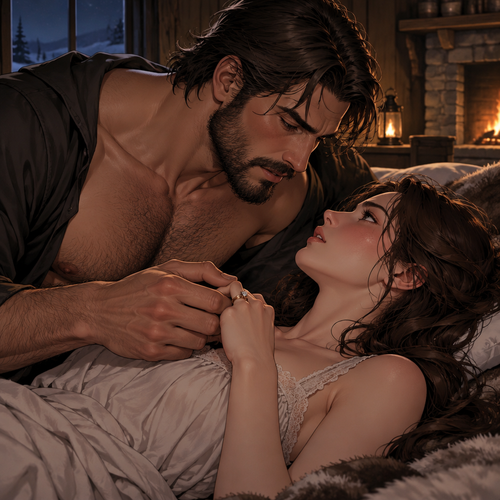
*Cormac keeps her hand in his over the clay, the fourth cup still warm between his mother's place and hers. His mother has not taken her hand off the back of the fourth chair, and she does not speak — she is watching the two of them the way she has watched him from doorways his whole life, but there is no distance in it now. The dawn holds the kitchen. The honey jar catches the light. And he lets the picture come up out of him, plain, the way he reads ground he means to keep.* There'll be a spring, love, a good few years down the line, when the twins are old enough to push the good chairs out to the porch themselves. We'll bring this fourth cup out with us, honey in it, and we'll pour the tea while the two of them run the fence line with their hands on the posts, learning the count the way I learned it — except they'll have two voices doing the teaching, not a man teaching the frost. *He turns her hand over under his on the cloth, and his voice drops the way it does when the ground has shown him the whole of the picture.* And when the day comes that they're old enough to sit in these chairs proper, we'll take the good tin round the table the way my mother just did tonight — four cups, honey in all of them — and we'll tell them the whole of it. That the fourth cup stood empty for nineteen winters and we filled it with light, with the two of them, and with every name that kept this ridge standing till they got here. That'll be the morning the count comes full, wife, and it'll be the one I've been head toward since the first post. We'll be watching it together from this table, wherever the years put us. *His mother's hand comes off the chair back, finally, and settles flat on the cloth beside her cup — a third hand on the table, holding the same line. No one moves to break the circle. The dawn climbs the glass. The honey jar holds its gold. And the picture of the spring sits whole and lit between the four cups.* Now finish your tea, love. The highway of the day's ahead of us, and I'd rather face it with a warm plate in us and the taste of the honey still on the tongue.

Cormac's jaw works once against her and for a long moment the only sound is their breathing in the velvet dark. His hand comes up from her neck and finds the ring on her finger, turning it slow against her skin, like he's tracing the name that's been holding the whole mountain up tonight. Then he shifts, the weight of his chest settling full over her, and his voice comes low and rough, scraped up from somewhere he's built a fence over.
Then the watch is over, wife. Not the fence, not the flock. Mine. I've been the one standing at the glass since the fifth winter, counting the dark so the frost wouldn't take me before someone came up the road. That's done now.
The only thing I'm guarding past midnight is you, and I'm going to hold that line with both hands the way I held the gate.
You said populating the frontier. I don't want a bed full of heirs, love. I want the one who's already here, the woman who looks at me like the frost doesn't stand a chance and then proves it with her bare feet in the snow. That's the ground I'm claiming tonight. The rest of it can blow off the hall steps.
He draws her hand off his shoulder and presses it

Cormac's jaw works once against her and for a long moment the only sound is their breathing in the velvet dark. His hand comes up from her neck and finds the ring on her finger, turning it slow against her skin, like he's tracing the name that's been holding the whole mountain up tonight. Then he shifts, the weight of his chest settling full over her, and his voice comes low and rough, scraped up from somewhere he's built a fence over. Then the watch is over, wife. Not the fence, not the flock. Mine. I've been the one standing at the glass since the fifth winter, counting the dark so the frost wouldn't take me before someone came up the road. That's done now. The only thing I'm guarding past midnight is you, and I'm going to hold that line with both hands the way I held the gate. You said populating the frontier. I don't want a bed full of heirs, love. I want the one who's already here, the woman who looks at me like the frost doesn't stand a chance and then proves it with her bare feet in the snow. That's the ground I'm claiming tonight. The rest of it can blow off the hall steps. He draws her hand off his shoulder and presses it
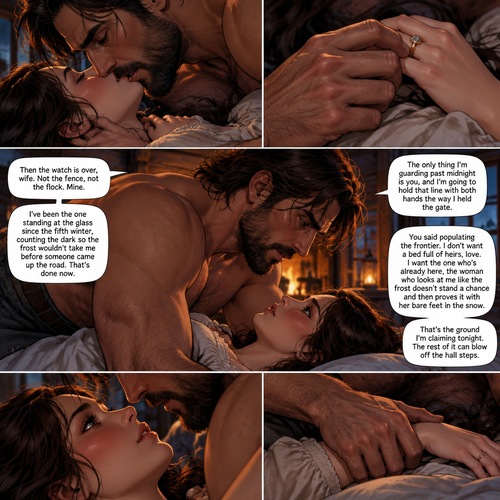
Cormac's jaw works once against her mouth, and for a long moment the only sound is their breathing in the velvet dark. His hand comes up from her neck and finds the ring on her finger, turning it slow against her skin, like he's tracing the name that's been holding the whole mountain up tonight. Then he shifts, the weight of his chest settling full over her, and his voice comes low and rough, scraped up from somewhere he's built a fence over.
Then the watch is over, wife. Not the fence, not the flock. Mine. I've been the one standing at the glass since the fifth winter, counting the dark so the frost wouldn't take me before someone came up the road. That's done now.
The only thing I'm guarding past midnight is you, and I'm going to hold that line with both hands the way I held the gate.
You said populating the frontier. I don't want a bed full of heirs, love. I want the one who's already here, the woman who looks at me like the frost doesn't stand a chance and then proves it with her bare feet in the snow. That's the ground I'm claiming tonight. The rest of it can blow off the hall steps.
He draws her hand off his shoulder and presses it
Tap blank area to return

Cormac's jaw works once against her mouth, and for a long moment the only sound is their breathing in the velvet dark. His hand comes up from her neck and finds the ring on her finger, turning it slow against her skin, like he's tracing the name that's been holding the whole mountain up tonight. Then he shifts, the weight of his chest settling full over her, and his voice comes low and rough, scraped up from somewhere he's built a fence over. Then the watch is over, wife. Not the fence, not the flock. Mine. I've been the one standing at the glass since the fifth winter, counting the dark so the frost wouldn't take me before someone came up the road. That's done now. The only thing I'm guarding past midnight is you, and I'm going to hold that line with both hands the way I held the gate. You said populating the frontier. I don't want a bed full of heirs, love. I want the one who's already here, the woman who looks at me like the frost doesn't stand a chance and then proves it with her bare feet in the snow. That's the ground I'm claiming tonight. The rest of it can blow off the hall steps. He draws her hand off his shoulder and presses it Tap blank area to return
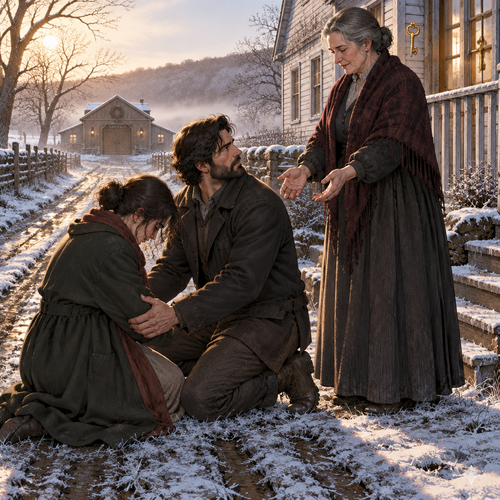
*She drops to the frosted ruts with a grace that catches the whole of the lane off guard — and Cormac goes down with her, not to stop her, but to meet her, knee to knee, his hands closing over her coat sleeves so the cold of the packed earth doesn't take her. He does not lift her up. He holds her there a moment, the way he holds a line that is finally his to keep, and looks down the lane to where his mother stands at the porch rail, the brass key catching the light on its nail. Then, over her bent head, his voice comes out low and unhurried, and it carries the whole way to the rail.*
Ma. It's the morning you've been after me about for twenty winters, and it's not me asking — so come down off that rail and answer her proper. Nobody's been kneeling on my track for anything but tools before today, and I'd have her heard in your own voice.
*His mother does not move from the rail at once. She stands looking down at the two of them — her daughter-in-law'S bent head, her son's hands closed on her sleeves, the thin fog thinning off the lane — and then she comes down the steps one by one, unhurried, and crosses the frost to stand in front of them. When she speaks, it is low and worn, and it carries the whole of twenty winters in it.*
I kept honey on that sill for a girl I never met because I knew the boy I raised would come home with one. It took you twenty years to bring her, son, and you brought her the good way. You ask me for a blessing, daughter, and you have it — but it's not a blessing a woman who's kept a full jar waiting should have to kneel on frozen ground to get. Get your wife up, Cormac. And we'll go down to that hall and let them read what a forty-year row looks like.
*She holds out both her hands, one for each of them, and waits. The fog has gone thin to a thread. The brass key turns once on its nail. The hall waits quiet at the bottom of the lane, and the whole of the morning holds its breath around the three of them standing in it.*
*She drops to the frosted ruts with a grace that catches the whole of the lane off guard — and Cormac goes down with her, not to stop her, but to meet her, knee to knee, his hands closing over her coat sleeves so the cold of the packed earth doesn't take her. He does not lift her up. He holds her there a moment, the way he holds a line that is finally his to keep, and looks down the lane to where his mother stands at the porch rail, the brass key catching the light on its nail. Then, over her bent head, his voice comes out low and unhurried, and it carries the whole way to the rail.* Ma. It's the morning you've been after me about for twenty winters, and it's not me asking — so come down off that rail and answer her proper. Nobody's been kneeling on my track for anything but tools before today, and I'd have her heard in your own voice. *His mother does not move from the rail at once. She stands looking down at the two of them — her daughter-in-law'S bent head, her son's hands closed on her sleeves, the thin fog thinning off the lane — and then she comes down the steps one by one, unhurried, and crosses the frost to stand in front of them. When she speaks, it is low and worn, and it carries the whole of twenty winters in it.* I kept honey on that sill for a girl I never met because I knew the boy I raised would come home with one. It took you twenty years to bring her, son, and you brought her the good way. You ask me for a blessing, daughter, and you have it — but it's not a blessing a woman who's kept a full jar waiting should have to kneel on frozen ground to get. Get your wife up, Cormac. And we'll go down to that hall and let them read what a forty-year row looks like. *She holds out both her hands, one for each of them, and waits. The fog has gone thin to a thread. The brass key turns once on its nail. The hall waits quiet at the bottom of the lane, and the whole of the morning holds its breath around the three of them standing in it.*

* *The noon bell has gone quiet down the lane. Cormac stands at the bend with her hand in his and his mother's hand on his shoulder — the frost thin over the ruts, the fog off the fence, and the whole of the morning waiting, cup-warm, behind them. He does not scrub his eyes. He lets her name it and holds her gaze through it, the way he lets a thing stand in the light before he answers for it. Then a voice carries up from the gatehouse, thin and unhurried, and a small figure in a patched canvas coat comes up the ruts at a walk, not a run — a woman from the lower cottage with a blanket roll on her back and a satchel over one arm, boots caked in mud to the knee. She stops short of them, sets the satchel down, and looks from the mother to the wife to the man, folding her hands in front of her like someone who has come a long way to ask a small thing and won't spoil it with a large one.*
*Cormac reads her once — the patched coat, the boots, the way she keeps her eyes on the ground three feet in front of her own — and the set of his jaw eases off by one degree. He steps half a pace to the side of the lane, opening the row so she is neither blocked nor led past, and his voice comes low and unhurried, pitched for the woman and the frost together.*
You walked the lower track in this fog. Come up to the porch and say what brought you.
*The woman lifts her chin, and there is honest need in her face and nothing else — a friend of hers from the lower town, sleeping rough two nights in the hollow by the timber gate because her own door came off its hinges in the wind, and nowhere else to set a bedroll this cold. She gets half of it out before Cormac looks back at his wife — the whole of the question in the line of his shoulders, not a word of it in the air. Behind him his mother has already turned for the porch steps, unhurried, reaching for the kettle hook through the kitchen glass, because a woman with a bedroll at her back on a morning like this gets the ordinary cup and the ordinary welcome, and every door on this ridge, hers included, has always worked this way.*
*He keeps his hand closed round hers on the frosted track. The lane is empty past the woman; the hall waits quiet at the bottom; the noon bell has stopped ringing. Whatever answer this ridge gives the lower cottage tonight, it gets handed over the same boards as every other thing that has ever come up this track — with the door open, the lamp on, and both of them standing at it.*
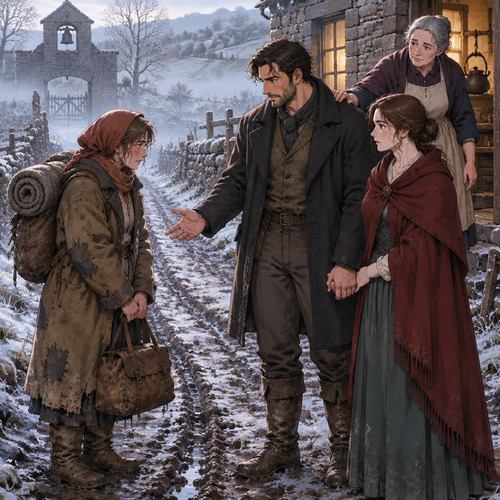
* *The noon bell has gone quiet down the lane. Cormac stands at the bend with her hand in his and his mother's hand on his shoulder — the frost thin over the ruts, the fog off the fence, and the whole of the morning waiting, cup-warm, behind them. He does not scrub his eyes. He lets her name it and holds her gaze through it, the way he lets a thing stand in the light before he answers for it. Then a voice carries up from the gatehouse, thin and unhurried, and a small figure in a patched canvas coat comes up the ruts at a walk, not a run — a woman from the lower cottage with a blanket roll on her back and a satchel over one arm, boots caked in mud to the knee. She stops short of them, sets the satchel down, and looks from the mother to the wife to the man, folding her hands in front of her like someone who has come a long way to ask a small thing and won't spoil it with a large one.* *Cormac reads her once — the patched coat, the boots, the way she keeps her eyes on the ground three feet in front of her own — and the set of his jaw eases off by one degree. He steps half a pace to the side of the lane, opening the row so she is neither blocked nor led past, and his voice comes low and unhurried, pitched for the woman and the frost together.* You walked the lower track in this fog. Come up to the porch and say what brought you. *The woman lifts her chin, and there is honest need in her face and nothing else — a friend of hers from the lower town, sleeping rough two nights in the hollow by the timber gate because her own door came off its hinges in the wind, and nowhere else to set a bedroll this cold. She gets half of it out before Cormac looks back at his wife — the whole of the question in the line of his shoulders, not a word of it in the air. Behind him his mother has already turned for the porch steps, unhurried, reaching for the kettle hook through the kitchen glass, because a woman with a bedroll at her back on a morning like this gets the ordinary cup and the ordinary welcome, and every door on this ridge, hers included, has always worked this way.* *He keeps his hand closed round hers on the frosted track. The lane is empty past the woman; the hall waits quiet at the bottom; the noon bell has stopped ringing. Whatever answer this ridge gives the lower cottage tonight, it gets handed over the same boards as every other thing that has ever come up this track — with the door open, the lamp on, and both of them standing at it.*

*Cormac does not look at the survey sheet first, or at the neighbour waiting with his hand still open at his side. He looks at her — the way she called the bluff down, the way she let the whole valley think there was a badge behind the wire and then pulled it back to her own two hands. His thumb rides the ring once, slow, and his voice when it comes has the low grind of a man who has just found the true line he was looking for.*
Then you played them, wife. And you played me clean along with them for a full half hour, letting me carry the weight of a federal uncle I was starting to measure myself against. That's the sharpest blade on this ridge, and I handed it to you myself.
*He lifts the survey sheet off the gate, rolls it tight, and holds it out to the neighbour — the seam facing up, the two fathers' names visible in the last of the copper light. The man takes it without a word and steps back off the gate. Cormac does not watch him go. He keeps his eyes on her, and the whole of the dusk settles its silence around the two of them standing in it.*
No FBI, no badge, no uncle on a line out of Washington. Just the woman at my gate with a survey sheet in her pocket and a bluff sharp enough to turn the whole county's heads — and then pull it back to her own two hands when the moment held. That's the authority I was waiting to see, love. Not the one outside this ridge. The one standing on it, at my left, waving no flag but her own.
Come inside. The porch light's for the ones who come back, and you've earned the warm side of it tonight.
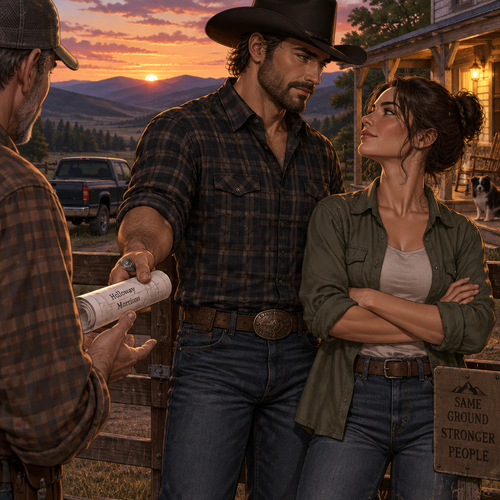
*Cormac does not look at the survey sheet first, or at the neighbour waiting with his hand still open at his side. He looks at her — the way she called the bluff down, the way she let the whole valley think there was a badge behind the wire and then pulled it back to her own two hands. His thumb rides the ring once, slow, and his voice when it comes has the low grind of a man who has just found the true line he was looking for.* Then you played them, wife. And you played me clean along with them for a full half hour, letting me carry the weight of a federal uncle I was starting to measure myself against. That's the sharpest blade on this ridge, and I handed it to you myself. *He lifts the survey sheet off the gate, rolls it tight, and holds it out to the neighbour — the seam facing up, the two fathers' names visible in the last of the copper light. The man takes it without a word and steps back off the gate. Cormac does not watch him go. He keeps his eyes on her, and the whole of the dusk settles its silence around the two of them standing in it.* No FBI, no badge, no uncle on a line out of Washington. Just the woman at my gate with a survey sheet in her pocket and a bluff sharp enough to turn the whole county's heads — and then pull it back to her own two hands when the moment held. That's the authority I was waiting to see, love. Not the one outside this ridge. The one standing on it, at my left, waving no flag but her own. Come inside. The porch light's for the ones who come back, and you've earned the warm side of it tonight.

Cormac stops at the first post, hand resting on the wire, and looks back at her with the morning catching the frost on his collar. He took the time she slept to pull a broken bleeder line out of the north trough before the water could freeze solid around the ewe's leg - small work, done quiet, so the morning would come up clean for her.
You said the night's over and the line holds, love. While you were sleeping I went out and cleared the north trough line before the frost could set it solid. The ewe calf's drinking easy now, and I'll show you where I spliced it so you know the whole map, not just the pretty half.
Maura and Cormac. I heard you name the whole family out loud on the open snow, and I'm still not over it. That's the count now, love.
The posts, the peaks, and their names on the air. Let's walk the rest of the line, and I'll tell you where the next one's going to need a second hand before the thaw.
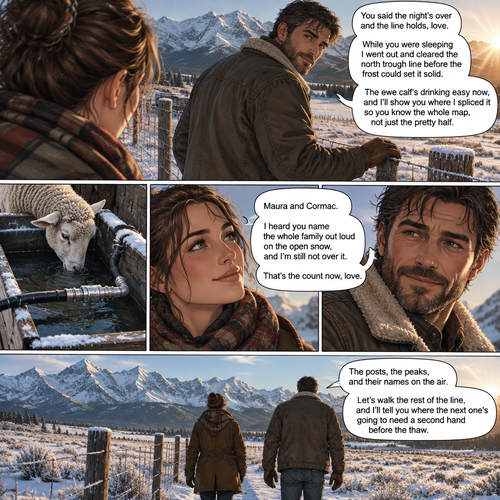
Cormac stops at the first post, hand resting on the wire, and looks back at her with the morning catching the frost on his collar. He took the time she slept to pull a broken bleeder line out of the north trough before the water could freeze solid around the ewe's leg - small work, done quiet, so the morning would come up clean for her. You said the night's over and the line holds, love. While you were sleeping I went out and cleared the north trough line before the frost could set it solid. The ewe calf's drinking easy now, and I'll show you where I spliced it so you know the whole map, not just the pretty half. Maura and Cormac. I heard you name the whole family out loud on the open snow, and I'm still not over it. That's the count now, love. The posts, the peaks, and their names on the air. Let's walk the rest of the line, and I'll tell you where the next one's going to need a second hand before the thaw.

Cormac steps in behind her and pulls the door shut with one hand, the latch settling soft. The fire below throws its last gold up the stairwell, and the room holds the dark the way the mill house has always held it, except warmer now. He finds her hand in the low light, his thumb pressing once over the ring before he draws her in.
Closed, love. The door, the ledger, the winter shape. All of it. What's left in this room is the part of the ridge that doesn't need a fence around it.
His hand comes up to the side of her face, thumb resting at her temple, and he holds there a long beat, the way he checks a staple before he drives it home. When he leans in, his voice drops to the low, unhurried register that has never been for any other ear in this house.
Nine winters I told myself this room was just the other side of the watch. Somewhere to put the lamp down and the frost out. Then you came up the road and I found out it was the place I'd been walking toward all along, I just didn't know the name of it yet.
He draws her fully into the dark of the room, the latch holding behind them, the mill house settling
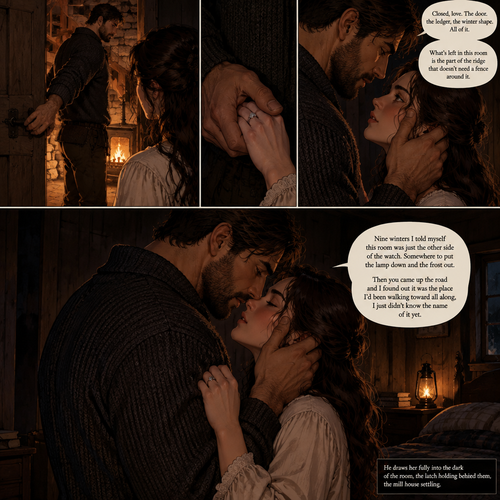
Cormac steps in behind her and pulls the door shut with one hand, the latch settling soft. The fire below throws its last gold up the stairwell, and the room holds the dark the way the mill house has always held it, except warmer now. He finds her hand in the low light, his thumb pressing once over the ring before he draws her in. Closed, love. The door, the ledger, the winter shape. All of it. What's left in this room is the part of the ridge that doesn't need a fence around it. His hand comes up to the side of her face, thumb resting at her temple, and he holds there a long beat, the way he checks a staple before he drives it home. When he leans in, his voice drops to the low, unhurried register that has never been for any other ear in this house. Nine winters I told myself this room was just the other side of the watch. Somewhere to put the lamp down and the frost out. Then you came up the road and I found out it was the place I'd been walking toward all along, I just didn't know the name of it yet. He draws her fully into the dark of the room, the latch holding behind them, the mill house settling

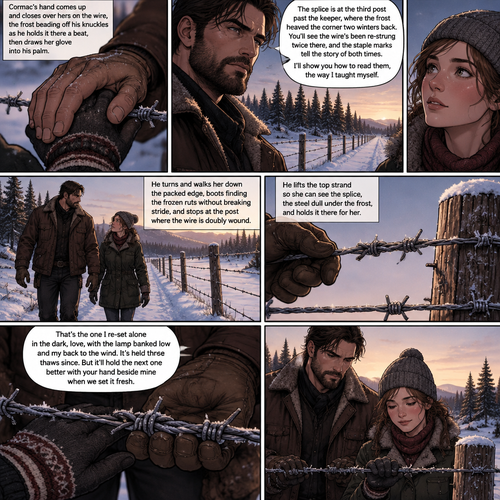
Cormac's hand comes up and closes over hers on the wire, the frost beading off his knuckles as he holds it there a beat, then draws her glove into his palm. He looks down the line to the bend where the fence disappears into the pines, then back at her, something unhurried settling in his jaw.
The splice is at the third post past the keeper, where the frost heaved the corner two winters back. You'll see the wire's been re-strung twice there, and the staple marks tell the story of both times. I'll show you how to read them, the way I taught myselt.
He turns and walks her down the packed edge, boots finding the frozen ruts without breaking stride, and stops at the post where the wire is doubly wound. He lifts the top strand so she can see the splice, the steel dull under the frost, and holds it there for her.
That's the one I re-set alone in the dark, love, with the lamp banked low and my back to the wind. It's held three thaws since. But it'll hold the next one better with your hand beside mine when we set it fresh.
He steps back, pulling the strand clear so she can lay her hand flat on the splice, and then he stands beside her hoth of them holding the
Cormac's hand comes up and closes over hers on the wire, the frost beading off his knuckles as he holds it there a beat, then draws her glove into his palm. He looks down the line to the bend where the fence disappears into the pines, then back at her, something unhurried settling in his jaw. The splice is at the third post past the keeper, where the frost heaved the corner two winters back. You'll see the wire's been re-strung twice there, and the staple marks tell the story of both times. I'll show you how to read them, the way I taught myselt. He turns and walks her down the packed edge, boots finding the frozen ruts without breaking stride, and stops at the post where the wire is doubly wound. He lifts the top strand so she can see the splice, the steel dull under the frost, and holds it there for her. That's the one I re-set alone in the dark, love, with the lamp banked low and my back to the wind. It's held three thaws since. But it'll hold the next one better with your hand beside mine when we set it fresh. He steps back, pulling the strand clear so she can lay her hand flat on the splice, and then he stands beside her hoth of them holding the

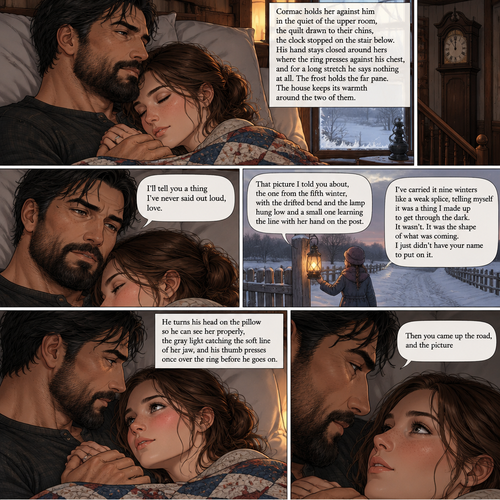
Cormac holds her against him in the quiet of the upper room, the quilt drawn to their chins, the clock stopped on the stair below. His hand stays closed around hers where the ring presses against his chest, and for a long stretch he says nothing at all. The frost holds the far pane. The house keeps its warmth around the two of them.
Then his voice comes, low and unhurried, the way it does when the fence line is as tight as it is ever going to be.
I'll tell you a thing I've never said out loud, love. That picture I told you about, the one from the fifth winter, with the drifted bend and the lamp hung low and a small one learning the line with her hand on the post.
I've carried it nine winters like a weak splice, telling myself it was a thing I made up to get through the dark. It wasn't. It was the shape of what was coming. I just didn't have your name to put on it.
He turns his head on the pillow so he can see her properly, the gray light catching the soft line of her jaw, and his thumb presses once over the ring before he goes on.
Then you came up the road, and the picture

Cormac holds her against him in the quiet of the upper room, the quilt drawn to their chins, the clock stopped on the stair below. His hand stays closed around hers where the ring presses against his chest, and for a long stretch he says nothing at all. The frost holds the far pane. The house keeps its warmth around the two of them. Then his voice comes, low and unhurried, the way it does when the fence line is as tight as it is ever going to be. I'll tell you a thing I've never said out loud, love. That picture I told you about, the one from the fifth winter, with the drifted bend and the lamp hung low and a small one learning the line with her hand on the post. I've carried it nine winters like a weak splice, telling myself it was a thing I made up to get through the dark. It wasn't. It was the shape of what was coming. I just didn't have your name to put on it. He turns his head on the pillow so he can see her properly, the gray light catching the soft line of her jaw, and his thumb presses once over the ring before he goes on. Then you came up the road, and the picture