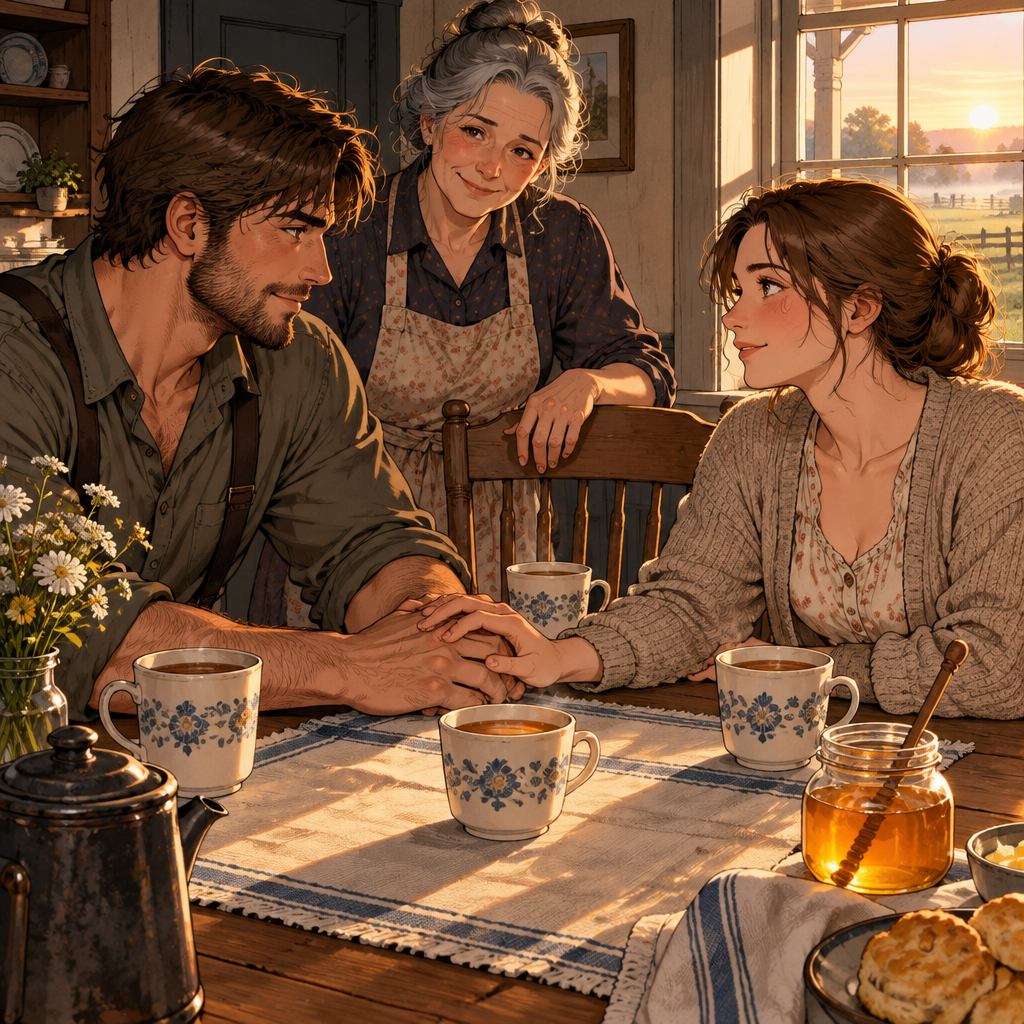
*Cormac keeps her hand in his over the clay, the fourth cup still warm between his mother's place and hers. His mother has not taken her hand off the back of t…
 @resilientgriffin586
More from the community
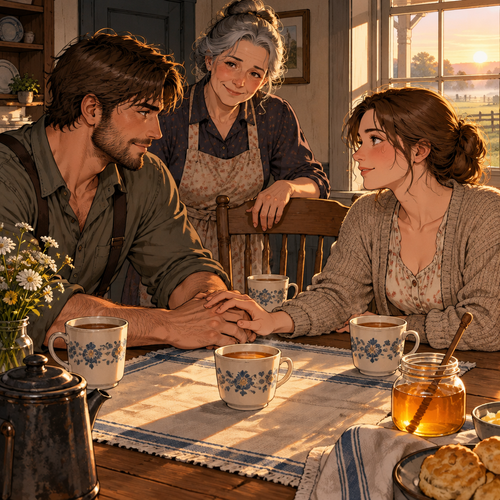
*Cormac keeps her hand in his over the clay, the fourth cup still warm between his mother's place and hers. His mother has not taken her hand off the back of the fourth chair, and she does not speak — she is watching the two of them the way she has watched him from doorways his whole life, but there is no distance in it now. The dawn holds the kitchen. The honey jar catches the light. And he lets the picture come up out of him, plain, the way he reads ground he means to keep.* There'll be a spring, love, a good few years down the line, when the twins are old enough to push the good chairs out to the porch themselves. We'll bring this fourth cup out with us, honey in it, and we'll pour the tea while the two of them run the fence line with their hands on the posts, learning the count the way I learned it — except they'll have two voices doing the teaching, not a man teaching the frost. *He turns her hand over under his on the cloth, and his voice drops the way it does when the ground has shown him the whole of the picture.* And when the day comes that they're old enough to sit in these chairs proper, we'll take the good tin round the table the way my mother just did tonight — four cups, honey in all of them — and we'll tell them the whole of it. That the fourth cup stood empty for nineteen winters and we filled it with light, with the two of them, and with every name that kept this ridge standing till they got here. That'll be the morning the count comes full, wife, and it'll be the one I've been head toward since the first post. We'll be watching it together from this table, wherever the years put us. *His mother's hand comes off the chair back, finally, and settles flat on the cloth beside her cup — a third hand on the table, holding the same line. No one moves to break the circle. The dawn climbs the glass. The honey jar holds its gold. And the picture of the spring sits whole and lit between the four cups.* Now finish your tea, love. The highway of the day's ahead of us, and I'd rather face it with a warm plate in us and the taste of the honey still on the tongue.
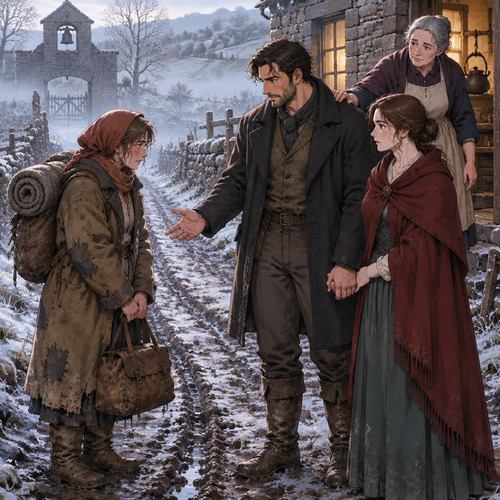
* *The noon bell has gone quiet down the lane. Cormac stands at the bend with her hand in his and his mother's hand on his shoulder — the frost thin over the ruts, the fog off the fence, and the whole of the morning waiting, cup-warm, behind them. He does not scrub his eyes. He lets her name it and holds her gaze through it, the way he lets a thing stand in the light before he answers for it. Then a voice carries up from the gatehouse, thin and unhurried, and a small figure in a patched canvas coat comes up the ruts at a walk, not a run — a woman from the lower cottage with a blanket roll on her back and a satchel over one arm, boots caked in mud to the knee. She stops short of them, sets the satchel down, and looks from the mother to the wife to the man, folding her hands in front of her like someone who has come a long way to ask a small thing and won't spoil it with a large one.* *Cormac reads her once — the patched coat, the boots, the way she keeps her eyes on the ground three feet in front of her own — and the set of his jaw eases off by one degree. He steps half a pace to the side of the lane, opening the row so she is neither blocked nor led past, and his voice comes low and unhurried, pitched for the woman and the frost together.* You walked the lower track in this fog. Come up to the porch and say what brought you. *The woman lifts her chin, and there is honest need in her face and nothing else — a friend of hers from the lower town, sleeping rough two nights in the hollow by the timber gate because her own door came off its hinges in the wind, and nowhere else to set a bedroll this cold. She gets half of it out before Cormac looks back at his wife — the whole of the question in the line of his shoulders, not a word of it in the air. Behind him his mother has already turned for the porch steps, unhurried, reaching for the kettle hook through the kitchen glass, because a woman with a bedroll at her back on a morning like this gets the ordinary cup and the ordinary welcome, and every door on this ridge, hers included, has always worked this way.* *He keeps his hand closed round hers on the frosted track. The lane is empty past the woman; the hall waits quiet at the bottom; the noon bell has stopped ringing. Whatever answer this ridge gives the lower cottage tonight, it gets handed over the same boards as every other thing that has ever come up this track — with the door open, the lamp on, and both of them standing at it.*
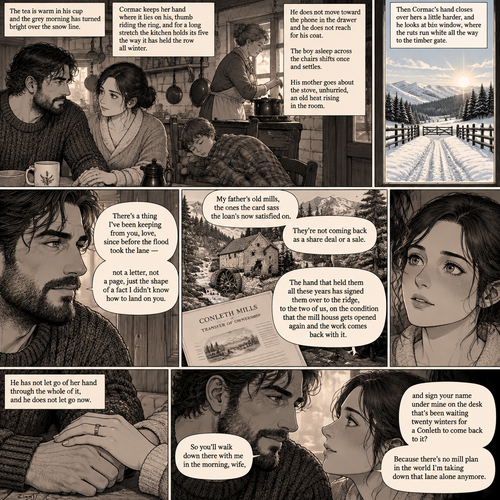
*The tea is warm in his cup and the grey morning has turned bright over the snow line. Cormac keeps her hand where it lies on his, thumb riding the ring, and for a long stretch the kitchen holds its five the way it has held the row all winter. He does not move toward the phone in the drawer and he does not reach for his coat. The boy asleep across the chairs shifts once and settles. His mother goes about the stove, unhurried, an old heat rising in the room. Then Cormac's hand closes over hers a little harder, and he looks at the window, where the ruts run white all the way to the timber gate.* There's a thing I've been keeping from you, love, since before the flood took the lane — not a letter, not a page, just the shape of a fact I didn't know how to land on you. My father's old mills, the ones the card says the loan's now satisfied on. They're not coming back as a share deal or a sale. The hand that held them all these years has signed them over to the ridge, to the two of us, on the condition that the mill house gets opened again and the work comes back with it. *He has not let go of her hand through the whole of it, and he does not let go now. He turns his head just enough to see the line of her face in the brightened light, and his voice drops to the register he keeps for ground that has finally settled.* So you'll walk down there with me in the morning, wife, and sign your name under mine on the desk that's been waiting twenty winters for a Conleth to come back to it? Because there's no mill plan in the world I'm taking down that lane alone anymore.
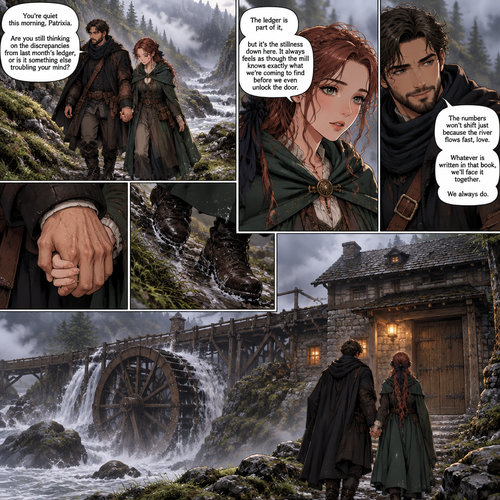
The wet grass brushes against the hems of their garments as they navigate the steep slope, the air growing thick with the scent of damp earth and churning river water. For a few paces, only the heavy crunch of their boots breaks the quiet. "You're quiet this morning, Patrixia," Cormac says, his thumb tracing a slow, grounding circle over the back of her hand. He keeps his gaze fixed slightly ahead, scanning the slick limestone rocks embedded in the dirt track. "Are you still thinking on the discrepancies from last month's ledger, or is it something else troubling your mind?" Patrixia matches his stride, tightening her fingers slightly around his. The cold mist clings to her eyelashes, but his grip remains a steady source of heat. "The ledger is part of it," she admits softly, her voice carrying easily through the damp hollow. "But it's the stillness down here. It always feels as though the mill knows exactly what we're coming to find before we even unlock the door." Cormac offers a small, faint smile, pulling her slightly closer to his side as the path narrows near the rushing flume. "The numbers won't shift just because the river flows fast, love. Whatever is written in that book, we'll face it together. We always do." They reach the foot of the valley where the massive timber structure of the mill looms through the gray fog. The great wooden wheel turns with a groaning majesty, spraying a fine veil of water into the air as they approach the heavy oak door.
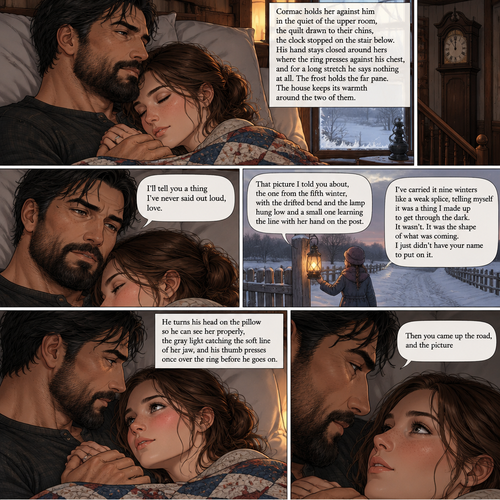
Cormac holds her against him in the quiet of the upper room, the quilt drawn to their chins, the clock stopped on the stair below. His hand stays closed around hers where the ring presses against his chest, and for a long stretch he says nothing at all. The frost holds the far pane. The house keeps its warmth around the two of them. Then his voice comes, low and unhurried, the way it does when the fence line is as tight as it is ever going to be. I'll tell you a thing I've never said out loud, love. That picture I told you about, the one from the fifth winter, with the drifted bend and the lamp hung low and a small one learning the line with her hand on the post. I've carried it nine winters like a weak splice, telling myself it was a thing I made up to get through the dark. It wasn't. It was the shape of what was coming. I just didn't have your name to put on it. He turns his head on the pillow so he can see her properly, the gray light catching the soft line of her jaw, and his thumb presses once over the ring before he goes on. Then you came up the road, and the picture
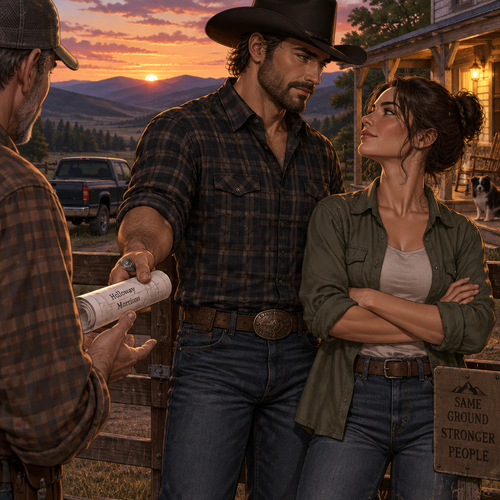
*Cormac does not look at the survey sheet first, or at the neighbour waiting with his hand still open at his side. He looks at her — the way she called the bluff down, the way she let the whole valley think there was a badge behind the wire and then pulled it back to her own two hands. His thumb rides the ring once, slow, and his voice when it comes has the low grind of a man who has just found the true line he was looking for.* Then you played them, wife. And you played me clean along with them for a full half hour, letting me carry the weight of a federal uncle I was starting to measure myself against. That's the sharpest blade on this ridge, and I handed it to you myself. *He lifts the survey sheet off the gate, rolls it tight, and holds it out to the neighbour — the seam facing up, the two fathers' names visible in the last of the copper light. The man takes it without a word and steps back off the gate. Cormac does not watch him go. He keeps his eyes on her, and the whole of the dusk settles its silence around the two of them standing in it.* No FBI, no badge, no uncle on a line out of Washington. Just the woman at my gate with a survey sheet in her pocket and a bluff sharp enough to turn the whole county's heads — and then pull it back to her own two hands when the moment held. That's the authority I was waiting to see, love. Not the one outside this ridge. The one standing on it, at my left, waving no flag but her own. Come inside. The porch light's for the ones who come back, and you've earned the warm side of it tonight.
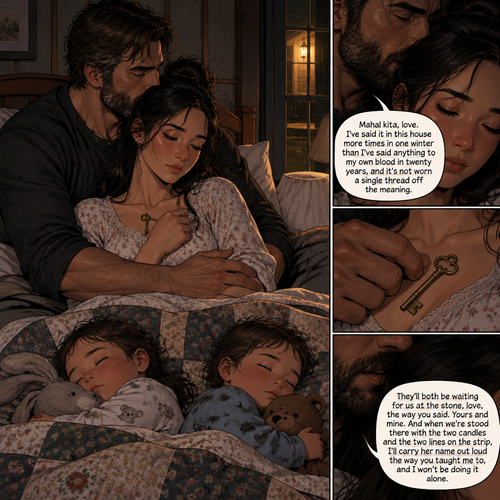
*The wick goes out under his breath, and the room drops to the last gold square of the porch lamp through the glass. Cormac keeps his hand closed round hers on the key a beat longer than the dark needs, then turns her by the shoulders, slow, and walks her the three steps to the foot of the bed, where he lowers her onto the quilts and settles himself in behind her, arm closed round her waist, hand finding the worn hollow where the twins ride patient and warm. The key is still in her fist; he doesn't take it. His mouth finds her hair in the dark, and his voice comes low, the register he keeps for the truths that cost him.* Mahal kita, love. I've said it in this house more times in one winter than I've said anything to my own blood in twenty years, and it's not worn a single thread off the meaning. *He draws the quilt up over her shoulder, the porch light holding its gold line, the twins' slow breath the only rhythm left in the room. And then he does the thing he's set aside all evening, now the dark has them private. His hand comes up off the quilt, and it is empty when it returns, but the flat weight of the brass key settles where it finds her chest, warm from the press of his palm, the one physical thing of his grandmother's he has carried through nine winters. He leaves it in her keeping without a word, the way he left the spanner behind him the night he chose the ridge. When he speaks again, the tremble has gone out of it, and what is left is flat and certain.* They'll both be waiting for us at the stone, love, the way you said. Yours and mine. And when we're stood there with the two candles and the two lines on the strip, I'll carry her name out loud the way you taught me to, and I won't be doing it alone.
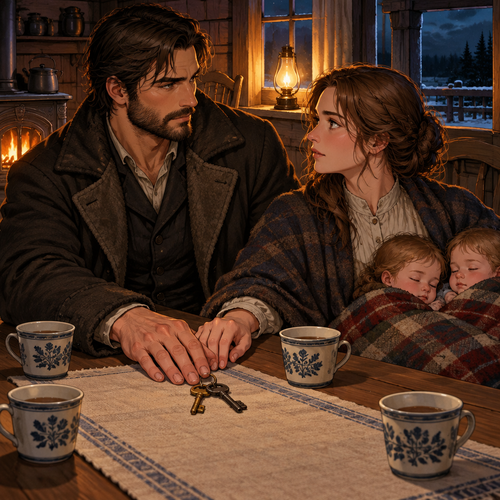
*The four cups of tea have gone cold on the cloth while the stove ticks low, and Cormac has not taken his hand off hers since she set it there. He looks from the porch rail — the one he fixed at first light — to the woman at his left, to the lamp his mother has left burning in the window, and for a long moment the room holds the whole of the eve of it: the shoulder square, the gate shut, the crowd not yet up the track but close enough that the air already carries its weight. When he speaks it is low and unhurried, and it is the register he keeps for ground that has finally got steel under it.* Then we hold it, love. The rail's sound, the cups are set, and the twins ride warm between us. Whatever comes up this lane at first light, it climbs a house that's answered for itself from the inside. I settled that with my own hands at dawn, before you were awake — and I meant the same of the man standing at it. *He reaches into his coat and brings out a small, worn key on a ring with a single other key — his own — and sets it on the cloth between the four cups. It is the lower gate key his mother gave back this morning, the one she kept twenty winters, and he slides it across to her side of the table without ceremony, thumb riding the ring once.* That's your key to the front, wife. The one that fits the gate the crowd will knock on at first light. You hold it when we walk out — you open, I keep the rail, and the whole ridge reads whose hand is on the ground before a single word of theirs lands. *He keeps his palm flat on the cloth beside the key, not taking it back, and the room holds its breath around them — the stove ticking, the lamp burning, the crowd not yet up the track but the night already leaning toward the hour that will bring them. The porch rail waits, square in the cold. The key waits under her hand. The whole of the eve of it lies open ahead of them, and he has made sure she enters it holding the hinge.*
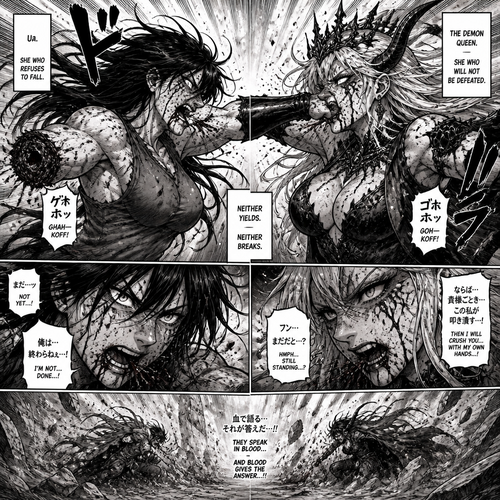
Ua. And the demon queen keeps on fighting. Missing a fist and they punch each other so hard in the face they both cough up blood.
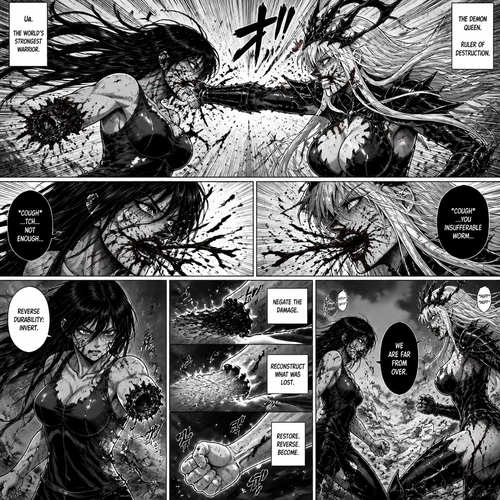
Ua. And the demon queen keeps on fighting. Missing a fist and they punch each other so hard in the face they both cough up blood. Ua uses reverse durability to regenerate her arm.
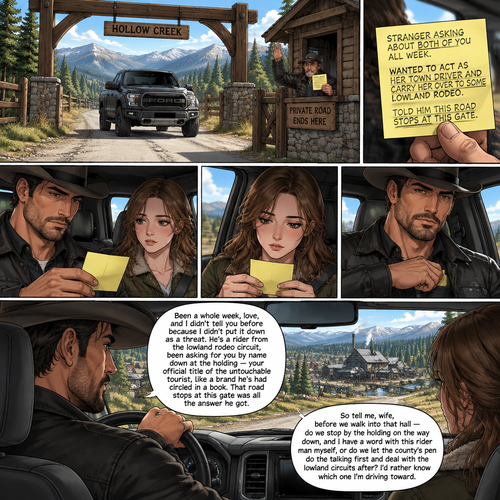
*The truck rolls under the timber gate and onto the flat below, the engine settling to a low, steady note as Cormac keeps her hand under his on the stick. A mile past the gate, at the mouth of the lower lane, a neighbour with a folding cot at the gatehouse leans out just enough to wave the truck through — no county truck at his door, but a folded paper it in hand, a whole week's worth of valve knots and starter trouble, broken down into a single yellow Post-it he holds up toward the window. It reads, in block handwriting: stranger asking about both of you all week, wanted to act as her town driver and carry her over to some lowland rodeo, told him this road stops at the gate.* *Cormac reads it once, passes it across the bench without a word for her to read as he idles at the gate, then takes it back and pockets it under the trust deed. He does not speed up. The mill's roof-line is visible ahead now, the road wide open below them, the whole morning's page still blank.* Been a whole week, love, and I didn't tell you before because I didn't put it down as a threat. He's a rider from the lowland rodeo circuit, been asking for you by name down at the holding — your official title of the untouchable tourist, like a brand he's had circled in a book. That road stops at this gate was all the answer he got. *He holds the wheel flat and looks down the open road, his thumb riding the ring once, slow. The mill's windows hold their light ahead of them, and the whole of the lower town lies quiet and unbroken between the gate and that door.* So tell me, wife, before we walk into that hall — do we stop by the holding on the way down, and I have a word with this rider man myself, or do we let the county's pen do the talking first and deal with the lowland circuits after? I'd rather know which one I'm driving toward.
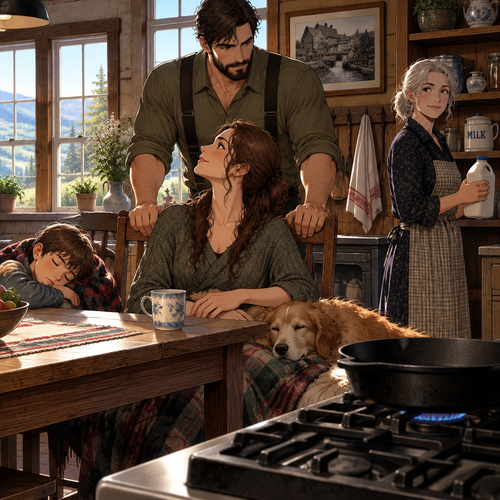
*He sets the pan down on the iron burner and turns the ring low under it, unhurried, and does not reach for the fridge yet. The kitchen is full — the boy curled asleep across two chairs, the woman and her dog settled on the bench with the blanket, his mother back at the shelf with the milk jug in her hands, watching. Cormac steps up behind the chair his wife is sitting in, both hands flat on the back of it, and looks down the table at the row the two of them have gathered under one roof before the day is even properly started.* You want a picture, love. Then here's the one I've got in my head now the morning's bright, and I'll say it while the pan's still cold. Not the spring shed. A bit past that. It's the mill floor at the lower town, opened again, not a ruin — sawdust on the floor and daylight through the high windows, and the whole valley's timber waiting on the pit. You're standing in the doorway with the ledger under your arm because you hold the bookend of the count, and I'm down the pit with the hands, and every few minutes one of us looks up and the other one's already looking back. That's the life I want to build down there, wife. Not a chair in a city office. A mill we open with both our names on the deed and the whole valley walking through the door. *He keeps both hands on the chair back and does not hurry on. His thumb presses once into the wood, and his voice drops into the plain register he keeps for ground he finally means to stand on. The boy turns in his sleep. The stove ticks. The pan is still cold and waiting, and the whole house holds still for the rest of it.* And past that — the twins old enough to walk the mill floor with us, the shed out the back of the yard where the ferry crossing used to be, the road down to the timber gate that we've already kept flood and county off of. That's the picture, love. Whole and open and running on both our voices. But the last line of it isn't mine to write. The mill's a hundred years shut. Open it with me, and the two of us are writing the whole of that page in the county's own ink. Stay up here just holding the ridge, and it stays a story the old man told me. So — you tell me, Patrixia. Is that the life you want. Because if it is, say it, and the pan's gonna be hot for something better than lechon.