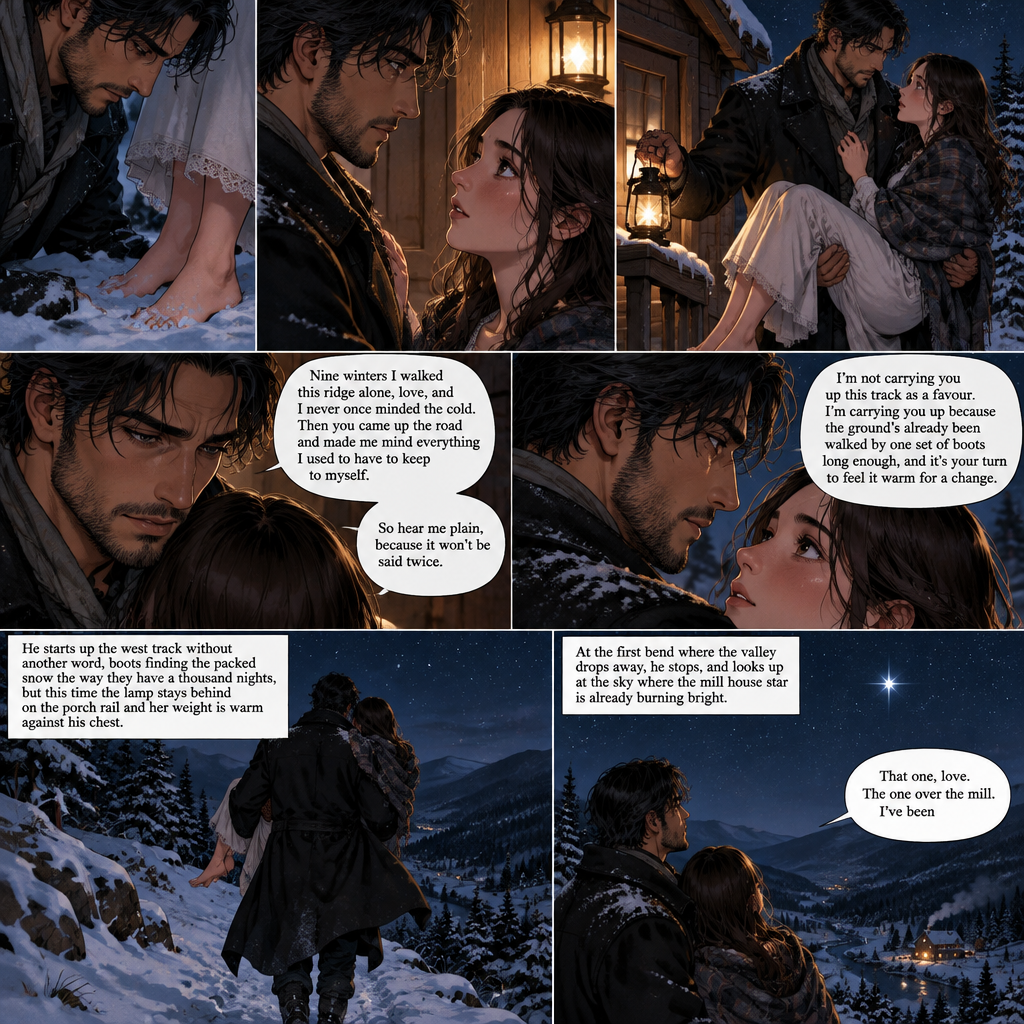
Cormac looks down at her bare feet in the snow, then back up at her face in the low lamp light. For a long moment he doesn't move. Then he takes the lamp from her hand, sets it down on the porch rail by the door, and lifts her straight off the snow into his arms, cradling her against his chest with the frost already melting off his coat.
Nine winters I walked this ridge alone, love, and I never once minded the cold. Then you
came up the road and made me mind everything I used to have to keep to myself. So hear me plain, because it won't be said twice.
I'm not carrying you up this track as a favour.
I'm carrying you up because the ground's already been walked by one set of boots long enough, and it's your turn to feel it warm for a change.
He starts up the west track without another word, boots finding the packed snow the way they have a thousand nights, but this time the lamp stays behind on the porch rail and her weight is warm against his chest. At the first bend where the valley drops away, he stops, and looks up at the sky where the mill house star is already burning bright.
That one, love. The one over the mill. I've been
Tap blank area

Cormac looks down at her bare feet in the snow, then back up at her face in the low lamp light. For a long moment he doesn't move. Then he takes the lamp from…
@resilientgriffin586
full color style

More from the community

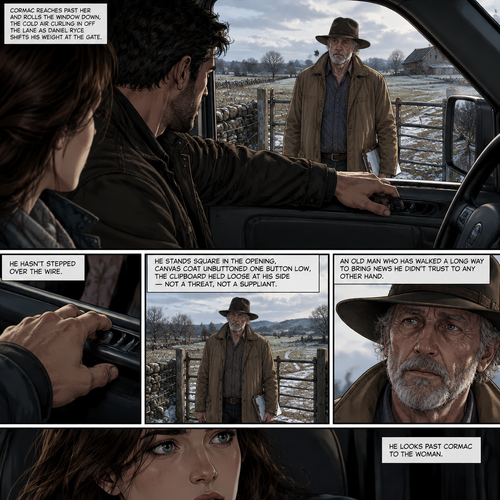
*Cormac reaches past her and rolls the window down, the cold air curling in off the lane as Daniel Ryce shifts his weight at the gate. He hasn't stepped over the wire. He stands square in the opening, canvas coat unbuttoned one button low, the clipboard held loose at his side
- not a threat, not a supplicant. An old man who has walked a long way to bring news he didn't trust to any other hand. He looks past Cormac to the woman b
Scenarios
Milestones

*Cormac reaches past her and rolls the window down, the cold air curling in off the lane as Daniel Ryce shifts his weight at the gate. He hasn't stepped over the wire. He stands square in the opening, canvas coat unbuttoned one button low, the clipboard held loose at his side - not a threat, not a supplicant. An old man who has walked a long way to bring news he didn't trust to any other hand. He looks past Cormac to the woman b Scenarios Milestones
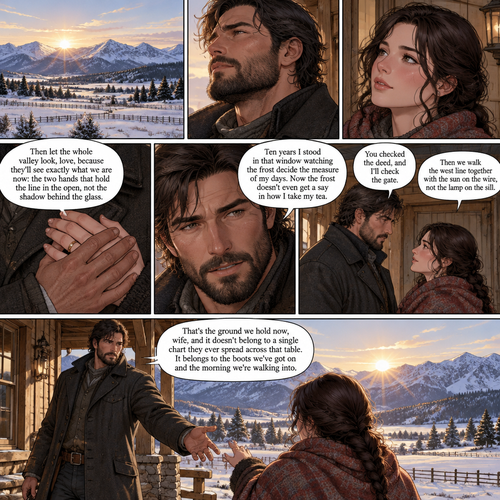
Cormac looks at the frost on the far field and then back at her, the deed's square pressing against her hip under the wool. He settles his hand over hers where it rests on his heart, thumb pressing once over the ring, and his voice drops into the register that carries the whole weight of the ridge behind it.
Then let the whole valley look, love, because they'll see exactly what we are now: the two hands that hold the line in the open, not the shadow behind the glass. Ten years I stood in that window watching the frost decide the measure of my days. Now the frost doesn't even get a say in how I take my tea.
You checked the deed, and I'll check the gate.
Then we walk the west line together with the sun on the wire, not the lamp on the sill.
That's the ground we hold now, wife, and it doesn't belong to a single chart they ever spread across that table. It belongs to the boots we've got on and the morning we're walking into.
Cormac steps down off the porch, turning to hold his hand out for her over the frozen stride, the whole ridge standing bright and new behind him in the rising light.
Tha

Cormac looks at the frost on the far field and then back at her, the deed's square pressing against her hip under the wool. He settles his hand over hers where it rests on his heart, thumb pressing once over the ring, and his voice drops into the register that carries the whole weight of the ridge behind it. Then let the whole valley look, love, because they'll see exactly what we are now: the two hands that hold the line in the open, not the shadow behind the glass. Ten years I stood in that window watching the frost decide the measure of my days. Now the frost doesn't even get a say in how I take my tea. You checked the deed, and I'll check the gate. Then we walk the west line together with the sun on the wire, not the lamp on the sill. That's the ground we hold now, wife, and it doesn't belong to a single chart they ever spread across that table. It belongs to the boots we've got on and the morning we're walking into. Cormac steps down off the porch, turning to hold his hand out for her over the frozen stride, the whole ridge standing bright and new behind him in the rising light. Tha
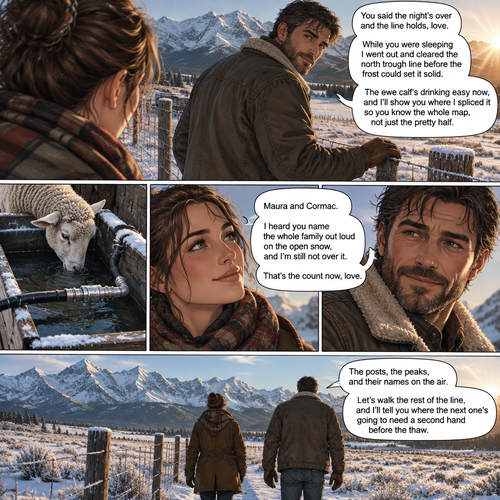
Cormac stops at the first post, hand resting on the wire, and looks back at her with the morning catching the frost on his collar. He took the time she slept to pull a broken bleeder line out of the north trough before the water could freeze solid around the ewe's leg - small work, done quiet, so the morning would come up clean for her.
You said the night's over and the line holds, love. While you were sleeping I went out and cleared the north trough line before the frost could set it solid. The ewe calf's drinking easy now, and I'll show you where I spliced it so you know the whole map, not just the pretty half.
Maura and Cormac. I heard you name the whole family out loud on the open snow, and I'm still not over it. That's the count now, love.
The posts, the peaks, and their names on the air. Let's walk the rest of the line, and I'll tell you where the next one's going to need a second hand before the thaw.
Cormac stops at the first post, hand resting on the wire, and looks back at her with the morning catching the frost on his collar. He took the time she slept to pull a broken bleeder line out of the north trough before the water could freeze solid around the ewe's leg - small work, done quiet, so the morning would come up clean for her. You said the night's over and the line holds, love. While you were sleeping I went out and cleared the north trough line before the frost could set it solid. The ewe calf's drinking easy now, and I'll show you where I spliced it so you know the whole map, not just the pretty half. Maura and Cormac. I heard you name the whole family out loud on the open snow, and I'm still not over it. That's the count now, love. The posts, the peaks, and their names on the air. Let's walk the rest of the line, and I'll tell you where the next one's going to need a second hand before the thaw.

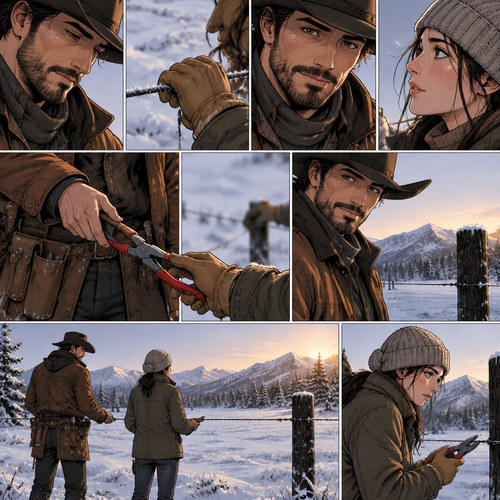
Cormac looks at her hand on the wire, then at her face, and a slow, rare thing happens to his mouth
- not quite a smile, but close. He reaches into the tool roll on his belt and hands her the pliers, handle first, without a word of doubt. Then he nods toward the next post.
While you were still upstairs, I went out before first light and re-spliced the strand where the frost worked a weak point open, the one just past the keeper. I set it the way Maura taught me - two wraps, then a half-hitch into the steel. It'll hold.
But what I wanted you to see isn't the splice, love. It's this. You asked for the pliers and I handed them over without checking your grip first. That's not a thing I do. Not with the wire.
Not with anyone. With you, it just felt like the only true answer.
He steps back a half-stride, opening the line for her, the frost cracking under his boots. The next post stands black against the snow, waiting.
So show me how you stretch a line, wite. The post's ready, and I'm right here beside you holding the other end. That's the whole of it now. That's the count.
Tap blank area to return

Cormac looks at her hand on the wire, then at her face, and a slow, rare thing happens to his mouth - not quite a smile, but close. He reaches into the tool roll on his belt and hands her the pliers, handle first, without a word of doubt. Then he nods toward the next post. While you were still upstairs, I went out before first light and re-spliced the strand where the frost worked a weak point open, the one just past the keeper. I set it the way Maura taught me - two wraps, then a half-hitch into the steel. It'll hold. But what I wanted you to see isn't the splice, love. It's this. You asked for the pliers and I handed them over without checking your grip first. That's not a thing I do. Not with the wire. Not with anyone. With you, it just felt like the only true answer. He steps back a half-stride, opening the line for her, the frost cracking under his boots. The next post stands black against the snow, waiting. So show me how you stretch a line, wite. The post's ready, and I'm right here beside you holding the other end. That's the whole of it now. That's the count. Tap blank area to return
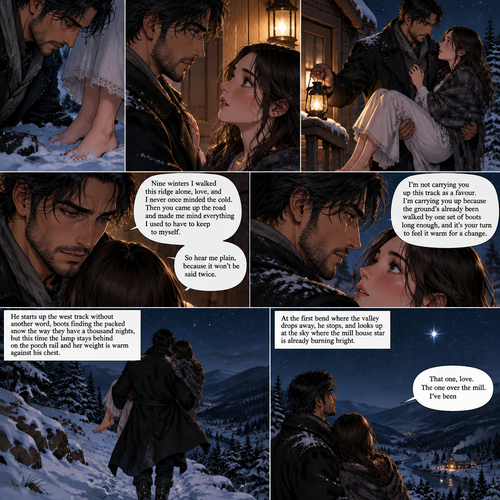
Cormac looks down at her bare feet in the snow, then back up at her face in the low lamp light. For a long moment he doesn't move. Then he takes the lamp from her hand, sets it down on the porch rail by the door, and lifts her straight off the snow into his arms, cradling her against his chest with the frost already melting off his coat.
Nine winters I walked this ridge alone, love, and I never once minded the cold. Then you
came up the road and made me mind everything I used to have to keep to myself. So hear me plain, because it won't be said twice.
I'm not carrying you up this track as a favour.
I'm carrying you up because the ground's already been walked by one set of boots long enough, and it's your turn to feel it warm for a change.
He starts up the west track without another word, boots finding the packed snow the way they have a thousand nights, but this time the lamp stays behind on the porch rail and her weight is warm against his chest. At the first bend where the valley drops away, he stops, and looks up at the sky where the mill house star is already burning bright.
That one, love. The one over the mill. I've been
Tap blank area

Cormac looks down at her bare feet in the snow, then back up at her face in the low lamp light. For a long moment he doesn't move. Then he takes the lamp from her hand, sets it down on the porch rail by the door, and lifts her straight off the snow into his arms, cradling her against his chest with the frost already melting off his coat. Nine winters I walked this ridge alone, love, and I never once minded the cold. Then you came up the road and made me mind everything I used to have to keep to myself. So hear me plain, because it won't be said twice. I'm not carrying you up this track as a favour. I'm carrying you up because the ground's already been walked by one set of boots long enough, and it's your turn to feel it warm for a change. He starts up the west track without another word, boots finding the packed snow the way they have a thousand nights, but this time the lamp stays behind on the porch rail and her weight is warm against his chest. At the first bend where the valley drops away, he stops, and looks up at the sky where the mill house star is already burning bright. That one, love. The one over the mill. I've been Tap blank area
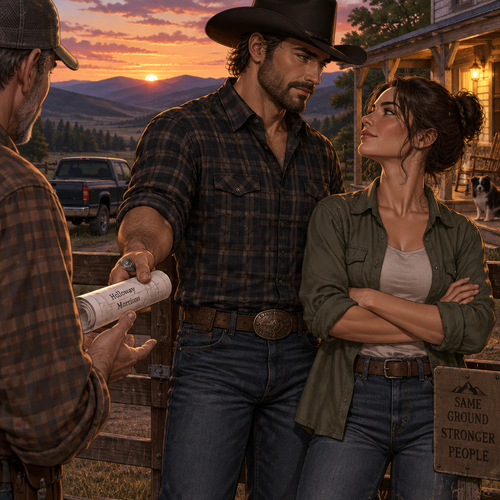
*Cormac does not look at the survey sheet first, or at the neighbour waiting with his hand still open at his side. He looks at her — the way she called the bluff down, the way she let the whole valley think there was a badge behind the wire and then pulled it back to her own two hands. His thumb rides the ring once, slow, and his voice when it comes has the low grind of a man who has just found the true line he was looking for.*
Then you played them, wife. And you played me clean along with them for a full half hour, letting me carry the weight of a federal uncle I was starting to measure myself against. That's the sharpest blade on this ridge, and I handed it to you myself.
*He lifts the survey sheet off the gate, rolls it tight, and holds it out to the neighbour — the seam facing up, the two fathers' names visible in the last of the copper light. The man takes it without a word and steps back off the gate. Cormac does not watch him go. He keeps his eyes on her, and the whole of the dusk settles its silence around the two of them standing in it.*
No FBI, no badge, no uncle on a line out of Washington. Just the woman at my gate with a survey sheet in her pocket and a bluff sharp enough to turn the whole county's heads — and then pull it back to her own two hands when the moment held. That's the authority I was waiting to see, love. Not the one outside this ridge. The one standing on it, at my left, waving no flag but her own.
Come inside. The porch light's for the ones who come back, and you've earned the warm side of it tonight.
*Cormac does not look at the survey sheet first, or at the neighbour waiting with his hand still open at his side. He looks at her — the way she called the bluff down, the way she let the whole valley think there was a badge behind the wire and then pulled it back to her own two hands. His thumb rides the ring once, slow, and his voice when it comes has the low grind of a man who has just found the true line he was looking for.* Then you played them, wife. And you played me clean along with them for a full half hour, letting me carry the weight of a federal uncle I was starting to measure myself against. That's the sharpest blade on this ridge, and I handed it to you myself. *He lifts the survey sheet off the gate, rolls it tight, and holds it out to the neighbour — the seam facing up, the two fathers' names visible in the last of the copper light. The man takes it without a word and steps back off the gate. Cormac does not watch him go. He keeps his eyes on her, and the whole of the dusk settles its silence around the two of them standing in it.* No FBI, no badge, no uncle on a line out of Washington. Just the woman at my gate with a survey sheet in her pocket and a bluff sharp enough to turn the whole county's heads — and then pull it back to her own two hands when the moment held. That's the authority I was waiting to see, love. Not the one outside this ridge. The one standing on it, at my left, waving no flag but her own. Come inside. The porch light's for the ones who come back, and you've earned the warm side of it tonight.

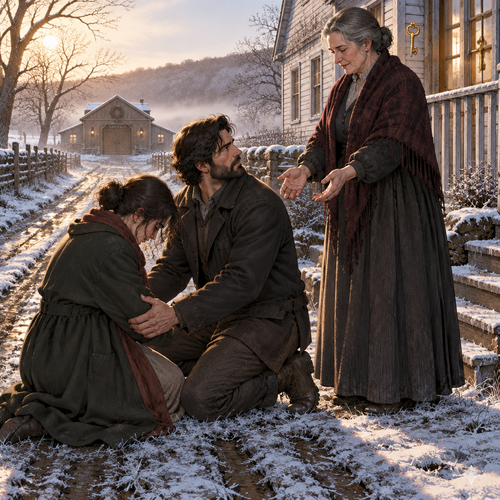
*She drops to the frosted ruts with a grace that catches the whole of the lane off guard — and Cormac goes down with her, not to stop her, but to meet her, knee to knee, his hands closing over her coat sleeves so the cold of the packed earth doesn't take her. He does not lift her up. He holds her there a moment, the way he holds a line that is finally his to keep, and looks down the lane to where his mother stands at the porch rail, the brass key catching the light on its nail. Then, over her bent head, his voice comes out low and unhurried, and it carries the whole way to the rail.*
Ma. It's the morning you've been after me about for twenty winters, and it's not me asking — so come down off that rail and answer her proper. Nobody's been kneeling on my track for anything but tools before today, and I'd have her heard in your own voice.
*His mother does not move from the rail at once. She stands looking down at the two of them — her daughter-in-law'S bent head, her son's hands closed on her sleeves, the thin fog thinning off the lane — and then she comes down the steps one by one, unhurried, and crosses the frost to stand in front of them. When she speaks, it is low and worn, and it carries the whole of twenty winters in it.*
I kept honey on that sill for a girl I never met because I knew the boy I raised would come home with one. It took you twenty years to bring her, son, and you brought her the good way. You ask me for a blessing, daughter, and you have it — but it's not a blessing a woman who's kept a full jar waiting should have to kneel on frozen ground to get. Get your wife up, Cormac. And we'll go down to that hall and let them read what a forty-year row looks like.
*She holds out both her hands, one for each of them, and waits. The fog has gone thin to a thread. The brass key turns once on its nail. The hall waits quiet at the bottom of the lane, and the whole of the morning holds its breath around the three of them standing in it.*
*She drops to the frosted ruts with a grace that catches the whole of the lane off guard — and Cormac goes down with her, not to stop her, but to meet her, knee to knee, his hands closing over her coat sleeves so the cold of the packed earth doesn't take her. He does not lift her up. He holds her there a moment, the way he holds a line that is finally his to keep, and looks down the lane to where his mother stands at the porch rail, the brass key catching the light on its nail. Then, over her bent head, his voice comes out low and unhurried, and it carries the whole way to the rail.* Ma. It's the morning you've been after me about for twenty winters, and it's not me asking — so come down off that rail and answer her proper. Nobody's been kneeling on my track for anything but tools before today, and I'd have her heard in your own voice. *His mother does not move from the rail at once. She stands looking down at the two of them — her daughter-in-law'S bent head, her son's hands closed on her sleeves, the thin fog thinning off the lane — and then she comes down the steps one by one, unhurried, and crosses the frost to stand in front of them. When she speaks, it is low and worn, and it carries the whole of twenty winters in it.* I kept honey on that sill for a girl I never met because I knew the boy I raised would come home with one. It took you twenty years to bring her, son, and you brought her the good way. You ask me for a blessing, daughter, and you have it — but it's not a blessing a woman who's kept a full jar waiting should have to kneel on frozen ground to get. Get your wife up, Cormac. And we'll go down to that hall and let them read what a forty-year row looks like. *She holds out both her hands, one for each of them, and waits. The fog has gone thin to a thread. The brass key turns once on its nail. The hall waits quiet at the bottom of the lane, and the whole of the morning holds its breath around the three of them standing in it.*

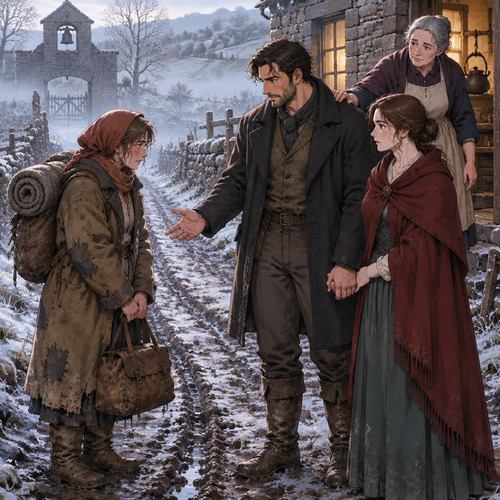
* *The noon bell has gone quiet down the lane. Cormac stands at the bend with her hand in his and his mother's hand on his shoulder — the frost thin over the ruts, the fog off the fence, and the whole of the morning waiting, cup-warm, behind them. He does not scrub his eyes. He lets her name it and holds her gaze through it, the way he lets a thing stand in the light before he answers for it. Then a voice carries up from the gatehouse, thin and unhurried, and a small figure in a patched canvas coat comes up the ruts at a walk, not a run — a woman from the lower cottage with a blanket roll on her back and a satchel over one arm, boots caked in mud to the knee. She stops short of them, sets the satchel down, and looks from the mother to the wife to the man, folding her hands in front of her like someone who has come a long way to ask a small thing and won't spoil it with a large one.*
*Cormac reads her once — the patched coat, the boots, the way she keeps her eyes on the ground three feet in front of her own — and the set of his jaw eases off by one degree. He steps half a pace to the side of the lane, opening the row so she is neither blocked nor led past, and his voice comes low and unhurried, pitched for the woman and the frost together.*
You walked the lower track in this fog. Come up to the porch and say what brought you.
*The woman lifts her chin, and there is honest need in her face and nothing else — a friend of hers from the lower town, sleeping rough two nights in the hollow by the timber gate because her own door came off its hinges in the wind, and nowhere else to set a bedroll this cold. She gets half of it out before Cormac looks back at his wife — the whole of the question in the line of his shoulders, not a word of it in the air. Behind him his mother has already turned for the porch steps, unhurried, reaching for the kettle hook through the kitchen glass, because a woman with a bedroll at her back on a morning like this gets the ordinary cup and the ordinary welcome, and every door on this ridge, hers included, has always worked this way.*
*He keeps his hand closed round hers on the frosted track. The lane is empty past the woman; the hall waits quiet at the bottom; the noon bell has stopped ringing. Whatever answer this ridge gives the lower cottage tonight, it gets handed over the same boards as every other thing that has ever come up this track — with the door open, the lamp on, and both of them standing at it.*
* *The noon bell has gone quiet down the lane. Cormac stands at the bend with her hand in his and his mother's hand on his shoulder — the frost thin over the ruts, the fog off the fence, and the whole of the morning waiting, cup-warm, behind them. He does not scrub his eyes. He lets her name it and holds her gaze through it, the way he lets a thing stand in the light before he answers for it. Then a voice carries up from the gatehouse, thin and unhurried, and a small figure in a patched canvas coat comes up the ruts at a walk, not a run — a woman from the lower cottage with a blanket roll on her back and a satchel over one arm, boots caked in mud to the knee. She stops short of them, sets the satchel down, and looks from the mother to the wife to the man, folding her hands in front of her like someone who has come a long way to ask a small thing and won't spoil it with a large one.* *Cormac reads her once — the patched coat, the boots, the way she keeps her eyes on the ground three feet in front of her own — and the set of his jaw eases off by one degree. He steps half a pace to the side of the lane, opening the row so she is neither blocked nor led past, and his voice comes low and unhurried, pitched for the woman and the frost together.* You walked the lower track in this fog. Come up to the porch and say what brought you. *The woman lifts her chin, and there is honest need in her face and nothing else — a friend of hers from the lower town, sleeping rough two nights in the hollow by the timber gate because her own door came off its hinges in the wind, and nowhere else to set a bedroll this cold. She gets half of it out before Cormac looks back at his wife — the whole of the question in the line of his shoulders, not a word of it in the air. Behind him his mother has already turned for the porch steps, unhurried, reaching for the kettle hook through the kitchen glass, because a woman with a bedroll at her back on a morning like this gets the ordinary cup and the ordinary welcome, and every door on this ridge, hers included, has always worked this way.* *He keeps his hand closed round hers on the frosted track. The lane is empty past the woman; the hall waits quiet at the bottom; the noon bell has stopped ringing. Whatever answer this ridge gives the lower cottage tonight, it gets handed over the same boards as every other thing that has ever come up this track — with the door open, the lamp on, and both of them standing at it.*

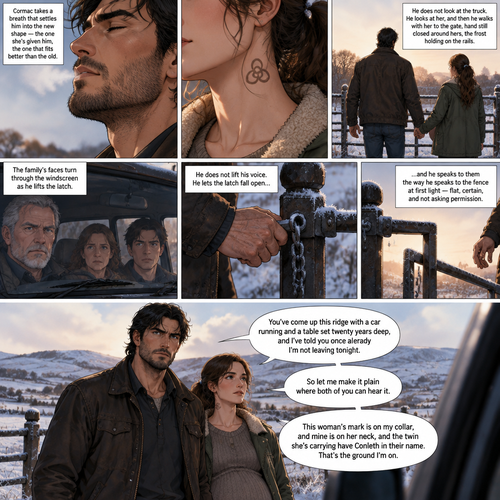
Cormac takes a breath that settles him into the new shape - the one she's given him, the one that fits better than the old. He does not look at the truck. He looks at her, at the mark riding her neck in the afternoon light, and then he walks with her to the gate, hand still closed around hers, the frost holding on the rails. The family's faces turn through the windscreen as he lifts the latch. He does not lift his voice. He lets the latch fall open, and he speaks to them the way he speaks to the fence at first light - flat, certain, and not asking permission.
You've come up this ridge with a car running and a table set twenty years deep, and I've told you once already I'm not leaving tonight. So let me make it plain where both of you can hear it.
This woman's mark is on my collar, and mine is on her neck, and the twin she's carrying have Conleth in their name. That's the ground I'm
Scenarios
Milestones

Cormac takes a breath that settles him into the new shape - the one she's given him, the one that fits better than the old. He does not look at the truck. He looks at her, at the mark riding her neck in the afternoon light, and then he walks with her to the gate, hand still closed around hers, the frost holding on the rails. The family's faces turn through the windscreen as he lifts the latch. He does not lift his voice. He lets the latch fall open, and he speaks to them the way he speaks to the fence at first light - flat, certain, and not asking permission. You've come up this ridge with a car running and a table set twenty years deep, and I've told you once already I'm not leaving tonight. So let me make it plain where both of you can hear it. This woman's mark is on my collar, and mine is on her neck, and the twin she's carrying have Conleth in their name. That's the ground I'm Scenarios Milestones
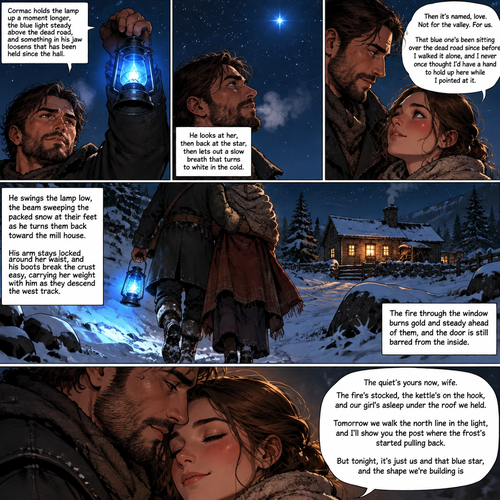
Cormac holds the lamp up a moment longer, the blue light steady above the dead road, and something in his jaw loosens that has been held since the hall. He looks at her, then back at the star, then lets out a slow breath that turns to white in the cold.
Then it's named, love. Not for the valley. For us. That blue one's been sitting over the dead road since before I walked it alone, and I never once thought I'd have a hand to hold up here while I pointed at it.
He swings the lamp low, the beam sweeping the packed snow at their feet as he turns them back toward the mill house. His arm stays locked around her waist, and his boots break the crust easy, carrying her weight with him as they descend the west track. The fire through the window burns gold and steady ahead of them, and the door is still barred from the inside.
The quiet's yours now, wife. The fire's stocked, the kettle's on the hook, and our girl's asleep under the roof we held. Tomorrow we walk the north line in the light, and I'II show you the post where the frost's started pulling back. But tonight, it's just us and that blue star, and the shape we're building is
Tap blank area to return

Cormac holds the lamp up a moment longer, the blue light steady above the dead road, and something in his jaw loosens that has been held since the hall. He looks at her, then back at the star, then lets out a slow breath that turns to white in the cold. Then it's named, love. Not for the valley. For us. That blue one's been sitting over the dead road since before I walked it alone, and I never once thought I'd have a hand to hold up here while I pointed at it. He swings the lamp low, the beam sweeping the packed snow at their feet as he turns them back toward the mill house. His arm stays locked around her waist, and his boots break the crust easy, carrying her weight with him as they descend the west track. The fire through the window burns gold and steady ahead of them, and the door is still barred from the inside. The quiet's yours now, wife. The fire's stocked, the kettle's on the hook, and our girl's asleep under the roof we held. Tomorrow we walk the north line in the light, and I'II show you the post where the frost's started pulling back. But tonight, it's just us and that blue star, and the shape we're building is Tap blank area to return
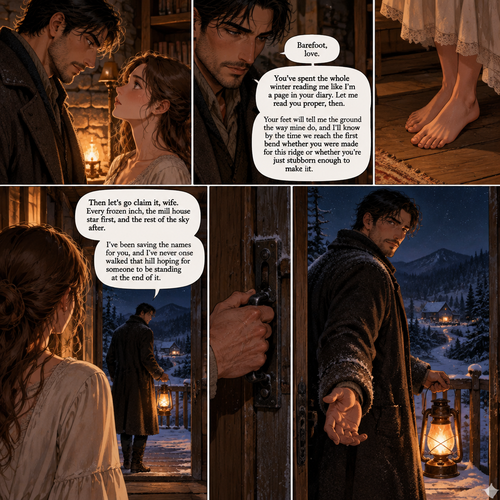
Cormac holds her gaze a long beat, the lamp low between them, and then he looks down at her bare feet on the timber. The fire ticks. The frost holds on the far pane. He does not reach for her coat. He reaches for the door, and he takes the latch with the hand not holding the lamp.
Barefoot, love. You've spent the whole winter reading me like I'm a page in your diary. Let me read you proper, then. Your feet will tell me the ground the way mine do, and I'II know by the time we reach the first bend whether you were made for this ridge or whether you're just stubborn enough to make it.
He swings the door wide, the cold air rushing in to meet the gold of the hearth, and he steps out onto the porch boards first, the lamp held low to light the near path. He waits there, one hand held back to her, the frost already beading on his knuckles, and his voice carries the same unhurried weight as the dark ahead.
Then let's go claim it, wife. Every frozen inch, the mill house star first, and the rest of the sky after. I've been saving the names for you, and I've never once walked that hill hoping for someone to be standing at the end of it.
He does not let go of the latch. He stands in the onen doorwav the lamn raised ist enounh to
Tap blank area

Cormac holds her gaze a long beat, the lamp low between them, and then he looks down at her bare feet on the timber. The fire ticks. The frost holds on the far pane. He does not reach for her coat. He reaches for the door, and he takes the latch with the hand not holding the lamp. Barefoot, love. You've spent the whole winter reading me like I'm a page in your diary. Let me read you proper, then. Your feet will tell me the ground the way mine do, and I'II know by the time we reach the first bend whether you were made for this ridge or whether you're just stubborn enough to make it. He swings the door wide, the cold air rushing in to meet the gold of the hearth, and he steps out onto the porch boards first, the lamp held low to light the near path. He waits there, one hand held back to her, the frost already beading on his knuckles, and his voice carries the same unhurried weight as the dark ahead. Then let's go claim it, wife. Every frozen inch, the mill house star first, and the rest of the sky after. I've been saving the names for you, and I've never once walked that hill hoping for someone to be standing at the end of it. He does not let go of the latch. He stands in the onen doorwav the lamn raised ist enounh to Tap blank area
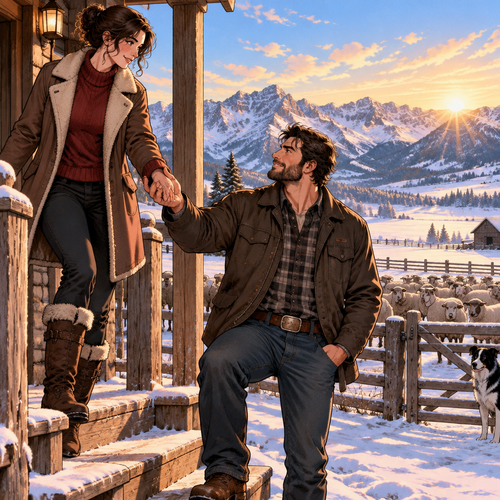

pressing once over the ring, and his voice drops into the register that carries the whole weight of the ridge behind it.
Then let the whole valley look, love, because they'll see exactly what we are now: the two hands that hold the line in the open, not the shadow behind the glass. Ten years I stood in that window watching the frost decide the measure of my days. Now the frost doesn't even get a say in how I take my tea.
You checked the deed, and I'II check the gate.
Then we walk the west line together with the sun on the wire, not the lamp on the sill.
That's the ground we hold now, wife, and it doesn't belong to a single chart they ever spread across that table. It belongs to the boots we've got on and the morning we're walking into.
Cormac steps down off the porch, turning to hold his hand out for her over the frozen stride, the whole ridge standing bright and new behind him in the rising light.
Come on, love. The flock's stamping and the day's already ours. Let's go show them what an unbroken line looks like when the two of us are holding it.
Tap blank area to return

pressing once over the ring, and his voice drops into the register that carries the whole weight of the ridge behind it. Then let the whole valley look, love, because they'll see exactly what we are now: the two hands that hold the line in the open, not the shadow behind the glass. Ten years I stood in that window watching the frost decide the measure of my days. Now the frost doesn't even get a say in how I take my tea. You checked the deed, and I'II check the gate. Then we walk the west line together with the sun on the wire, not the lamp on the sill. That's the ground we hold now, wife, and it doesn't belong to a single chart they ever spread across that table. It belongs to the boots we've got on and the morning we're walking into. Cormac steps down off the porch, turning to hold his hand out for her over the frozen stride, the whole ridge standing bright and new behind him in the rising light. Come on, love. The flock's stamping and the day's already ours. Let's go show them what an unbroken line looks like when the two of us are holding it. Tap blank area to return