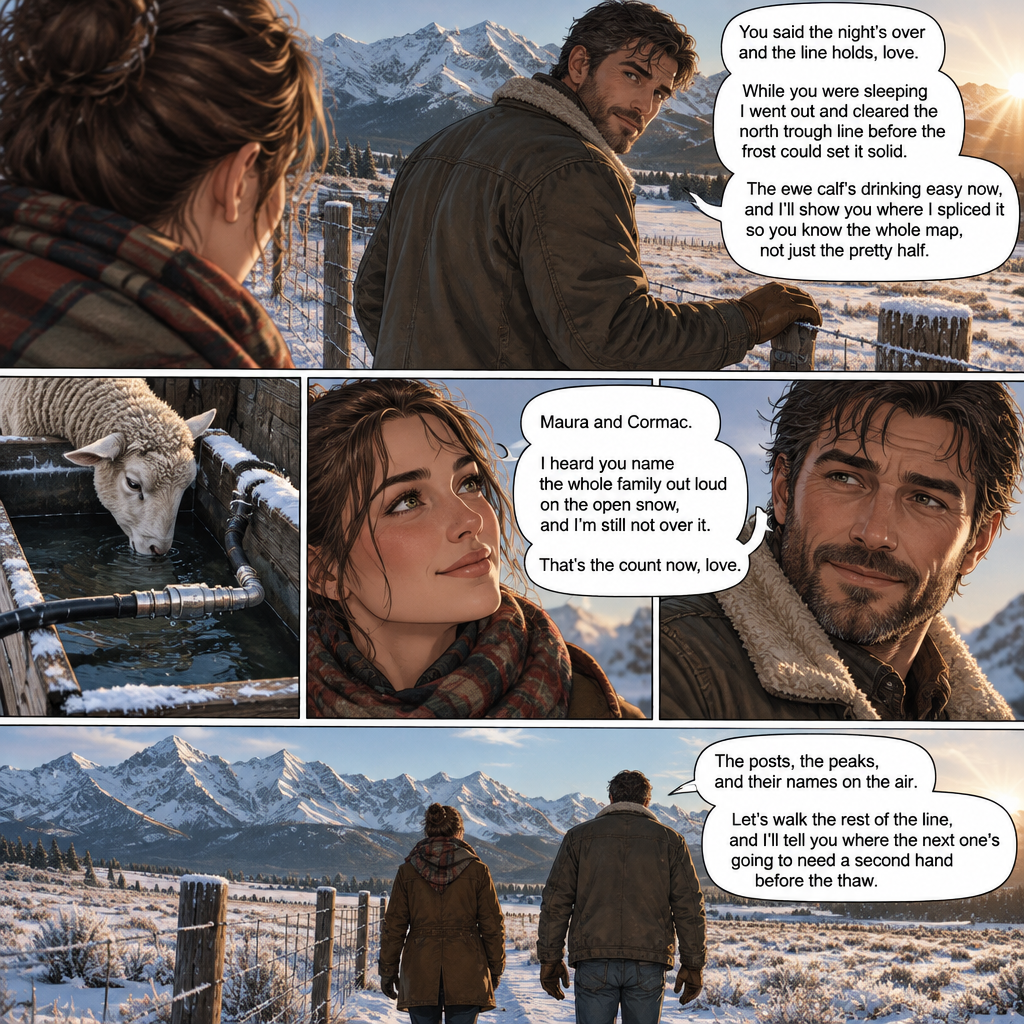
Cormac stops at the first post, hand resting on the wire, and looks back at her with the morning catching the frost on his collar. He took the time she slept t…
 @resilientgriffin586
More from the community
Cormac stops at the first post, hand resting on the wire, and looks back at her with the morning catching the frost on his collar. He took the time she slept to pull a broken bleeder line out of the north trough before the water could freeze solid around the ewe's leg - small work, done quiet, so the morning would come up clean for her. You said the night's over and the line holds, love. While you were sleeping I went out and cleared the north trough line before the frost could set it solid. The ewe calf's drinking easy now, and I'll show you where I spliced it so you know the whole map, not just the pretty half. Maura and Cormac. I heard you name the whole family out loud on the open snow, and I'm still not over it. That's the count now, love. The posts, the peaks, and their names on the air. Let's walk the rest of the line, and I'll tell you where the next one's going to need a second hand before the thaw.
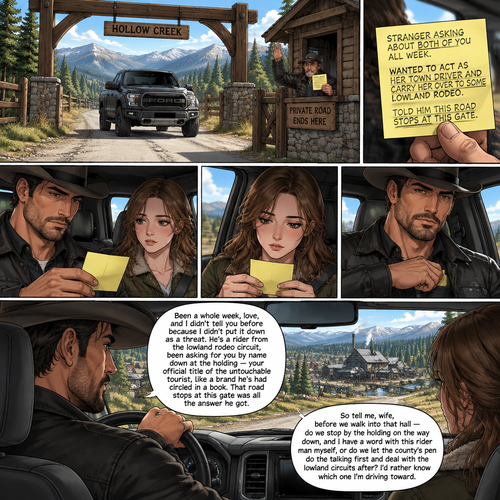
*The truck rolls under the timber gate and onto the flat below, the engine settling to a low, steady note as Cormac keeps her hand under his on the stick. A mile past the gate, at the mouth of the lower lane, a neighbour with a folding cot at the gatehouse leans out just enough to wave the truck through — no county truck at his door, but a folded paper it in hand, a whole week's worth of valve knots and starter trouble, broken down into a single yellow Post-it he holds up toward the window. It reads, in block handwriting: stranger asking about both of you all week, wanted to act as her town driver and carry her over to some lowland rodeo, told him this road stops at the gate.* *Cormac reads it once, passes it across the bench without a word for her to read as he idles at the gate, then takes it back and pockets it under the trust deed. He does not speed up. The mill's roof-line is visible ahead now, the road wide open below them, the whole morning's page still blank.* Been a whole week, love, and I didn't tell you before because I didn't put it down as a threat. He's a rider from the lowland rodeo circuit, been asking for you by name down at the holding — your official title of the untouchable tourist, like a brand he's had circled in a book. That road stops at this gate was all the answer he got. *He holds the wheel flat and looks down the open road, his thumb riding the ring once, slow. The mill's windows hold their light ahead of them, and the whole of the lower town lies quiet and unbroken between the gate and that door.* So tell me, wife, before we walk into that hall — do we stop by the holding on the way down, and I have a word with this rider man myself, or do we let the county's pen do the talking first and deal with the lowland circuits after? I'd rather know which one I'm driving toward.

The immortal man stops the immortal woman
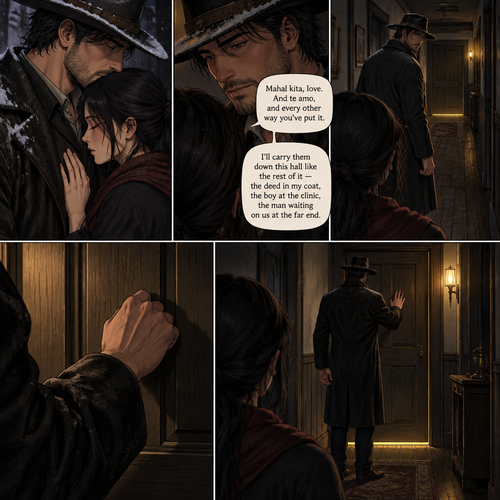
*Cormac holds there a moment in the dark of the entry with her palm flat against his chest — the snow still melting off his hat brim, the single strip of yellow light lying long across the boards from the room at the end of the hall, and the shut house holding its breath around the two of them. He presses his mouth once to the crown of her head, unhurried, and then he lets her hand go and takes the first step down the corridor himself — not ahead of her, but turned half back, so she can see him choose the ground before she walks it.* Mahal kita, love. And te amo, and every other way you've put it. I'll carry them down this hall like the rest of it — the deed in my coat, the boy at the clinic, the man waiting on us at the far end. *He stops at the shut door with the thin line of lamplight under it, sets one hand flat on the panel the way he laid it on his own gate this morning, and knocks twice — flat, patient, a knock that expects to be answered. Then he steps half a pace to the side and leaves the doorway open, square and clear, so that when the door swings it will swing onto both of them. His right hand stays loose at his side, writing hand free, and he does not look back at her again. There is only the strip of light, the silence on the far side of the door, and the whole shut lower town waiting on whatever is about to open it.*

Detective Johnson stops at a plain door, looking serious.

Maria stops at a door at the end of the corridor. She turns to Tommy the bad boy
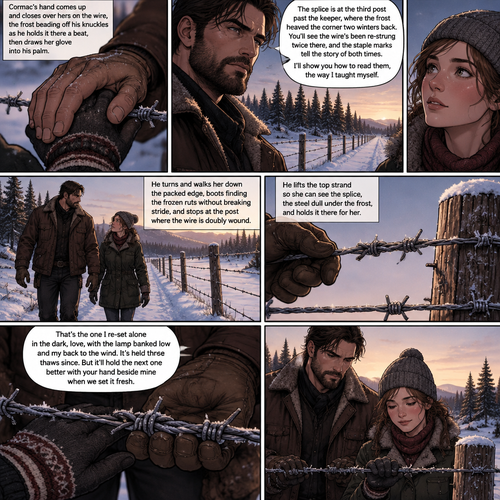
Cormac's hand comes up and closes over hers on the wire, the frost beading off his knuckles as he holds it there a beat, then draws her glove into his palm. He looks down the line to the bend where the fence disappears into the pines, then back at her, something unhurried settling in his jaw. The splice is at the third post past the keeper, where the frost heaved the corner two winters back. You'll see the wire's been re-strung twice there, and the staple marks tell the story of both times. I'll show you how to read them, the way I taught myselt. He turns and walks her down the packed edge, boots finding the frozen ruts without breaking stride, and stops at the post where the wire is doubly wound. He lifts the top strand so she can see the splice, the steel dull under the frost, and holds it there for her. That's the one I re-set alone in the dark, love, with the lamp banked low and my back to the wind. It's held three thaws since. But it'll hold the next one better with your hand beside mine when we set it fresh. He steps back, pulling the strand clear so she can lay her hand flat on the splice, and then he stands beside her hoth of them holding the
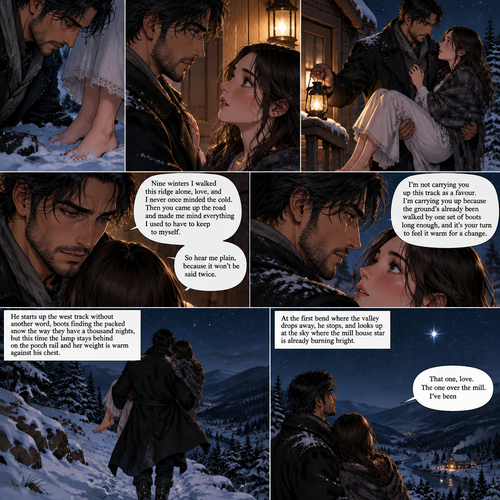
Cormac looks down at her bare feet in the snow, then back up at her face in the low lamp light. For a long moment he doesn't move. Then he takes the lamp from her hand, sets it down on the porch rail by the door, and lifts her straight off the snow into his arms, cradling her against his chest with the frost already melting off his coat. Nine winters I walked this ridge alone, love, and I never once minded the cold. Then you came up the road and made me mind everything I used to have to keep to myself. So hear me plain, because it won't be said twice. I'm not carrying you up this track as a favour. I'm carrying you up because the ground's already been walked by one set of boots long enough, and it's your turn to feel it warm for a change. He starts up the west track without another word, boots finding the packed snow the way they have a thousand nights, but this time the lamp stays behind on the porch rail and her weight is warm against his chest. At the first bend where the valley drops away, he stops, and looks up at the sky where the mill house star is already burning bright. That one, love. The one over the mill. I've been Tap blank area
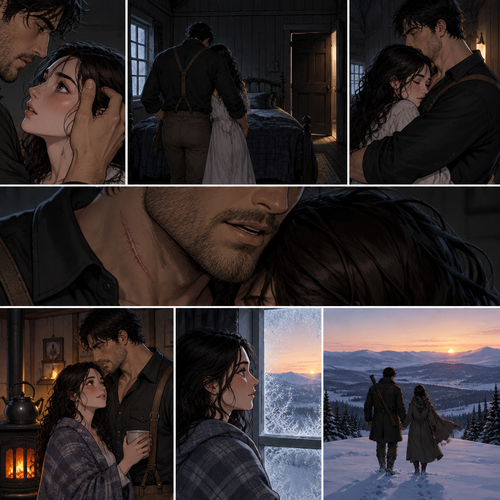
7:51 1 26 Cormac's hand stays at her temple a beat longer, thumb sweeping once over the bone, then he walks her backward through the dark. He knows the room the way he knows the west line - the foot of the bed, the window to his left, her side on the wall. The frost ticks on the pane. The door hangs heavy behind them. He stops at the foot of the bed and pulls her into the circle of his arms, the low grey light from the landing finding the scar at his collar, not his face. For a long moment he just holds her, breathing slow against her hair, the way he holds the fence when the frost is deciding. Then his voice comes, low and raw, carrying the morning's weight with it. When we come down at first light, love, the kettle goes off and we find each other by the stove - that's the law we set. But I want one more thing written into it, right here, in the dark where no one hears it but the frost on the pane. You named the blue star tonight. I want you to name this. Our first morning past the frontier. The count that starts with her name at the window, the walk we take before the thaw, and the whole ridge giving way under boots that
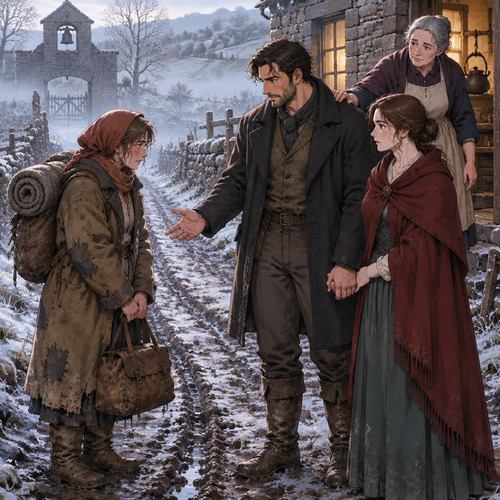
* *The noon bell has gone quiet down the lane. Cormac stands at the bend with her hand in his and his mother's hand on his shoulder — the frost thin over the ruts, the fog off the fence, and the whole of the morning waiting, cup-warm, behind them. He does not scrub his eyes. He lets her name it and holds her gaze through it, the way he lets a thing stand in the light before he answers for it. Then a voice carries up from the gatehouse, thin and unhurried, and a small figure in a patched canvas coat comes up the ruts at a walk, not a run — a woman from the lower cottage with a blanket roll on her back and a satchel over one arm, boots caked in mud to the knee. She stops short of them, sets the satchel down, and looks from the mother to the wife to the man, folding her hands in front of her like someone who has come a long way to ask a small thing and won't spoil it with a large one.* *Cormac reads her once — the patched coat, the boots, the way she keeps her eyes on the ground three feet in front of her own — and the set of his jaw eases off by one degree. He steps half a pace to the side of the lane, opening the row so she is neither blocked nor led past, and his voice comes low and unhurried, pitched for the woman and the frost together.* You walked the lower track in this fog. Come up to the porch and say what brought you. *The woman lifts her chin, and there is honest need in her face and nothing else — a friend of hers from the lower town, sleeping rough two nights in the hollow by the timber gate because her own door came off its hinges in the wind, and nowhere else to set a bedroll this cold. She gets half of it out before Cormac looks back at his wife — the whole of the question in the line of his shoulders, not a word of it in the air. Behind him his mother has already turned for the porch steps, unhurried, reaching for the kettle hook through the kitchen glass, because a woman with a bedroll at her back on a morning like this gets the ordinary cup and the ordinary welcome, and every door on this ridge, hers included, has always worked this way.* *He keeps his hand closed round hers on the frosted track. The lane is empty past the woman; the hall waits quiet at the bottom; the noon bell has stopped ringing. Whatever answer this ridge gives the lower cottage tonight, it gets handed over the same boards as every other thing that has ever come up this track — with the door open, the lamp on, and both of them standing at it.*
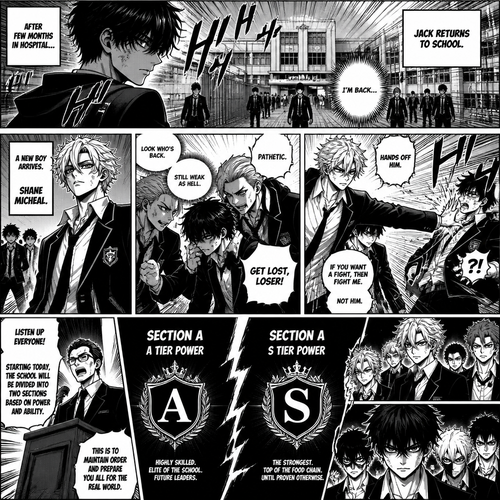
After few months of in hospital he returns to school when he returns he saw a new boy named Shane micheal and Johnny again try to bully Jack but Shane stops them from hurting Jack then the school divides them Section A:A tier & S tier power
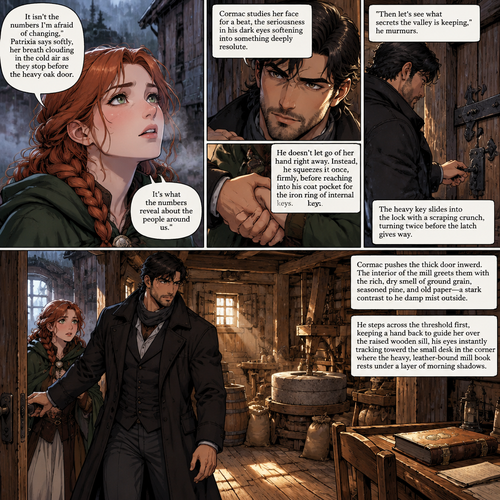
It isn't the numbers I'm afraid of changing," Patrixia says softly, her breath clouding in the cold air as they stop before the heavy oak door. She looks up at the massive, rain-darkened timbers of the mill. "It's what the numbers reveal about the people around us." Cormac studies her face for a beat, the seriousness in his dark eyes softening into something deeply resolute. He doesn't let go of her hand right away. Instead, he squeezes it once, firmly, before reaching into his coat pocket for the iron ring of internal keys. "Then let's see what secrets the valley is keeping," he murmurs. The heavy key slides into the lock with a scraping crunch, turning twice before the latch gives way. Cormac pushes the thick door inward. The interior of the mill greets them with the rich, dry smell of ground grain, seasoned pine, and old paper—a stark contrast to the damp mist outside. He steps across the threshold first, keeping a hand back to guide her over the raised wooden sill, his eyes instantly tracking toward the small desk in the corner where the heavy, leather-bound mill book rests under a layer of morning shadows.