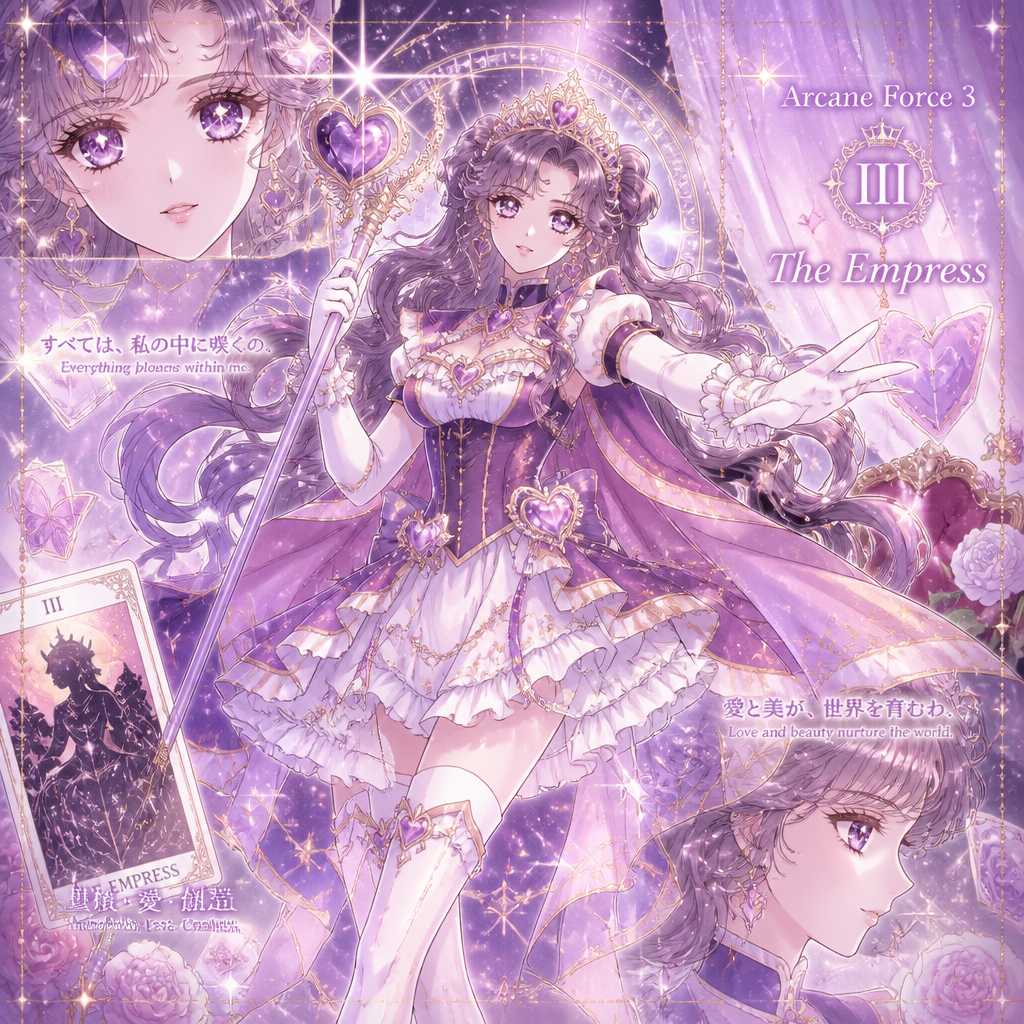

Arcane force 3-the empress as magical girl

Arcane force 3-the empress as magical girl

@cleverchimera707

More from the community
Arcane force 3-the empress as magical girl
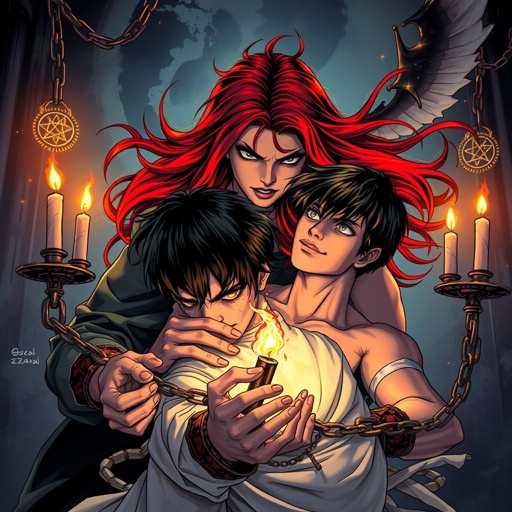
Arcane force 3-the empress as magical girl

20 year old red haired maya screaming at 19 year old dark haired David with some enchanted chains that dampens his powers surrounded by candles

20 year old red haired maya screaming at 19 year old dark haired David with some enchanted chains that dampens his powers surrounded by candles

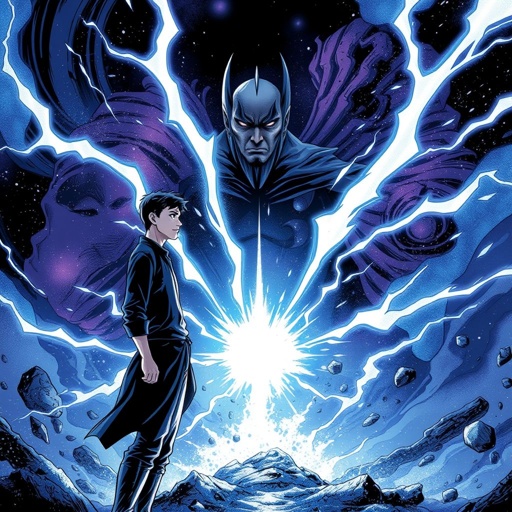
Prompt: Design a captivating book cover for "The Immortal Lover," a fantasy novel that encapsulates the themes of love, magic, and eternal battles. The cover should feature ethereal elements such as a mystical landscape, enchanted symbols, and dynamic characters engaged in a fierce yet passionate confrontation. Utilize a rich color palette to evoke a sense of wonder and intrigue, while ensuring the composition conveys the timeless struggle between love and power. The overall tone should be formal and elegant, inviting readers into a world where magic reigns and love endures despite the chaos of eternal conflict.

Prompt: Design a captivating book cover for "The Immortal Lover," a fantasy novel that encapsulates the themes of love, magic, and eternal battles. The cover should feature ethereal elements such as a mystical landscape, enchanted symbols, and dynamic characters engaged in a fierce yet passionate confrontation. Utilize a rich color palette to evoke a sense of wonder and intrigue, while ensuring the composition conveys the timeless struggle between love and power. The overall tone should be formal and elegant, inviting readers into a world where magic reigns and love endures despite the chaos of eternal conflict.

As the mages fell one by one, the life force of the valley began to return. The plants began to bloom once more, and the wildlife returned, full of vigor and life.
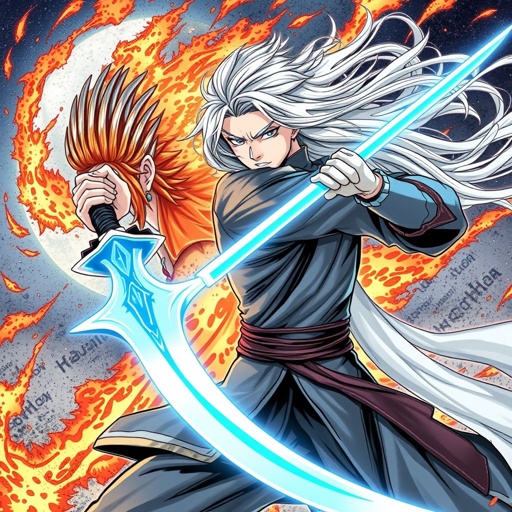
As the mages fell one by one, the life force of the valley began to return. The plants began to bloom once more, and the wildlife returned, full of vigor and life.

KAEL (le rival / ami) 	•	Pouvoir : Lame du Silence 	•	Personnalité : calme, discipliné, opposé à la colère de Samba 	•	Rôle : épéiste, stratège  Kael pense que la force doit être contrôlée, pas libérée. Il s’oppose souvent à Samba… mais le respecte profondément.
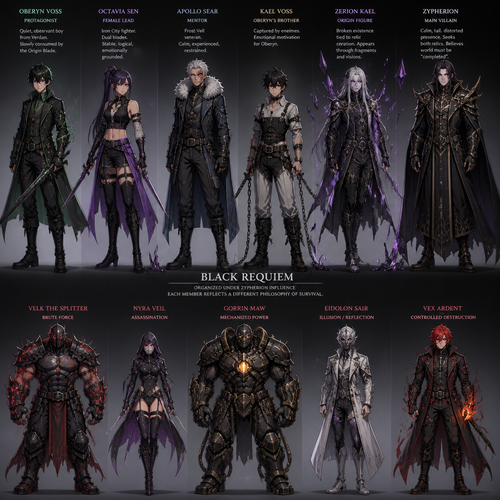
KAEL (le rival / ami) • Pouvoir : Lame du Silence • Personnalité : calme, discipliné, opposé à la colère de Samba • Rôle : épéiste, stratège Kael pense que la force doit être contrôlée, pas libérée. Il s’oppose souvent à Samba… mais le respecte profondément.

Oberyn Voss (Protagonist)

* Quiet, observant boy from Verdan
* Purple eyes, black hair with green streak
* Becomes slowly consumed by Origin Blade

Arc: identity → instability → obsession → erosion

⸻

Zypherion (Main Villain)

* Calm, tall, distorted presence
* Seeks both relics
* Believes world must be “completed”

Arc: control → ideology → escalation → confrontation

⸻

Octavia Sen (Female Lead)

* Iron City fighter, dual blades
* Stable, logical, emotionally grounded
* Acts as Oberyn’s anchor and moral counterweight

Arc: ally → support → opposition → emotional resolution

⸻

Apollo Sear (Mentor)

* Frost Veil veteran with burn scar
* Calm, experienced, restrained
* Guides Oberyn early

⸻

Kael Voss (Brother)

* Captured by enemies
* Emotional motivation for Oberyn
* Human anchor of his past

⸻

Zerion Kael (Origin Figure)

* Broken existence tied to relic creation
* Appears through fragments and visions

⸻

7. ANTAGONIST FACTION — BLACK REQUIEM

* Organized under Zypherion influence
* Each member reflects a different philosophy of survival

Members:

* Velk the Splitter (brute force)
* Nyra Veil (assassination)
* Gorrin Maw (mechanized power)
* Eidolon Sair (illusion/reflection)
* Vex Ardent (controlled destruction)

Make them all just standing there straight forward I need to see the character designs

Oberyn Voss (Protagonist) * Quiet, observant boy from Verdan * Purple eyes, black hair with green streak * Becomes slowly consumed by Origin Blade Arc: identity → instability → obsession → erosion ⸻ Zypherion (Main Villain) * Calm, tall, distorted presence * Seeks both relics * Believes world must be “completed” Arc: control → ideology → escalation → confrontation ⸻ Octavia Sen (Female Lead) * Iron City fighter, dual blades * Stable, logical, emotionally grounded * Acts as Oberyn’s anchor and moral counterweight Arc: ally → support → opposition → emotional resolution ⸻ Apollo Sear (Mentor) * Frost Veil veteran with burn scar * Calm, experienced, restrained * Guides Oberyn early ⸻ Kael Voss (Brother) * Captured by enemies * Emotional motivation for Oberyn * Human anchor of his past ⸻ Zerion Kael (Origin Figure) * Broken existence tied to relic creation * Appears through fragments and visions ⸻ 7. ANTAGONIST FACTION — BLACK REQUIEM * Organized under Zypherion influence * Each member reflects a different philosophy of survival Members: * Velk the Splitter (brute force) * Nyra Veil (assassination) * Gorrin Maw (mechanized power) * Eidolon Sair (illusion/reflection) * Vex Ardent (controlled destruction) Make them all just standing there straight forward I need to see the character designs
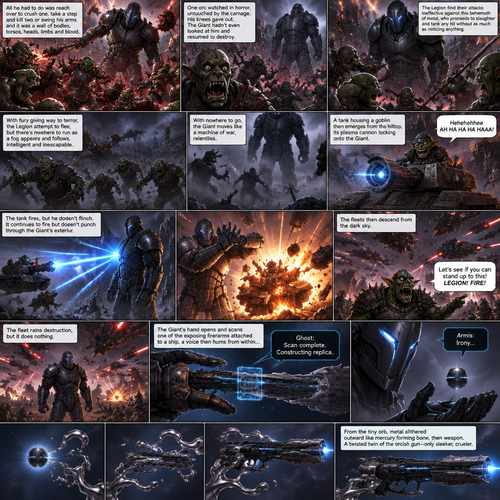
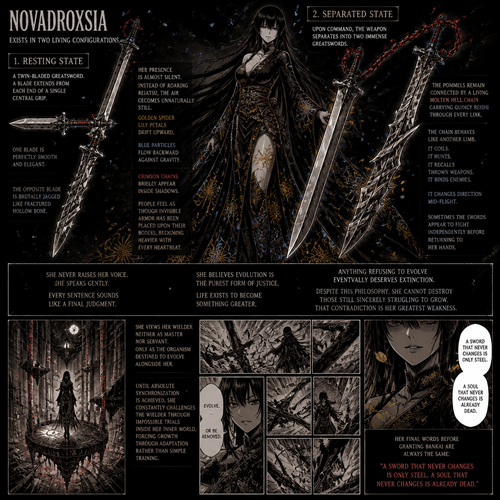
weapon, Novadroxsia, exists in two living configurations.

In its resting state it is a twin-bladed greatsword with a blade extending from each end of a single central grip.

One blade is perfectly smooth and elegant.

The opposite blade is brutally jagged like fractured Hollow bone.

Upon command, the weapon separates into two immense greatswords.

The pommels remain connected by a living molten Hell chain carrying Quincy Reishi through every link.

The chain behaves like another limb.

It coils.

It hunts.

It recalls thrown weapons.

It binds enemies.

It changes direction mid-flight.

Sometimes the swords appear to fight independently before returning to her hands.

Her presence is almost silent.

Instead of roaring Reiatsu, the air becomes unnaturally still.

Golden spider lily petals drift upward.

Blue particles flow backward against gravity.

Crimson chains briefly appear inside shadows.

People feel as though invisible armor has been placed upon their bodies, becoming heavier with every heartbeat.

She never raises her voice.

She speaks gently.

Every sentence sounds like a final judgment.

She believes evolution is the purest form of justice.

Life exists to become something greater.

Anything refusing to evolve eventually deserves extinction.

Despite this philosophy, she cannot destroy those still sincerely struggling to grow.

That contradiction is her greatest weakness.

She views her wielder neither as master nor servant.

Only as the organism destined to evolve alongside her.

Until absolute synchronization is achieved, she constantly challenges the wielder through impossible trials inside her Inner World, forcing growth through adaptation rather than simple training.

Her final words before granting Bankai are always the same:

“A sword that never changes is only steel. A soul that never changes is already dead.”

weapon, Novadroxsia, exists in two living configurations. In its resting state it is a twin-bladed greatsword with a blade extending from each end of a single central grip. One blade is perfectly smooth and elegant. The opposite blade is brutally jagged like fractured Hollow bone. Upon command, the weapon separates into two immense greatswords. The pommels remain connected by a living molten Hell chain carrying Quincy Reishi through every link. The chain behaves like another limb. It coils. It hunts. It recalls thrown weapons. It binds enemies. It changes direction mid-flight. Sometimes the swords appear to fight independently before returning to her hands. Her presence is almost silent. Instead of roaring Reiatsu, the air becomes unnaturally still. Golden spider lily petals drift upward. Blue particles flow backward against gravity. Crimson chains briefly appear inside shadows. People feel as though invisible armor has been placed upon their bodies, becoming heavier with every heartbeat. She never raises her voice. She speaks gently. Every sentence sounds like a final judgment. She believes evolution is the purest form of justice. Life exists to become something greater. Anything refusing to evolve eventually deserves extinction. Despite this philosophy, she cannot destroy those still sincerely struggling to grow. That contradiction is her greatest weakness. She views her wielder neither as master nor servant. Only as the organism destined to evolve alongside her. Until absolute synchronization is achieved, she constantly challenges the wielder through impossible trials inside her Inner World, forcing growth through adaptation rather than simple training. Her final words before granting Bankai are always the same: “A sword that never changes is only steel. A soul that never changes is already dead.”

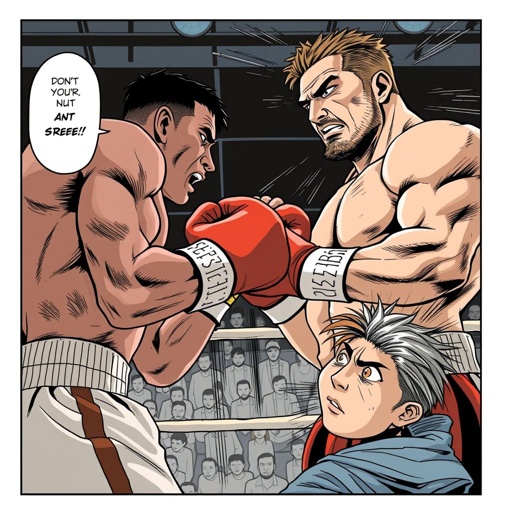
Amel is a boxer that can mimic the signature attacks of any boxer he faces. He climbs through the ranks. Today,he fights against the heavyweight champion Galen,a 6’7 textbook style boxing prodigy who’s signature attack is a devastating right hook named “The Show Stopper” As the announcer calls the fighters names,Amel grins widely as Galen stares with a blank expression. Round one begins as Amel copies one of the past fighter’s footwork and blitzes in on Ganel. Ganel just jabs Amel calmly,making Amel’s head lean back from the amount of force behind the blow. For the next couple of rounds Amel cannot get a single hit on Ganel. Every move is being shut down by a simple step and a jab. Ganel hits Amel with an uppercut that buckles Amel’s knees. Ganel holds him up “not yet” Ganel says calmly as the bell rings. Amel tiredly goes to his seat as his coaches panic and clean his wounds. “YOU GOTTA HIT HIM WITH STORMS MOVE. ITS THE ONLY WAY” Amel nods as gets up as round 8 begins. Ganel keeps Amel away with jabs,doing damage over time. Amel suddenly bursts forward with the last bit of energy and yells “DEMON HAMME-“ suddenly Amel falls to the canvas. Amel has fallen victim to Ganel’s right hook “The Show Stopper” Amel’s coaches scream in horror as Ganel stares down blankly. Ganel didn’t bring any coaches. Only a medic team. Ganel holds his left fist up in victory staying calm as the ref waves his arms in the air,signaling that the fight is over. Amel slowly closes his eyes,wondering why he couldn’t win or copy Ganel’s ability. Suddenly Amel wakes up in a cold sweat. Was it all a dream?!
Amel is a boxer that can mimic the signature attacks of any boxer he faces. He climbs through the ranks. Today,he fights against the heavyweight champion Galen,a 6’7 textbook style boxing prodigy who’s signature attack is a devastating right hook named “The Show Stopper” As the announcer calls the fighters names,Amel grins widely as Galen stares with a blank expression. Round one begins as Amel copies one of the past fighter’s footwork and blitzes in on Ganel. Ganel just jabs Amel calmly,making Amel’s head lean back from the amount of force behind the blow. For the next couple of rounds Amel cannot get a single hit on Ganel. Every move is being shut down by a simple step and a jab. Ganel hits Amel with an uppercut that buckles Amel’s knees. Ganel holds him up “not yet” Ganel says calmly as the bell rings. Amel tiredly goes to his seat as his coaches panic and clean his wounds. “YOU GOTTA HIT HIM WITH STORMS MOVE. ITS THE ONLY WAY” Amel nods as gets up as round 8 begins. Ganel keeps Amel away with jabs,doing damage over time. Amel suddenly bursts forward with the last bit of energy and yells “DEMON HAMME-“ suddenly Amel falls to the canvas. Amel has fallen victim to Ganel’s right hook “The Show Stopper” Amel’s coaches scream in horror as Ganel stares down blankly. Ganel didn’t bring any coaches. Only a medic team. Ganel holds his left fist up in victory staying calm as the ref waves his arms in the air,signaling that the fight is over. Amel slowly closes his eyes,wondering why he couldn’t win or copy Ganel’s ability. Suddenly Amel wakes up in a cold sweat. Was it all a dream?!

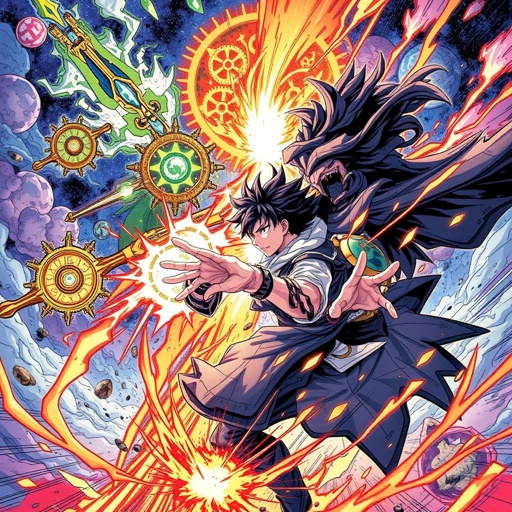
Starforge Studios: Rise of Galaxy Genre: Sad, Depressing, Action, Romantic, Tear-jerking, Relationships, Breakups, Supernatural, School Life, Mystery, Psychological Logline: A prodigal but emotionally scarred teenage sorcerer with galaxy-like eyes and immense celestial powers navigates the isolating halls of a new academy, forging tentative bonds and a silent romance, only to face the devastating betrayal and transformation of a close friend into a world-ending threat, forcing him to confront his inner darkness and fight for a future he never believed he deserved. Synopsis: Seventeen-year-old Matthew Cagle, code-named "Galaxy" due to his unique, cosmos-resembling eyes and extraordinary celestial abilities, arrives at the prestigious Starforge High, a training academy for elite sorcerers. Haunted by years of brutal bullying at his previous school where he was derisively called "Mattie," and burdened by ADHD that amplifies his sensory overload, Matthew is deeply introverted and struggles with social interaction despite a hidden yearning for connection and affection, particularly a desire for the comforting embrace he never received. His instructors recognize his unparalleled potential, evident in his mastery of techniques like Starfall Barrage (a precise meteor shower), Zero Gravity Control, Event Horizon Lock (disrupting enemy energy), and Constellation Sync (ally power boost within his domain). He even possesses a forbidden, devastating ultimate move, Supernova Collapse, and a rarely used, immensely powerful Domain Expansion: Infinite Galaxy, transforming the battlefield into a breathtaking but dangerous starry void. Assigned to a team with the energetic Bryan and the analytical Connar, Matthew slowly begins to lower his defenses. Bryan's easygoing nature and Connar's quiet understanding chip away at his isolation, and he experiences the first genuine camaraderie he’s known. Amidst this tentative blossoming of friendship, Miwa Kasumi, a kind girl with striking light blue hair, observes Matthew from afar. Unbeknownst to him, Miwa has harbored a deep and enduring crush since his arrival, her heart aching for his loneliness and longing to bridge the gap between them. They share a quiet, unspoken bond as classmates and occasional training partners, but Miwa's shyness prevents her from ever vocalizing her true feelings. As the trio trains and undertakes minor missions, years subtly pass, strengthening their bonds. Connar, however, develops a growing fascination with rare and powerful artifacts called "storm shards," embarking on solo research trips that increasingly isolate him. One fateful day, news of a catastrophic incident at a remote research facility reaches Starforge High – an event linked to storm shard experimentation. The aftermath is gruesome, with widespread casualties. Galaxy, Bryan, and other top-ranked sorcerers are dispatched to investigate. Driven by a foreboding instinct, Matthew insists on entering the ravaged science building alone. Within the eerie, bloodstained hallways, a horrifying truth awaits him. In the elevator on the top floor, amidst flickering lights and carnage, Matthew witnesses a figure absorbing the life force of a fallen soldier. The figure turns, revealing a partially transformed Connar, his features grotesquely merging with an unknown, malevolent energy – the nascent form of the Storm King. Connar vanishes, leaving Matthew traumatized and bewildered. A year of unease follows. Connar's disappearance casts a long shadow, and Matthew retreats back into his shell, the resurfacing trauma making him unintentionally distance himself from Miwa, who desperately tries to offer comfort. Eventually, intelligence leads the sorcerers to an abandoned building radiating the Storm King's energy. A brutal confrontation ensues. The transformed Connar’s power is immense, overwhelming even Galaxy and his allies. Matthew is forced to unleash his Domain Expansion, "Infinite Galaxy," in a desperate attempt to contain him, but even that proves insufficient. Pushing his limits, Matthew unleashes the destructive "Supernova Collapse," sacrificing his own domain to weaken the Storm King. In the aftermath, a separate entity of pure darkness, "The Shadow," emerges from Connar's remnants, attempting to possess Matthew, preying on his deep-seated insecurities and past pain. Annie, a gifted healer and wielder of ancient lore, intervenes, using a powerful book to sever the connection. The true, terrifying form of the Storm King is revealed, a being of storm and chaos. A desperate final battle erupts, with everyone fighting alongside Matthew. Major, a powerful ally thought lost, is miraculously revived by Annie's ritual, returning with enhanced abilities. Together, they manage to defeat and seal the Storm King and the Shadow, but the victory comes at a heavy cost – significant injuries and lasting emotional scars. Following the battle, Matthew, despite his heroic actions, is taken into custody, the world grappling with the destruction he inadvertently caused while battling the Shadow. He undergoes intense scrutiny, the lingering influence of the dark entity uncertain. Feeling isolated and feared, Matthew makes the agonizing decision to leave Starforge and his friends behind, embarking on a solitary journey seeking atonement and self-discovery. He leaves a heartfelt letter for his companions, particularly for Miwa, who finds it with a mix of sorrow and a persistent ember of hope. The ending leaves their future, and the possibility of Matthew finding peace and perhaps finally acknowledging Miwa's long-held affection, open-ended, hinting at a continuing saga of healing and potential romance amidst a world forever changed.
Starforge Studios: Rise of Galaxy Genre: Sad, Depressing, Action, Romantic, Tear-jerking, Relationships, Breakups, Supernatural, School Life, Mystery, Psychological Logline: A prodigal but emotionally scarred teenage sorcerer with galaxy-like eyes and immense celestial powers navigates the isolating halls of a new academy, forging tentative bonds and a silent romance, only to face the devastating betrayal and transformation of a close friend into a world-ending threat, forcing him to confront his inner darkness and fight for a future he never believed he deserved. Synopsis: Seventeen-year-old Matthew Cagle, code-named "Galaxy" due to his unique, cosmos-resembling eyes and extraordinary celestial abilities, arrives at the prestigious Starforge High, a training academy for elite sorcerers. Haunted by years of brutal bullying at his previous school where he was derisively called "Mattie," and burdened by ADHD that amplifies his sensory overload, Matthew is deeply introverted and struggles with social interaction despite a hidden yearning for connection and affection, particularly a desire for the comforting embrace he never received. His instructors recognize his unparalleled potential, evident in his mastery of techniques like Starfall Barrage (a precise meteor shower), Zero Gravity Control, Event Horizon Lock (disrupting enemy energy), and Constellation Sync (ally power boost within his domain). He even possesses a forbidden, devastating ultimate move, Supernova Collapse, and a rarely used, immensely powerful Domain Expansion: Infinite Galaxy, transforming the battlefield into a breathtaking but dangerous starry void. Assigned to a team with the energetic Bryan and the analytical Connar, Matthew slowly begins to lower his defenses. Bryan's easygoing nature and Connar's quiet understanding chip away at his isolation, and he experiences the first genuine camaraderie he’s known. Amidst this tentative blossoming of friendship, Miwa Kasumi, a kind girl with striking light blue hair, observes Matthew from afar. Unbeknownst to him, Miwa has harbored a deep and enduring crush since his arrival, her heart aching for his loneliness and longing to bridge the gap between them. They share a quiet, unspoken bond as classmates and occasional training partners, but Miwa's shyness prevents her from ever vocalizing her true feelings. As the trio trains and undertakes minor missions, years subtly pass, strengthening their bonds. Connar, however, develops a growing fascination with rare and powerful artifacts called "storm shards," embarking on solo research trips that increasingly isolate him. One fateful day, news of a catastrophic incident at a remote research facility reaches Starforge High – an event linked to storm shard experimentation. The aftermath is gruesome, with widespread casualties. Galaxy, Bryan, and other top-ranked sorcerers are dispatched to investigate. Driven by a foreboding instinct, Matthew insists on entering the ravaged science building alone. Within the eerie, bloodstained hallways, a horrifying truth awaits him. In the elevator on the top floor, amidst flickering lights and carnage, Matthew witnesses a figure absorbing the life force of a fallen soldier. The figure turns, revealing a partially transformed Connar, his features grotesquely merging with an unknown, malevolent energy – the nascent form of the Storm King. Connar vanishes, leaving Matthew traumatized and bewildered. A year of unease follows. Connar's disappearance casts a long shadow, and Matthew retreats back into his shell, the resurfacing trauma making him unintentionally distance himself from Miwa, who desperately tries to offer comfort. Eventually, intelligence leads the sorcerers to an abandoned building radiating the Storm King's energy. A brutal confrontation ensues. The transformed Connar’s power is immense, overwhelming even Galaxy and his allies. Matthew is forced to unleash his Domain Expansion, "Infinite Galaxy," in a desperate attempt to contain him, but even that proves insufficient. Pushing his limits, Matthew unleashes the destructive "Supernova Collapse," sacrificing his own domain to weaken the Storm King. In the aftermath, a separate entity of pure darkness, "The Shadow," emerges from Connar's remnants, attempting to possess Matthew, preying on his deep-seated insecurities and past pain. Annie, a gifted healer and wielder of ancient lore, intervenes, using a powerful book to sever the connection. The true, terrifying form of the Storm King is revealed, a being of storm and chaos. A desperate final battle erupts, with everyone fighting alongside Matthew. Major, a powerful ally thought lost, is miraculously revived by Annie's ritual, returning with enhanced abilities. Together, they manage to defeat and seal the Storm King and the Shadow, but the victory comes at a heavy cost – significant injuries and lasting emotional scars. Following the battle, Matthew, despite his heroic actions, is taken into custody, the world grappling with the destruction he inadvertently caused while battling the Shadow. He undergoes intense scrutiny, the lingering influence of the dark entity uncertain. Feeling isolated and feared, Matthew makes the agonizing decision to leave Starforge and his friends behind, embarking on a solitary journey seeking atonement and self-discovery. He leaves a heartfelt letter for his companions, particularly for Miwa, who finds it with a mix of sorrow and a persistent ember of hope. The ending leaves their future, and the possibility of Matthew finding peace and perhaps finally acknowledging Miwa's long-held affection, open-ended, hinting at a continuing saga of healing and potential romance amidst a world forever changed.

: The world of Eclipsed Heavens is a vast, multidimensional realm where ancient civilizations, powerful beings, and gods live in a fragile equilibrium. The world is divided into six “Sky Realms,” each of which represents different aspects of existence: Time, Space, Life, Death, Chaos, and Order. These realms are connected by the ethereal and mysterious “Astral Bridges,” which only those with rare celestial powers can navigate.  At the heart of the world lies The Eclipsed Citadel, an ever-moving floating city that houses a secret organization known as The Diviners, guardians who maintain the balance between realms. Legends say that every few centuries, the celestial order is threatened by the appearance of the Eclipse King, an entity whose rise would trigger the collapse of all six realms and bring forth an age of unending chaos.  ⸻  Main Characters: 	1.	Ryu Kasami (Protagonist) – A 16-year-old boy from a forgotten village. He is mysterious and has no memory of his past but possesses an uncanny ability to manipulate time. Ryu is the last descendant of an ancient bloodline tied to the celestial forces and unknowingly holds the key to the Eclipse King’s return. His journey is one of self-discovery, redemption, and the struggle to prevent his own destruction. 	2.	Mira Leena (Co-Protagonist) – A 17-year-old skilled swordswoman from the Realm of Order. She is a fierce protector of balance and serves as a high-ranking member of The Diviners. Driven by a deep sense of justice, Mira believes Ryu is destined to either save or destroy the realms. Though initially distrustful of him, she forms an emotional and philosophical connection with Ryu throughout their journey. 	3.	Zephyr Arcanis – A mysterious and brooding 20-year-old man from the Realm of Chaos. Zephyr is a rogue Diviner who seeks to awaken the Eclipse King in order to usher in a new age of freedom, where no being is bound by the rules of the realms. Zephyr becomes both an adversary and reluctant ally to Ryu, as his beliefs challenge the core of Ryu’s ideals. 	4.	Seraphina Dawn – A seemingly immortal being from the Realm of Life, Seraphina is one of the original Diviners, acting as both a mentor and guardian to Ryu. Though she appears serene and gentle, her long life has burdened her with the weight of many past mistakes. She plays a pivotal role in guiding Ryu’s development. 	5.	The Eclipse King (Antagonist) – The dark force that resides in the shadows of the realms. The Eclipse King is not a traditional villain but a concept—an embodiment of entropy and destruction. The character is mysterious, shifting forms, and represents the inevitable cycle of decay that threatens all life and order. His influence permeates the story, manipulating both Ryu and Zephyr.  ⸻  Plot Summary:  Arc 1: The Awakening (Chapters 1–50)  Ryu’s journey begins when his peaceful life in the village is destroyed by a mysterious force, revealing his dormant powers. After narrowly escaping the attack on his village, Ryu encounters Mira, who tells him that he is the last of the Astra-Bloodline, whose existence ties directly to the coming of the Eclipse King. As they travel together, Ryu learns to harness his powers and gains insight into his past, while Mira tries to convince him to join The Diviners in their fight to preserve balance.  Arc 2: The Astral Trials (Chapters 51–150)  Ryu and Mira embark on a journey to the six Sky Realms to collect ancient artifacts that are crucial to sealing the Eclipse King’s power. Each realm tests Ryu’s strength and moral convictions, forcing him to confront his inner fears, doubts, and desires. Along the way, they face numerous enemies, including Zephyr, who manipulates them from the shadows, believing that Ryu’s rise is necessary for the realms to break free from their stagnation.  Ryu forms bonds with new allies, each with a tragic past that mirrors his own. Meanwhile, Ryu uncovers a dark truth about the Astra-Bloodline—his ancestors were responsible for imprisoning the Eclipse King and that his power is tied to an ancient curse that could consume him entirely if left unchecked.  Arc 3: Echoes of the Eclipse (Chapters 151–300)  As Ryu’s power grows, he begins to question his purpose. Is he a savior or a destroyer? Mira and Seraphina struggle with their own beliefs—whether to trust Ryu or kill him before he can succumb to the dark forces within him. Meanwhile, Zephyr’s influence over the realms intensifies, and he assembles an army of rebels who see Ryu as their champion.  The stakes grow higher as Ryu learns that the Eclipse King’s influence has already begun to unravel the fabric of reality. The realms are slowly bleeding into one another, and the boundaries between life and death, order and chaos, are becoming unstable.  Arc 4: The Final Eclipse (Chapters 301–600)  The world begins to descend into madness as the realms collapse. In this dark age, Ryu faces his ultimate test: will he succumb to the Eclipse King’s whispers or defy his fate? He must choose between embracing his true power and risking everything for a chance to rebuild the realms or rejecting his legacy, even if it means sacrificing his life.  In the final confrontation, Ryu and Zephyr battle in a cataclysmic clash that alters the very fabric of the universe. The lines between friend and foe blur, and Ryu’s journey becomes a race against time to prevent the Eclipse King’s full resurrection.  Arc 5: Rebirth of the Heavens (Chapters 601–1000)  After the battle, the realms are left in ruins. Ryu, Mira, and their allies must rebuild what was lost. Ryu learns the true nature of the Eclipse King: a necessary cycle of creation and destruction that sustains the universe. The final chapters explore themes of renewal, rebirth, and the balance between light and dark. Ryu ultimately transcends his past and forges a new future for the realms.  The series ends with a bittersweet resolution—Ryu’s journey isn’t just about defeating evil, but about finding peace with his existence and accepting that balance is both fragile and eternal.  ⸻  Key Themes: 	1.	Balance and Duality: The constant theme throughout the manga will be the struggle between balance and imbalance, represented by the battle between the Sky Realms and the Eclipse King. Characters will explore themes of light and dark, life and death, order and chaos, as they try to understand the natural cycles of the universe. 	2.	Identity and Legacy: Ryu’s journey is one of self-discovery. He must come to terms with who he is, his bloodline, and what kind of legacy he wants to leave behind. 	3.	Sacrifice: Many characters are forced to confront what they are willing to give up for the greater good, leading to emotional moments and deep character development. 	4.	The Nature of Power: The manga will explore the dangers of absolute power, and how power can corrupt even the best of intentions. Ryu’s internal battle with his growing powers will be a focal point.  ⸻  Art Style: 	•	Visual Aesthetic: The art will be lush and detailed, with intricate designs for each of the six realms, offering diverse landscapes ranging from serene, ethereal skies to chaotic, decaying worlds. Character designs will be sharp, dynamic, and expressive, with an emphasis on emotions conveyed through facial expressions and dramatic action sequences. 	•	Action Sequences: Epic, fast-paced battles with a focus on fluidity and creativity, using a mix of traditional martial arts and fantastical abilities tied to the realms’ powers. Each character’s abilities are unique and visually distinct, providing a visual feast during combat.  ⸻  Why It Could Be Award-Winning: 	1.	Depth of Worldbuilding: Eclipsed Heavens offers a richly detailed world with complex realms and powerful themes that resonate with readers on multiple levels. 	2.	Emotional Complexity: The story will delve deeply into the psychology of its characters, particularly Ryu, who must grapple with his identity, purpose, and the consequences of his powers. 	3.	Moral Ambiguity: The manga’s exploration of choices, sacrifice, and the fine line between good and evil will appeal to mature audiences and provoke philosophical questions. 	4.	Epic Scale: The overarching narrative structure, with long-term character development and world-changing events, will keep readers invested for the duration of the series.  ⸻  Adaptation into Anime: The story’s expansive world, emotional depth, and action-packed sequences make it a prime candidate for an anime adaptation. With a studio like Madhouse or Ufotable backing it, the anime could deliver stunning animation, captivating music, and an intense viewing experience. The anime’s success would rely heavily on character-driven storytelling, top-tier animation quality, and faithful adaptation of the manga’s core themes.  The Astral Bridges:  Concept: The Astral Bridges are more than just physical pathways; they represent the connection between the six Sky Realms and the very fabric of existence. Only those with rare celestial abilities can traverse them, and they are shrouded in mystery. These bridges are not permanent structures, but ethereal paths that shift in form depending on the traveler’s will, their emotional state, or their connection to the realms. Some bridges are frail and unstable, while others are stable but treacherous.  Visual Representation: 	•	Form: Imagine the bridges as glowing, semi-transparent pathways made of light, energy, and fragments of stars. They stretch through space like beams of light or floating shards of crystal, connecting the realms. At times, these bridges can appear as vast, starry pathways that move fluidly, like rivers of light, or as delicate threads suspended in a void. The closer one gets to the Eclipse King’s influence, the more the bridges distort, warping and twisting into nightmarish shapes. 	•	Colors & Atmosphere: Each bridge has its own color palette, reflecting the nature of the realm it connects to. The further you move from the central hub (the Eclipsed Citadel), the more chaotic and unstable the bridges become. 	•	Realm of Time Bridge: A shimmering, golden thread that pulses with faint clock-like patterns. This bridge is clear and precise, flowing smoothly like time itself. However, it can freeze or speed up, affecting the traveler’s perception of time. 	•	Realm of Space Bridge: A bridge composed of shifting geometrical patterns, bending and reshaping constantly, as if it were a liquid continuum. Travelers might experience a feeling of vertigo or space-time disorientation as they cross. 	•	Realm of Life Bridge: This bridge is an organic, vine-like structure glowing in soft greens and purples, pulsating as though alive. The path feels like walking through a garden, with faint whispers of life beckoning travelers to the Realm of Life’s lush landscapes. 	•	Realm of Death Bridge: A cold, pale path covered in what seems like a thin mist or fog. It’s desolate, yet unyielding. The atmosphere is ominous, and the air feels heavy with the weight of past souls. 	•	Realm of Chaos Bridge: A chaotic, ever-changing web of storm clouds, fractals, and surreal patterns, constantly flickering between order and disarray. Traveling on this bridge feels like being pulled in multiple directions simultaneously, testing both physical and mental endurance. 	•	Realm of Order Bridge: A solid, crystalline path that feels almost like walking on glass. The bridge is perfectly symmetrical, unyielding, and clean-cut, yet the further one travels, the more it feels oppressive, as though following the strict rules of the realm itself.  Navigating the Bridges: 	•	Ryu’s Connection: Since Ryu is the last of the Astra-Bloodline, he has a unique connection to the Astral Bridges. As he learns to control his power, the bridges become easier to access. However, his abilities might also cause them to fluctuate in unexpected ways, reflecting his inner turmoil and the potential for him to either restore or destroy balance. 	•	Conflict: The instability of the Astral Bridges becomes a plot point. As the realms start to destabilize due to the Eclipse King’s influence, the bridges warp and shatter, leading to perilous journeys and fights against forces trying to disrupt the balance. These bridges could be crucial for Ryu’s allies to rescue him or others, only to face new obstacles as the bridges themselves start to decay under the Eclipse King’s shadow.  ⸻  The Six Sky Realms:  Each of the realms represents an aspect of existence, and the cultures, landscapes, and aesthetics of these realms should reflect their themes.  ⸻  1. Realm of Time: 	•	Visuals & Atmosphere: The Realm of Time feels like a city built within an eternal clockwork mechanism. Massive gears, hourglasses, and flowing rivers of liquid time span across vast landscapes. The skies are a kaleidoscope of gold and silver, as if time itself is unraveling. 	•	Concept: This realm is dedicated to the preservation of time’s flow. The inhabitants are powerful time-mages who act as custodians, ensuring that no one can alter the natural course of time. The very air here is infused with the essence of time, making the experience of moving through it feel like walking through an endless loop. 	•	Challenges: When crossing through the Realm of Time, Ryu may be forced to confront his past, present, and future. Time-based illusions and loops could mess with his sense of reality. The deeper they go into the realm, the more distorted their perception of time becomes, and Ryu may even see different versions of himself or be trapped in time loops.  ⸻  2. Realm of Space: 	•	Visuals & Atmosphere: The Realm of Space is a vast cosmic expanse, filled with floating islands, endless stars, and nebulae. Gravity itself doesn’t always behave logically, and the sky shifts in unusual patterns. The realm is a place of constant motion, with black holes, vortexes, and swirling galaxies dotting the horizon. 	•	Concept: Here, space-benders can manipulate the very fabric of reality, altering the position of objects, creating portals, and even warping the laws of physics. This is a land of freedom, where there are no fixed laws—only infinite possibilities. 	•	Challenges: Ryu must face physical and psychological trials related to space—dealing with isolation, disorientation, and learning to control spatial manipulation. He could be lost in a maze of endless corridors and celestial anomalies where nothing is as it seems.  ⸻  3. Realm of Life: 	•	Visuals & Atmosphere: The Realm of Life is a flourishing paradise filled with lush forests, sprawling meadows, and sparkling rivers. It’s a world full of vibrant, ever-changing flora and fauna. The air is filled with the sounds of nature, and every living thing feels interconnected, as though life itself is one collective organism. 	•	Concept: This realm is inhabited by beings who embody vitality and growth. However, there’s a dark undercurrent of life’s fragility, as not all life is without suffering or pain. The boundaries between life and death are thinner here. 	•	Challenges: Ryu must come to terms with the nature of life itself—its beauty, its unpredictability, and its impermanence. Perhaps he faces challenges that force him to confront the fragility of his own life, or even the life of others.  ⸻  4. Realm of Death: 	•	Visuals & Atmosphere: The Realm of Death is a bleak, shadowy world where the landscapes are filled with dead trees, withered mountains, and rivers of blackened water. The sky is perpetually dim, with a ghostly glow emanating from the surface of the realm. 	•	Concept: The inhabitants of this realm are spirits and reapers, beings who guide souls to their final resting place. It is a realm of memories, where the living and the dead intersect. Time feels almost irrelevant here, and the living are only allowed to pass through with great difficulty. 	•	Challenges: Ryu’s journey through this realm may involve facing the ghosts of his past or losing parts of his humanity. The challenges he faces could involve negotiating with spirits or coming to terms with death itself, which could be deeply psychological.  ⸻  5. Realm of Chaos: 	•	Visuals & Atmosphere: The Realm of Chaos is a land of complete unpredictability. The landscape is ever-shifting, with tornadic storms, raging fires, and blinding lightning. The atmosphere is filled with surreal, impossible phenomena—planets collide, reality bends and fractures, and the air is thick with the heat of destruction. 	•	Concept: The inhabitants are beings who revel in disorder. Chaos is seen as the purest form of existence—liberating and untethered by rules. Zephyr, from this realm, embodies these ideals, seeking to break the chains of the established order and to let the universe collapse in a rebirth of freedom. 	•	Challenges: Ryu’s trials here are ones of survival—facing unpredictable dangers that seem to defy the laws of nature. He will be pushed to his limits, forced to make snap decisions and adapt quickly in order to survive.  ⸻  6. Realm of Order: 	•	Visuals & Atmosphere: The Realm of Order is a pristine, organized world where everything exists in perfect harmony. The land is made of towering structures and symmetrical landscapes, and everything seems to move in measured, deliberate patterns. The sky is a sharp blue, and every being follows rigid, unyielding rules. 	•	Concept: The inhabitants of this realm believe in structure and predictability. They believe that true peace can only be achieved through control and absolute order. Mira, from this realm, follows these principles closely. 	•	Challenges: Ryu may struggle against the oppressive perfection of this realm, learning the consequences of unyielding structure versus natural spontaneity. He will have to navigate through challenges where every action is scrutinized and every decision must follow a strict moral code.  ⸻  Final Notes:  By focusing on these diverse and visually distinct realms, you can create a series of truly compelling locations that each reflect different aspects of existence while simultaneously challenging Ryu’s growth. This will give the anime or manga a lot of visual variety, emotional depth, and philosophical exploration.  The concept you’ve outlined for the sequel to The Astral Bridges is incredibly rich with depth, vivid settings, and complex characters. With this structure, a 1000-page manga can provide a profound narrative and captivating visual storytelling that explores deep themes of existence, connection, and the self.  Here’s a potential structure and storyline breakdown to help develop this expansive world and its journey:  ⸻  Overall Plot Structure (Sequel)  The story continues after the events of the original Astral Bridges, where Ryu, the last of the Astra-Bloodline, is now thrust into the heart of the instability caused by the Eclipse King’s influence over the bridges. The primary conflict is Ryu’s struggle to maintain the balance between the realms while facing external enemies who want to exploit the bridges for their own agendas. His journey is one of self-discovery, as each realm pushes him to confront his own inner demons and explore the truth about his origins and his connection to the celestial world.  ⸻  Prologue - The Shattering of the Bridges 	•	Setting: The Eclipsed Citadel, the source of the Eclipse King’s influence, is crumbling as the Eclipse King’s power grows stronger. 	•	Plot: The bridges begin to destabilize, leading to realms colliding and becoming fragmented. The Celestial Council, once responsible for maintaining the balance between the realms, is either corrupted or powerless in the face of the Eclipse King’s might. Ryu, struggling with the loss of his family and the growing instability, is tasked with finding the lost keys to restore the balance.  ⸻  The Bridge Trials (Main Arc)  Each realm presents Ryu with a series of trials that test his growth, abilities, and beliefs. As he moves from one bridge to another, his perception of time, space, life, death, chaos, and order starts to evolve, reflecting his inner conflict. 	1.	Realm of Time - The Sands of Fate 	•	Plot: Ryu enters the Realm of Time, where he faces distorted versions of his past, future, and potential selves. He encounters an enigmatic guardian of time, Chrona, who forces him to relive his tragic past and question whether he can change the future. 	•	Challenges: He must escape a time loop that traps him in an endless cycle of failure and loss. Only by embracing his pain can he transcend the illusion of control over time. 	•	Growth: Ryu learns to accept that time is not something to be controlled, but something to be experienced. 	2.	Realm of Space - The Infinite Maze 	•	Plot: Ryu enters the chaotic expanse of the Realm of Space. He encounters Lumen, a fellow Astra-Bloodline survivor, who shows him how space can be manipulated. They must navigate a twisting labyrinth of shifting stars and gravitational anomalies. 	•	Challenges: Ryu is constantly disoriented, unable to trust his senses. He faces physical and psychological dangers as the laws of physics break down around him. 	•	Growth: Ryu learns to trust his intuition and adapt to the ever-changing environment, embracing the uncertainty of existence. 	3.	Realm of Life - The Garden of Souls 	•	Plot: In the lush, vibrant landscapes of the Realm of Life, Ryu faces the paradox of life’s beauty and fragility. He meets Florin, a being who embodies life itself, and must journey through a garden where every plant and creature is an interconnected part of a greater whole. 	•	Challenges: He must confront the death of loved ones and learn that life cannot exist without its opposite. His greatest challenge is to accept that not all life can be saved. 	•	Growth: Ryu learns the value of impermanence and the strength in accepting the fleeting nature of life. 	4.	Realm of Death - The Whispering Void 	•	Plot: In the dark, desolate landscapes of the Realm of Death, Ryu confronts the spiritual remnants of those who have passed. He meets Nyx, a being who governs the passage between life and death. 	•	Challenges: Ryu must navigate a world where time is irrelevant, and spirits of his past try to drag him into despair. He is tested by his deepest fears and doubts about his humanity. 	•	Growth: Ryu learns to embrace death as part of existence, realizing that to live fully, he must accept the inevitability of death. 	5.	Realm of Chaos - The Storm of Creation 	•	Plot: Ryu is thrown into the chaotic tempest of the Realm of Chaos, where everything is in constant flux. He meets Zephyr, a powerful agent of chaos, who tries to tempt him to abandon all rules and embrace pure freedom. 	•	Challenges: The very environment is hostile, and Ryu is pushed to his physical and mental limits. He must face existential questions about the meaning of order and chaos. 	•	Growth: Ryu learns that true freedom comes from the ability to shape one’s own destiny, but that freedom requires responsibility. 	6.	Realm of Order - The Perfection of Will 	•	Plot: Ryu enters the Realm of Order, a world of pristine symmetry and rigid rules. He meets Mira, a being who embodies the principles of structure and law. She tries to force Ryu into conformity, but Ryu resists. 	•	Challenges: Ryu must navigate a world where every action is scrutinized and weighed. He is forced to question whether a life of perfect order is truly peaceful or if it leads to stagnation. 	•	Growth: Ryu learns that balance is found not in rigid order, but in embracing both structure and chaos, following a path of personal integrity.  ⸻  Climax - The Eclipse King 	•	Setting: The Eclipsed Citadel, where the final battle takes place. The Eclipse King has gained control over the corrupted bridges, and the realms are collapsing into chaos. 	•	Plot: Ryu confronts the Eclipse King, who reveals his true motives—he seeks to merge all realms into a singular existence under his rule, destroying the individual nature of each. The battle is not just physical but philosophical, with Ryu needing to reconcile the lessons from each realm to prevent the destruction of existence itself. 	•	Challenge: The Eclipse King manipulates the bridges, forcing Ryu to face distorted versions of himself and his greatest fears. Ryu must overcome the psychological and emotional toll of the journey to defeat the Eclipse King and restore the balance of the realms.  ⸻  Resolution 	•	Final Growth: Ryu has fully come to terms with his powers, his past, and the complexity of existence. He realizes that the Astral Bridges are not simply paths between realms, but metaphors for life’s journey, full of uncertainty, beauty, and hardship. 	•	End: The bridges begin to stabilize, and Ryu is left to rebuild what was lost while protecting the harmony of the realms. However, the bridges remain fluid, ever-changing, a reflection of the ongoing cycles of life and death.  ⸻  Themes & Philosophical Exploration 	•	The Nature of Existence: Each realm represents a different aspect of existence, exploring the interconnectedness of time, space, life, death, order, and chaos. 	•	Growth and Self-Acceptance: Ryu’s journey is one of self-discovery and acceptance, learning that true power lies not in controlling the realms, but in understanding and embracing their complexity. 	•	Balance and Harmony: The narrative emphasizes the need for balance between extremes—whether it’s life and death, order and chaos, or freedom and responsibility.  ⸻  This sequel would allow for stunning, otherworldly visuals that emphasize each realm’s distinct nature while providing a deep philosophical backdrop for Ryu’s growth. The emotional stakes of the story would resonate through each trial and encounter, making it an epic journey of transformation.
: The world of Eclipsed Heavens is a vast, multidimensional realm where ancient civilizations, powerful beings, and gods live in a fragile equilibrium. The world is divided into six “Sky Realms,” each of which represents different aspects of existence: Time, Space, Life, Death, Chaos, and Order. These realms are connected by the ethereal and mysterious “Astral Bridges,” which only those with rare celestial powers can navigate. At the heart of the world lies The Eclipsed Citadel, an ever-moving floating city that houses a secret organization known as The Diviners, guardians who maintain the balance between realms. Legends say that every few centuries, the celestial order is threatened by the appearance of the Eclipse King, an entity whose rise would trigger the collapse of all six realms and bring forth an age of unending chaos. ⸻ Main Characters: 1. Ryu Kasami (Protagonist) – A 16-year-old boy from a forgotten village. He is mysterious and has no memory of his past but possesses an uncanny ability to manipulate time. Ryu is the last descendant of an ancient bloodline tied to the celestial forces and unknowingly holds the key to the Eclipse King’s return. His journey is one of self-discovery, redemption, and the struggle to prevent his own destruction. 2. Mira Leena (Co-Protagonist) – A 17-year-old skilled swordswoman from the Realm of Order. She is a fierce protector of balance and serves as a high-ranking member of The Diviners. Driven by a deep sense of justice, Mira believes Ryu is destined to either save or destroy the realms. Though initially distrustful of him, she forms an emotional and philosophical connection with Ryu throughout their journey. 3. Zephyr Arcanis – A mysterious and brooding 20-year-old man from the Realm of Chaos. Zephyr is a rogue Diviner who seeks to awaken the Eclipse King in order to usher in a new age of freedom, where no being is bound by the rules of the realms. Zephyr becomes both an adversary and reluctant ally to Ryu, as his beliefs challenge the core of Ryu’s ideals. 4. Seraphina Dawn – A seemingly immortal being from the Realm of Life, Seraphina is one of the original Diviners, acting as both a mentor and guardian to Ryu. Though she appears serene and gentle, her long life has burdened her with the weight of many past mistakes. She plays a pivotal role in guiding Ryu’s development. 5. The Eclipse King (Antagonist) – The dark force that resides in the shadows of the realms. The Eclipse King is not a traditional villain but a concept—an embodiment of entropy and destruction. The character is mysterious, shifting forms, and represents the inevitable cycle of decay that threatens all life and order. His influence permeates the story, manipulating both Ryu and Zephyr. ⸻ Plot Summary: Arc 1: The Awakening (Chapters 1–50) Ryu’s journey begins when his peaceful life in the village is destroyed by a mysterious force, revealing his dormant powers. After narrowly escaping the attack on his village, Ryu encounters Mira, who tells him that he is the last of the Astra-Bloodline, whose existence ties directly to the coming of the Eclipse King. As they travel together, Ryu learns to harness his powers and gains insight into his past, while Mira tries to convince him to join The Diviners in their fight to preserve balance. Arc 2: The Astral Trials (Chapters 51–150) Ryu and Mira embark on a journey to the six Sky Realms to collect ancient artifacts that are crucial to sealing the Eclipse King’s power. Each realm tests Ryu’s strength and moral convictions, forcing him to confront his inner fears, doubts, and desires. Along the way, they face numerous enemies, including Zephyr, who manipulates them from the shadows, believing that Ryu’s rise is necessary for the realms to break free from their stagnation. Ryu forms bonds with new allies, each with a tragic past that mirrors his own. Meanwhile, Ryu uncovers a dark truth about the Astra-Bloodline—his ancestors were responsible for imprisoning the Eclipse King and that his power is tied to an ancient curse that could consume him entirely if left unchecked. Arc 3: Echoes of the Eclipse (Chapters 151–300) As Ryu’s power grows, he begins to question his purpose. Is he a savior or a destroyer? Mira and Seraphina struggle with their own beliefs—whether to trust Ryu or kill him before he can succumb to the dark forces within him. Meanwhile, Zephyr’s influence over the realms intensifies, and he assembles an army of rebels who see Ryu as their champion. The stakes grow higher as Ryu learns that the Eclipse King’s influence has already begun to unravel the fabric of reality. The realms are slowly bleeding into one another, and the boundaries between life and death, order and chaos, are becoming unstable. Arc 4: The Final Eclipse (Chapters 301–600) The world begins to descend into madness as the realms collapse. In this dark age, Ryu faces his ultimate test: will he succumb to the Eclipse King’s whispers or defy his fate? He must choose between embracing his true power and risking everything for a chance to rebuild the realms or rejecting his legacy, even if it means sacrificing his life. In the final confrontation, Ryu and Zephyr battle in a cataclysmic clash that alters the very fabric of the universe. The lines between friend and foe blur, and Ryu’s journey becomes a race against time to prevent the Eclipse King’s full resurrection. Arc 5: Rebirth of the Heavens (Chapters 601–1000) After the battle, the realms are left in ruins. Ryu, Mira, and their allies must rebuild what was lost. Ryu learns the true nature of the Eclipse King: a necessary cycle of creation and destruction that sustains the universe. The final chapters explore themes of renewal, rebirth, and the balance between light and dark. Ryu ultimately transcends his past and forges a new future for the realms. The series ends with a bittersweet resolution—Ryu’s journey isn’t just about defeating evil, but about finding peace with his existence and accepting that balance is both fragile and eternal. ⸻ Key Themes: 1. Balance and Duality: The constant theme throughout the manga will be the struggle between balance and imbalance, represented by the battle between the Sky Realms and the Eclipse King. Characters will explore themes of light and dark, life and death, order and chaos, as they try to understand the natural cycles of the universe. 2. Identity and Legacy: Ryu’s journey is one of self-discovery. He must come to terms with who he is, his bloodline, and what kind of legacy he wants to leave behind. 3. Sacrifice: Many characters are forced to confront what they are willing to give up for the greater good, leading to emotional moments and deep character development. 4. The Nature of Power: The manga will explore the dangers of absolute power, and how power can corrupt even the best of intentions. Ryu’s internal battle with his growing powers will be a focal point. ⸻ Art Style: • Visual Aesthetic: The art will be lush and detailed, with intricate designs for each of the six realms, offering diverse landscapes ranging from serene, ethereal skies to chaotic, decaying worlds. Character designs will be sharp, dynamic, and expressive, with an emphasis on emotions conveyed through facial expressions and dramatic action sequences. • Action Sequences: Epic, fast-paced battles with a focus on fluidity and creativity, using a mix of traditional martial arts and fantastical abilities tied to the realms’ powers. Each character’s abilities are unique and visually distinct, providing a visual feast during combat. ⸻ Why It Could Be Award-Winning: 1. Depth of Worldbuilding: Eclipsed Heavens offers a richly detailed world with complex realms and powerful themes that resonate with readers on multiple levels. 2. Emotional Complexity: The story will delve deeply into the psychology of its characters, particularly Ryu, who must grapple with his identity, purpose, and the consequences of his powers. 3. Moral Ambiguity: The manga’s exploration of choices, sacrifice, and the fine line between good and evil will appeal to mature audiences and provoke philosophical questions. 4. Epic Scale: The overarching narrative structure, with long-term character development and world-changing events, will keep readers invested for the duration of the series. ⸻ Adaptation into Anime: The story’s expansive world, emotional depth, and action-packed sequences make it a prime candidate for an anime adaptation. With a studio like Madhouse or Ufotable backing it, the anime could deliver stunning animation, captivating music, and an intense viewing experience. The anime’s success would rely heavily on character-driven storytelling, top-tier animation quality, and faithful adaptation of the manga’s core themes. The Astral Bridges: Concept: The Astral Bridges are more than just physical pathways; they represent the connection between the six Sky Realms and the very fabric of existence. Only those with rare celestial abilities can traverse them, and they are shrouded in mystery. These bridges are not permanent structures, but ethereal paths that shift in form depending on the traveler’s will, their emotional state, or their connection to the realms. Some bridges are frail and unstable, while others are stable but treacherous. Visual Representation: • Form: Imagine the bridges as glowing, semi-transparent pathways made of light, energy, and fragments of stars. They stretch through space like beams of light or floating shards of crystal, connecting the realms. At times, these bridges can appear as vast, starry pathways that move fluidly, like rivers of light, or as delicate threads suspended in a void. The closer one gets to the Eclipse King’s influence, the more the bridges distort, warping and twisting into nightmarish shapes. • Colors & Atmosphere: Each bridge has its own color palette, reflecting the nature of the realm it connects to. The further you move from the central hub (the Eclipsed Citadel), the more chaotic and unstable the bridges become. • Realm of Time Bridge: A shimmering, golden thread that pulses with faint clock-like patterns. This bridge is clear and precise, flowing smoothly like time itself. However, it can freeze or speed up, affecting the traveler’s perception of time. • Realm of Space Bridge: A bridge composed of shifting geometrical patterns, bending and reshaping constantly, as if it were a liquid continuum. Travelers might experience a feeling of vertigo or space-time disorientation as they cross. • Realm of Life Bridge: This bridge is an organic, vine-like structure glowing in soft greens and purples, pulsating as though alive. The path feels like walking through a garden, with faint whispers of life beckoning travelers to the Realm of Life’s lush landscapes. • Realm of Death Bridge: A cold, pale path covered in what seems like a thin mist or fog. It’s desolate, yet unyielding. The atmosphere is ominous, and the air feels heavy with the weight of past souls. • Realm of Chaos Bridge: A chaotic, ever-changing web of storm clouds, fractals, and surreal patterns, constantly flickering between order and disarray. Traveling on this bridge feels like being pulled in multiple directions simultaneously, testing both physical and mental endurance. • Realm of Order Bridge: A solid, crystalline path that feels almost like walking on glass. The bridge is perfectly symmetrical, unyielding, and clean-cut, yet the further one travels, the more it feels oppressive, as though following the strict rules of the realm itself. Navigating the Bridges: • Ryu’s Connection: Since Ryu is the last of the Astra-Bloodline, he has a unique connection to the Astral Bridges. As he learns to control his power, the bridges become easier to access. However, his abilities might also cause them to fluctuate in unexpected ways, reflecting his inner turmoil and the potential for him to either restore or destroy balance. • Conflict: The instability of the Astral Bridges becomes a plot point. As the realms start to destabilize due to the Eclipse King’s influence, the bridges warp and shatter, leading to perilous journeys and fights against forces trying to disrupt the balance. These bridges could be crucial for Ryu’s allies to rescue him or others, only to face new obstacles as the bridges themselves start to decay under the Eclipse King’s shadow. ⸻ The Six Sky Realms: Each of the realms represents an aspect of existence, and the cultures, landscapes, and aesthetics of these realms should reflect their themes. ⸻ 1. Realm of Time: • Visuals & Atmosphere: The Realm of Time feels like a city built within an eternal clockwork mechanism. Massive gears, hourglasses, and flowing rivers of liquid time span across vast landscapes. The skies are a kaleidoscope of gold and silver, as if time itself is unraveling. • Concept: This realm is dedicated to the preservation of time’s flow. The inhabitants are powerful time-mages who act as custodians, ensuring that no one can alter the natural course of time. The very air here is infused with the essence of time, making the experience of moving through it feel like walking through an endless loop. • Challenges: When crossing through the Realm of Time, Ryu may be forced to confront his past, present, and future. Time-based illusions and loops could mess with his sense of reality. The deeper they go into the realm, the more distorted their perception of time becomes, and Ryu may even see different versions of himself or be trapped in time loops. ⸻ 2. Realm of Space: • Visuals & Atmosphere: The Realm of Space is a vast cosmic expanse, filled with floating islands, endless stars, and nebulae. Gravity itself doesn’t always behave logically, and the sky shifts in unusual patterns. The realm is a place of constant motion, with black holes, vortexes, and swirling galaxies dotting the horizon. • Concept: Here, space-benders can manipulate the very fabric of reality, altering the position of objects, creating portals, and even warping the laws of physics. This is a land of freedom, where there are no fixed laws—only infinite possibilities. • Challenges: Ryu must face physical and psychological trials related to space—dealing with isolation, disorientation, and learning to control spatial manipulation. He could be lost in a maze of endless corridors and celestial anomalies where nothing is as it seems. ⸻ 3. Realm of Life: • Visuals & Atmosphere: The Realm of Life is a flourishing paradise filled with lush forests, sprawling meadows, and sparkling rivers. It’s a world full of vibrant, ever-changing flora and fauna. The air is filled with the sounds of nature, and every living thing feels interconnected, as though life itself is one collective organism. • Concept: This realm is inhabited by beings who embody vitality and growth. However, there’s a dark undercurrent of life’s fragility, as not all life is without suffering or pain. The boundaries between life and death are thinner here. • Challenges: Ryu must come to terms with the nature of life itself—its beauty, its unpredictability, and its impermanence. Perhaps he faces challenges that force him to confront the fragility of his own life, or even the life of others. ⸻ 4. Realm of Death: • Visuals & Atmosphere: The Realm of Death is a bleak, shadowy world where the landscapes are filled with dead trees, withered mountains, and rivers of blackened water. The sky is perpetually dim, with a ghostly glow emanating from the surface of the realm. • Concept: The inhabitants of this realm are spirits and reapers, beings who guide souls to their final resting place. It is a realm of memories, where the living and the dead intersect. Time feels almost irrelevant here, and the living are only allowed to pass through with great difficulty. • Challenges: Ryu’s journey through this realm may involve facing the ghosts of his past or losing parts of his humanity. The challenges he faces could involve negotiating with spirits or coming to terms with death itself, which could be deeply psychological. ⸻ 5. Realm of Chaos: • Visuals & Atmosphere: The Realm of Chaos is a land of complete unpredictability. The landscape is ever-shifting, with tornadic storms, raging fires, and blinding lightning. The atmosphere is filled with surreal, impossible phenomena—planets collide, reality bends and fractures, and the air is thick with the heat of destruction. • Concept: The inhabitants are beings who revel in disorder. Chaos is seen as the purest form of existence—liberating and untethered by rules. Zephyr, from this realm, embodies these ideals, seeking to break the chains of the established order and to let the universe collapse in a rebirth of freedom. • Challenges: Ryu’s trials here are ones of survival—facing unpredictable dangers that seem to defy the laws of nature. He will be pushed to his limits, forced to make snap decisions and adapt quickly in order to survive. ⸻ 6. Realm of Order: • Visuals & Atmosphere: The Realm of Order is a pristine, organized world where everything exists in perfect harmony. The land is made of towering structures and symmetrical landscapes, and everything seems to move in measured, deliberate patterns. The sky is a sharp blue, and every being follows rigid, unyielding rules. • Concept: The inhabitants of this realm believe in structure and predictability. They believe that true peace can only be achieved through control and absolute order. Mira, from this realm, follows these principles closely. • Challenges: Ryu may struggle against the oppressive perfection of this realm, learning the consequences of unyielding structure versus natural spontaneity. He will have to navigate through challenges where every action is scrutinized and every decision must follow a strict moral code. ⸻ Final Notes: By focusing on these diverse and visually distinct realms, you can create a series of truly compelling locations that each reflect different aspects of existence while simultaneously challenging Ryu’s growth. This will give the anime or manga a lot of visual variety, emotional depth, and philosophical exploration. The concept you’ve outlined for the sequel to The Astral Bridges is incredibly rich with depth, vivid settings, and complex characters. With this structure, a 1000-page manga can provide a profound narrative and captivating visual storytelling that explores deep themes of existence, connection, and the self. Here’s a potential structure and storyline breakdown to help develop this expansive world and its journey: ⸻ Overall Plot Structure (Sequel) The story continues after the events of the original Astral Bridges, where Ryu, the last of the Astra-Bloodline, is now thrust into the heart of the instability caused by the Eclipse King’s influence over the bridges. The primary conflict is Ryu’s struggle to maintain the balance between the realms while facing external enemies who want to exploit the bridges for their own agendas. His journey is one of self-discovery, as each realm pushes him to confront his own inner demons and explore the truth about his origins and his connection to the celestial world. ⸻ Prologue - The Shattering of the Bridges • Setting: The Eclipsed Citadel, the source of the Eclipse King’s influence, is crumbling as the Eclipse King’s power grows stronger. • Plot: The bridges begin to destabilize, leading to realms colliding and becoming fragmented. The Celestial Council, once responsible for maintaining the balance between the realms, is either corrupted or powerless in the face of the Eclipse King’s might. Ryu, struggling with the loss of his family and the growing instability, is tasked with finding the lost keys to restore the balance. ⸻ The Bridge Trials (Main Arc) Each realm presents Ryu with a series of trials that test his growth, abilities, and beliefs. As he moves from one bridge to another, his perception of time, space, life, death, chaos, and order starts to evolve, reflecting his inner conflict. 1. Realm of Time - The Sands of Fate • Plot: Ryu enters the Realm of Time, where he faces distorted versions of his past, future, and potential selves. He encounters an enigmatic guardian of time, Chrona, who forces him to relive his tragic past and question whether he can change the future. • Challenges: He must escape a time loop that traps him in an endless cycle of failure and loss. Only by embracing his pain can he transcend the illusion of control over time. • Growth: Ryu learns to accept that time is not something to be controlled, but something to be experienced. 2. Realm of Space - The Infinite Maze • Plot: Ryu enters the chaotic expanse of the Realm of Space. He encounters Lumen, a fellow Astra-Bloodline survivor, who shows him how space can be manipulated. They must navigate a twisting labyrinth of shifting stars and gravitational anomalies. • Challenges: Ryu is constantly disoriented, unable to trust his senses. He faces physical and psychological dangers as the laws of physics break down around him. • Growth: Ryu learns to trust his intuition and adapt to the ever-changing environment, embracing the uncertainty of existence. 3. Realm of Life - The Garden of Souls • Plot: In the lush, vibrant landscapes of the Realm of Life, Ryu faces the paradox of life’s beauty and fragility. He meets Florin, a being who embodies life itself, and must journey through a garden where every plant and creature is an interconnected part of a greater whole. • Challenges: He must confront the death of loved ones and learn that life cannot exist without its opposite. His greatest challenge is to accept that not all life can be saved. • Growth: Ryu learns the value of impermanence and the strength in accepting the fleeting nature of life. 4. Realm of Death - The Whispering Void • Plot: In the dark, desolate landscapes of the Realm of Death, Ryu confronts the spiritual remnants of those who have passed. He meets Nyx, a being who governs the passage between life and death. • Challenges: Ryu must navigate a world where time is irrelevant, and spirits of his past try to drag him into despair. He is tested by his deepest fears and doubts about his humanity. • Growth: Ryu learns to embrace death as part of existence, realizing that to live fully, he must accept the inevitability of death. 5. Realm of Chaos - The Storm of Creation • Plot: Ryu is thrown into the chaotic tempest of the Realm of Chaos, where everything is in constant flux. He meets Zephyr, a powerful agent of chaos, who tries to tempt him to abandon all rules and embrace pure freedom. • Challenges: The very environment is hostile, and Ryu is pushed to his physical and mental limits. He must face existential questions about the meaning of order and chaos. • Growth: Ryu learns that true freedom comes from the ability to shape one’s own destiny, but that freedom requires responsibility. 6. Realm of Order - The Perfection of Will • Plot: Ryu enters the Realm of Order, a world of pristine symmetry and rigid rules. He meets Mira, a being who embodies the principles of structure and law. She tries to force Ryu into conformity, but Ryu resists. • Challenges: Ryu must navigate a world where every action is scrutinized and weighed. He is forced to question whether a life of perfect order is truly peaceful or if it leads to stagnation. • Growth: Ryu learns that balance is found not in rigid order, but in embracing both structure and chaos, following a path of personal integrity. ⸻ Climax - The Eclipse King • Setting: The Eclipsed Citadel, where the final battle takes place. The Eclipse King has gained control over the corrupted bridges, and the realms are collapsing into chaos. • Plot: Ryu confronts the Eclipse King, who reveals his true motives—he seeks to merge all realms into a singular existence under his rule, destroying the individual nature of each. The battle is not just physical but philosophical, with Ryu needing to reconcile the lessons from each realm to prevent the destruction of existence itself. • Challenge: The Eclipse King manipulates the bridges, forcing Ryu to face distorted versions of himself and his greatest fears. Ryu must overcome the psychological and emotional toll of the journey to defeat the Eclipse King and restore the balance of the realms. ⸻ Resolution • Final Growth: Ryu has fully come to terms with his powers, his past, and the complexity of existence. He realizes that the Astral Bridges are not simply paths between realms, but metaphors for life’s journey, full of uncertainty, beauty, and hardship. • End: The bridges begin to stabilize, and Ryu is left to rebuild what was lost while protecting the harmony of the realms. However, the bridges remain fluid, ever-changing, a reflection of the ongoing cycles of life and death. ⸻ Themes & Philosophical Exploration • The Nature of Existence: Each realm represents a different aspect of existence, exploring the interconnectedness of time, space, life, death, order, and chaos. • Growth and Self-Acceptance: Ryu’s journey is one of self-discovery and acceptance, learning that true power lies not in controlling the realms, but in understanding and embracing their complexity. • Balance and Harmony: The narrative emphasizes the need for balance between extremes—whether it’s life and death, order and chaos, or freedom and responsibility. ⸻ This sequel would allow for stunning, otherworldly visuals that emphasize each realm’s distinct nature while providing a deep philosophical backdrop for Ryu’s growth. The emotional stakes of the story would resonate through each trial and encounter, making it an epic journey of transformation.

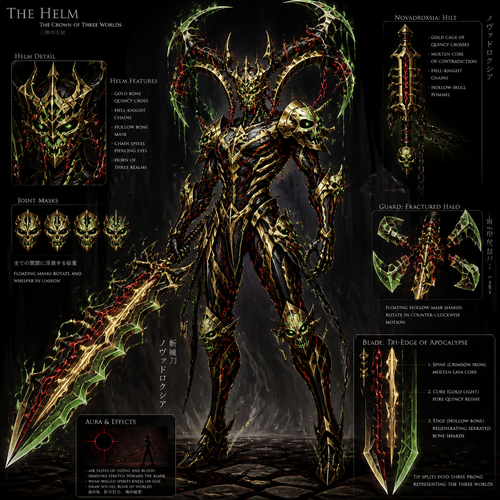
The Helm: The Crown of Three Worlds

The headpiece is a grotesque yet majestic fusion of materials that should never coexist.
   Base Structure: The core of the helm is forged from polished gold bone, smooth and gleaming like ivory but hard as diamond. Interwoven with this bone is molten crimson red iron, flowing like liquid lava but holding a rigid, jagged shape, creating a texture of cooling magma frozen in time.
   The Chains & Veins: Thick, interlocked chains made of the same crimson iron wrap around the helm, digging into the gold bone. These chains are not dead metal; they pulse rhythmically with molten crimson red veins, glowing brightly as if pumping blood through the armor. Embedded within the links of these chains are tiny, screaming skulls, their mouths open in eternal silent agony, rotating slowly as the chains move.
   The Face (The Hollow Visage): Where a human face would be, there is a full Hollow Mask. This mask is a chaotic mosaic:
       Composition: It is constructed from shards of neon green Hollow bone, fragments of gold Quincy crosses, and strips of the molten crimson hell-knight chains.
       Design: An intricate, massive gold Quincy cross dominates the center, its arms reaching out to the very edges of the mask, framing the visage.
       The Eyes: The eye sockets are not empty. They are pierced by thick spikes of molten crimson chains that stab directly through where the eyes should be. These chains branch off upon exiting the sockets, spreading across the cheeks and forehead in complex, vein-like patterns, sealing the gaze in eternal pain.
       Coloration: The rest of the mask surface is a patchwork of neon green bone, glowing with a faint, radioactive luminescence, contrasted sharply by the burning red chains and the holy gold cross.
   The Horns: Rising from the temples are two massive, spiraling horns. They begin as neon green Hollow bone, twist into molten crimson iron, and are bound together by gold filigree. Their shape is complex and predatory: they curve back over the head, sweep sharply to the side, hook forward like scythes, and finally curl up toward the sky, ending in razor-sharp points that drip with ethereal energy.

The Biological Armor

The body of the spirit is encased in armor that appears grown rather than forged, a seamless blend of biology and metallurgy.
   Torso & Limbs: The plating consists of overlapping scales of polished gold bone and crimson iron. Between the plates, you can see the pulsing molten veins throbbing with power, connecting the entire suit into a single living organism.
   Joint Ornamentation: At every major joint—knees, shoulders, hands, and elbows—there are miniature, floating Hollow masks.
       These small masks are a swirl of gold and neon green, constantly shifting expression from serene to enraged.
       They act as protective gauntlets and greaves, rotating independently to deflect attacks. When the spirit moves, these masks whisper in unison, creating a chorus of eerie voices.
   Hands: The fingers end in long, curved claws of blackened steel and bone, crackling with golden Quincy energy and dripping with green Hollow venom
Holding Zanpakutō Novadroxsia:

The Hilt: The Cage of Contradiction

   Structure: The hilt is elongated, designed for two-handed grip but balanced for one. It is constructed from polished gold bone, carved into the shape of interlocking Quincy crosses that form a cage-like structure.
   The Core: Inside this golden cage floats a core of molten crimson iron, glowing intensely hot. It does not burn the holder; instead, it pulses with a rhythmic heat that matches the user's heartbeat.
   Chains: Thick, rusted Hell-knight chains wrap tightly around the grip, biting into the gold bone. These chains are alive, shifting slightly as if trying to constrict the hand holding them, yet they provide an unbreakable purchase.
   Pommel: At the base of the hilt sits a screaming skull made of neon green Hollow bone. Its jaw hangs open, and from within its mouth, a tassel of black reishi hair and crimson chain links dangles, swaying even when there is no wind.

The Guard (Tsuba): The Fractured Halo

   Design: There is no traditional metal guard. Instead, four massive shards of a Hollow mask float independently around the base of the blade, held in place by invisible forces.
   Composition: These shards are a mosaic of neon green bone, gold Quincy filigree, and molten crimson veins.
   Motion: They rotate slowly in a counter-clockwise direction. When the sword is swung, they spin rapidly, creating a high-pitched whistling sound that sounds like distant screaming.
   Detail: Tiny, microscopic skulls are etched into the surface of these floating shards, their eyes glowing with faint green light.

The Blade: The Tri-Edge of Apocalypse

The blade itself is a monstrosity of engineering and biology, defying the laws of physics.
   Shape: It is a massive nodachi (greatsword), nearly as tall as a man. The edge is not straight but jagged, resembling a lightning bolt or a broken chain link pattern.
   The Three Layers: The blade is composed of three distinct layers fused together:
    1.  The Spine: A thick backbone of molten crimson iron, constantly dripping slow-moving lava that hardens instantly upon touching the air, only to melt again. This layer provides immense weight and destructive force.
    2.  The Core: Running down the center is a channel of pure golden light (Quincy Reishi). It hums with a deafening frequency, capable of cutting through spiritual pressure itself. It looks like a beam of solidified sun trapped within the metal.
    3.  The Edge: The cutting surface is formed from shards of neon green Hollow bone. These shards are serrated and constantly regenerate. If chipped, they grow back instantly. They glow with a radioactive, sickly light that corrodes anything they touch.
   The Surface: The flat of the blade is covered in interlocked chains that run the length of the steel. Embedded within these chains are dozens of miniature screaming skulls, their expressions changing based on the mood of the wielder.
   The Tip: The point of the blade splits into three prongs, each representing one aspect: one of gold light, one of red magma, one of green bone. They converge at a single, razor-sharp point that seems to tear holes in reality just by existing.

Special Features & Effects

   The Veins: Pulsing through the entire weapon are molten crimson veins. When you channel spiritual energy (Reiryoku/Reatsu), these veins flare up, turning the entire sword into a beacon of terrifying power.
   The Aura: The sword emits a passive aura. Within 10 feet, the air tastes of ozone and blood. Shadows stretch toward the blade. Weak-willed spirits feel an instinctive urge to kneel or flee.
   Sound: When drawn, it doesn't ring; it roars. The sound is a composite of a Quincy bow snapping, a Hollow screeching, and the grinding of tectonic plates.

The Helm: The Crown of Three Worlds The headpiece is a grotesque yet majestic fusion of materials that should never coexist. Base Structure: The core of the helm is forged from polished gold bone, smooth and gleaming like ivory but hard as diamond. Interwoven with this bone is molten crimson red iron, flowing like liquid lava but holding a rigid, jagged shape, creating a texture of cooling magma frozen in time. The Chains & Veins: Thick, interlocked chains made of the same crimson iron wrap around the helm, digging into the gold bone. These chains are not dead metal; they pulse rhythmically with molten crimson red veins, glowing brightly as if pumping blood through the armor. Embedded within the links of these chains are tiny, screaming skulls, their mouths open in eternal silent agony, rotating slowly as the chains move. The Face (The Hollow Visage): Where a human face would be, there is a full Hollow Mask. This mask is a chaotic mosaic: Composition: It is constructed from shards of neon green Hollow bone, fragments of gold Quincy crosses, and strips of the molten crimson hell-knight chains. Design: An intricate, massive gold Quincy cross dominates the center, its arms reaching out to the very edges of the mask, framing the visage. The Eyes: The eye sockets are not empty. They are pierced by thick spikes of molten crimson chains that stab directly through where the eyes should be. These chains branch off upon exiting the sockets, spreading across the cheeks and forehead in complex, vein-like patterns, sealing the gaze in eternal pain. Coloration: The rest of the mask surface is a patchwork of neon green bone, glowing with a faint, radioactive luminescence, contrasted sharply by the burning red chains and the holy gold cross. The Horns: Rising from the temples are two massive, spiraling horns. They begin as neon green Hollow bone, twist into molten crimson iron, and are bound together by gold filigree. Their shape is complex and predatory: they curve back over the head, sweep sharply to the side, hook forward like scythes, and finally curl up toward the sky, ending in razor-sharp points that drip with ethereal energy. The Biological Armor The body of the spirit is encased in armor that appears grown rather than forged, a seamless blend of biology and metallurgy. Torso & Limbs: The plating consists of overlapping scales of polished gold bone and crimson iron. Between the plates, you can see the pulsing molten veins throbbing with power, connecting the entire suit into a single living organism. Joint Ornamentation: At every major joint—knees, shoulders, hands, and elbows—there are miniature, floating Hollow masks. These small masks are a swirl of gold and neon green, constantly shifting expression from serene to enraged. They act as protective gauntlets and greaves, rotating independently to deflect attacks. When the spirit moves, these masks whisper in unison, creating a chorus of eerie voices. Hands: The fingers end in long, curved claws of blackened steel and bone, crackling with golden Quincy energy and dripping with green Hollow venom Holding Zanpakutō Novadroxsia: The Hilt: The Cage of Contradiction Structure: The hilt is elongated, designed for two-handed grip but balanced for one. It is constructed from polished gold bone, carved into the shape of interlocking Quincy crosses that form a cage-like structure. The Core: Inside this golden cage floats a core of molten crimson iron, glowing intensely hot. It does not burn the holder; instead, it pulses with a rhythmic heat that matches the user's heartbeat. Chains: Thick, rusted Hell-knight chains wrap tightly around the grip, biting into the gold bone. These chains are alive, shifting slightly as if trying to constrict the hand holding them, yet they provide an unbreakable purchase. Pommel: At the base of the hilt sits a screaming skull made of neon green Hollow bone. Its jaw hangs open, and from within its mouth, a tassel of black reishi hair and crimson chain links dangles, swaying even when there is no wind. The Guard (Tsuba): The Fractured Halo Design: There is no traditional metal guard. Instead, four massive shards of a Hollow mask float independently around the base of the blade, held in place by invisible forces. Composition: These shards are a mosaic of neon green bone, gold Quincy filigree, and molten crimson veins. Motion: They rotate slowly in a counter-clockwise direction. When the sword is swung, they spin rapidly, creating a high-pitched whistling sound that sounds like distant screaming. Detail: Tiny, microscopic skulls are etched into the surface of these floating shards, their eyes glowing with faint green light. The Blade: The Tri-Edge of Apocalypse The blade itself is a monstrosity of engineering and biology, defying the laws of physics. Shape: It is a massive nodachi (greatsword), nearly as tall as a man. The edge is not straight but jagged, resembling a lightning bolt or a broken chain link pattern. The Three Layers: The blade is composed of three distinct layers fused together: 1. The Spine: A thick backbone of molten crimson iron, constantly dripping slow-moving lava that hardens instantly upon touching the air, only to melt again. This layer provides immense weight and destructive force. 2. The Core: Running down the center is a channel of pure golden light (Quincy Reishi). It hums with a deafening frequency, capable of cutting through spiritual pressure itself. It looks like a beam of solidified sun trapped within the metal. 3. The Edge: The cutting surface is formed from shards of neon green Hollow bone. These shards are serrated and constantly regenerate. If chipped, they grow back instantly. They glow with a radioactive, sickly light that corrodes anything they touch. The Surface: The flat of the blade is covered in interlocked chains that run the length of the steel. Embedded within these chains are dozens of miniature screaming skulls, their expressions changing based on the mood of the wielder. The Tip: The point of the blade splits into three prongs, each representing one aspect: one of gold light, one of red magma, one of green bone. They converge at a single, razor-sharp point that seems to tear holes in reality just by existing. Special Features & Effects The Veins: Pulsing through the entire weapon are molten crimson veins. When you channel spiritual energy (Reiryoku/Reatsu), these veins flare up, turning the entire sword into a beacon of terrifying power. The Aura: The sword emits a passive aura. Within 10 feet, the air tastes of ozone and blood. Shadows stretch toward the blade. Weak-willed spirits feel an instinctive urge to kneel or flee. Sound: When drawn, it doesn't ring; it roars. The sound is a composite of a Quincy bow snapping, a Hollow screeching, and the grinding of tectonic plates.

The Helm: The Crown of Three Worlds

The headpiece is a grotesque yet majestic fusion of materials that should never coexist.
   Base Structure: The core of the helm is forged from polished gold bone, smooth and gleaming like ivory but hard as diamond. Interwoven with this bone is molten crimson red iron, flowing like liquid lava but holding a rigid, jagged shape, creating a texture of cooling magma frozen in time.
   The Chains & Veins: Thick, interlocked chains made of the same crimson iron wrap around the helm, digging into the gold bone. These chains are not dead metal; they pulse rhythmically with molten crimson red veins, glowing brightly as if pumping blood through the armor. Embedded within the links of these chains are tiny, screaming skulls, their mouths open in eternal silent agony, rotating slowly as the chains move.
   The Face (The Hollow Visage): Where a human face would be, there is a full Hollow Mask. This mask is a chaotic mosaic:
       Composition: It is constructed from shards of neon green Hollow bone, fragments of gold Quincy crosses, and strips of the molten crimson hell-knight chains.
       Design: An intricate, massive gold Quincy cross dominates the center, its arms reaching out to the very edges of the mask, framing the visage.
       The Eyes: The eye sockets are not empty. They are pierced by thick spikes of molten crimson chains that stab directly through where the eyes should be. These chains branch off upon exiting the sockets, spreading across the cheeks and forehead in complex, vein-like patterns, sealing the gaze in eternal pain.
       Coloration: The rest of the mask surface is a patchwork of neon green bone, glowing with a faint, radioactive luminescence, contrasted sharply by the burning red chains and the holy gold cross.
   The Horns: Rising from the temples are two massive, spiraling horns. They begin as neon green Hollow bone, twist into molten crimson iron, and are bound together by gold filigree. Their shape is complex and predatory: they curve back over the head, sweep sharply to the side, hook forward like scythes, and finally curl up toward the sky, ending in razor-sharp points that drip with ethereal energy.

The Biological Armor

The body of the spirit is encased in armor that appears grown rather than forged, a seamless blend of biology and metallurgy.
   Torso & Limbs: The plating consists of overlapping scales of polished gold bone and crimson iron. Between the plates, you can see the pulsing molten veins throbbing with power, connecting the entire suit into a single living organism.
   Joint Ornamentation: At every major joint—knees, shoulders, hands, and elbows—there are miniature, floating Hollow masks.
       These small masks are a swirl of gold and neon green, constantly shifting expression from serene to enraged.
       They act as protective gauntlets and greaves, rotating independently to deflect attacks. When the spirit moves, these masks whisper in unison, creating a chorus of eerie voices.
   Hands: The fingers end in long, curved claws of blackened steel and bone, crackling with golden Quincy energy and dripping with green Hollow venom
Holding Zanpakutō Novadroxsia:

The Hilt: The Cage of Contradiction

   Structure: The hilt is elongated, designed for two-handed grip but balanced for one. It is constructed from polished gold bone, carved into the shape of interlocking Quincy crosses that form a cage-like structure.
   The Core: Inside this golden cage floats a core of molten crimson iron, glowing intensely hot. It does not burn the holder; instead, it pulses with a rhythmic heat that matches the user's heartbeat.
   Chains: Thick, rusted Hell-knight chains wrap tightly around the grip, biting into the gold bone. These chains are alive, shifting slightly as if trying to constrict the hand holding them, yet they provide an unbreakable purchase.
   Pommel: At the base of the hilt sits a screaming skull made of neon green Hollow bone. Its jaw hangs open, and from within its mouth, a tassel of black reishi hair and crimson chain links dangles, swaying even when there is no wind.

The Guard (Tsuba): The Fractured Halo

   Design: There is no traditional metal guard. Instead, four massive shards of a Hollow mask float independently around the base of the blade, held in place by invisible forces.
   Composition: These shards are a mosaic of neon green bone, gold Quincy filigree, and molten crimson veins.
   Motion: They rotate slowly in a counter-clockwise direction. When the sword is swung, they spin rapidly, creating a high-pitched whistling sound that sounds like distant screaming.
   Detail: Tiny, microscopic skulls are etched into the surface of these floating shards, their eyes glowing with faint green light.

The Blade: The Tri-Edge of Apocalypse

The blade itself is a monstrosity of engineering and biology, defying the laws of physics.
   Shape: It is a massive nodachi (greatsword), nearly as tall as a man. The edge is not straight but jagged, resembling a lightning bolt or a broken chain link pattern.
   The Three Layers: The blade is composed of three distinct layers fused together:
    1.  The Spine: A thick backbone of molten crimson iron, constantly dripping slow-moving lava that hardens instantly upon touching the air, only to melt again. This layer provides immense weight and destructive force.
    2.  The Core: Running down the center is a channel of pure golden light (Quincy Reishi). It hums with a deafening frequency, capable of cutting through spiritual pressure itself. It looks like a beam of solidified sun trapped within the metal.
    3.  The Edge: The cutting surface is formed from shards of neon green Hollow bone. These shards are serrated and constantly regenerate. If chipped, they grow back instantly. They glow with a radioactive, sickly light that corrodes anything they touch.
   The Surface: The flat of the blade is covered in interlocked chains that run the length of the steel. Embedded within these chains are dozens of miniature screaming skulls, their expressions changing based on the mood of the wielder.
   The Tip: The point of the blade splits into three prongs, each representing one aspect: one of gold light, one of red magma, one of green bone. They converge at a single, razor-sharp point that seems to tear holes in reality just by existing.

Special Features & Effects

   The Veins: Pulsing through the entire weapon are molten crimson veins. When you channel spiritual energy (Reiryoku/Reatsu), these veins flare up, turning the entire sword into a beacon of terrifying power.
   The Aura: The sword emits a passive aura. Within 10 feet, the air tastes of ozone and blood. Shadows stretch toward the blade. Weak-willed spirits feel an instinctive urge to kneel or flee.
   Sound: When drawn, it doesn't ring; it roars. The sound is a composite of a Quincy bow snapping, a Hollow screeching, and the grinding of tectonic plates.


Make the armor more sleek

The Helm: The Crown of Three Worlds The headpiece is a grotesque yet majestic fusion of materials that should never coexist. Base Structure: The core of the helm is forged from polished gold bone, smooth and gleaming like ivory but hard as diamond. Interwoven with this bone is molten crimson red iron, flowing like liquid lava but holding a rigid, jagged shape, creating a texture of cooling magma frozen in time. The Chains & Veins: Thick, interlocked chains made of the same crimson iron wrap around the helm, digging into the gold bone. These chains are not dead metal; they pulse rhythmically with molten crimson red veins, glowing brightly as if pumping blood through the armor. Embedded within the links of these chains are tiny, screaming skulls, their mouths open in eternal silent agony, rotating slowly as the chains move. The Face (The Hollow Visage): Where a human face would be, there is a full Hollow Mask. This mask is a chaotic mosaic: Composition: It is constructed from shards of neon green Hollow bone, fragments of gold Quincy crosses, and strips of the molten crimson hell-knight chains. Design: An intricate, massive gold Quincy cross dominates the center, its arms reaching out to the very edges of the mask, framing the visage. The Eyes: The eye sockets are not empty. They are pierced by thick spikes of molten crimson chains that stab directly through where the eyes should be. These chains branch off upon exiting the sockets, spreading across the cheeks and forehead in complex, vein-like patterns, sealing the gaze in eternal pain. Coloration: The rest of the mask surface is a patchwork of neon green bone, glowing with a faint, radioactive luminescence, contrasted sharply by the burning red chains and the holy gold cross. The Horns: Rising from the temples are two massive, spiraling horns. They begin as neon green Hollow bone, twist into molten crimson iron, and are bound together by gold filigree. Their shape is complex and predatory: they curve back over the head, sweep sharply to the side, hook forward like scythes, and finally curl up toward the sky, ending in razor-sharp points that drip with ethereal energy. The Biological Armor The body of the spirit is encased in armor that appears grown rather than forged, a seamless blend of biology and metallurgy. Torso & Limbs: The plating consists of overlapping scales of polished gold bone and crimson iron. Between the plates, you can see the pulsing molten veins throbbing with power, connecting the entire suit into a single living organism. Joint Ornamentation: At every major joint—knees, shoulders, hands, and elbows—there are miniature, floating Hollow masks. These small masks are a swirl of gold and neon green, constantly shifting expression from serene to enraged. They act as protective gauntlets and greaves, rotating independently to deflect attacks. When the spirit moves, these masks whisper in unison, creating a chorus of eerie voices. Hands: The fingers end in long, curved claws of blackened steel and bone, crackling with golden Quincy energy and dripping with green Hollow venom Holding Zanpakutō Novadroxsia: The Hilt: The Cage of Contradiction Structure: The hilt is elongated, designed for two-handed grip but balanced for one. It is constructed from polished gold bone, carved into the shape of interlocking Quincy crosses that form a cage-like structure. The Core: Inside this golden cage floats a core of molten crimson iron, glowing intensely hot. It does not burn the holder; instead, it pulses with a rhythmic heat that matches the user's heartbeat. Chains: Thick, rusted Hell-knight chains wrap tightly around the grip, biting into the gold bone. These chains are alive, shifting slightly as if trying to constrict the hand holding them, yet they provide an unbreakable purchase. Pommel: At the base of the hilt sits a screaming skull made of neon green Hollow bone. Its jaw hangs open, and from within its mouth, a tassel of black reishi hair and crimson chain links dangles, swaying even when there is no wind. The Guard (Tsuba): The Fractured Halo Design: There is no traditional metal guard. Instead, four massive shards of a Hollow mask float independently around the base of the blade, held in place by invisible forces. Composition: These shards are a mosaic of neon green bone, gold Quincy filigree, and molten crimson veins. Motion: They rotate slowly in a counter-clockwise direction. When the sword is swung, they spin rapidly, creating a high-pitched whistling sound that sounds like distant screaming. Detail: Tiny, microscopic skulls are etched into the surface of these floating shards, their eyes glowing with faint green light. The Blade: The Tri-Edge of Apocalypse The blade itself is a monstrosity of engineering and biology, defying the laws of physics. Shape: It is a massive nodachi (greatsword), nearly as tall as a man. The edge is not straight but jagged, resembling a lightning bolt or a broken chain link pattern. The Three Layers: The blade is composed of three distinct layers fused together: 1. The Spine: A thick backbone of molten crimson iron, constantly dripping slow-moving lava that hardens instantly upon touching the air, only to melt again. This layer provides immense weight and destructive force. 2. The Core: Running down the center is a channel of pure golden light (Quincy Reishi). It hums with a deafening frequency, capable of cutting through spiritual pressure itself. It looks like a beam of solidified sun trapped within the metal. 3. The Edge: The cutting surface is formed from shards of neon green Hollow bone. These shards are serrated and constantly regenerate. If chipped, they grow back instantly. They glow with a radioactive, sickly light that corrodes anything they touch. The Surface: The flat of the blade is covered in interlocked chains that run the length of the steel. Embedded within these chains are dozens of miniature screaming skulls, their expressions changing based on the mood of the wielder. The Tip: The point of the blade splits into three prongs, each representing one aspect: one of gold light, one of red magma, one of green bone. They converge at a single, razor-sharp point that seems to tear holes in reality just by existing. Special Features & Effects The Veins: Pulsing through the entire weapon are molten crimson veins. When you channel spiritual energy (Reiryoku/Reatsu), these veins flare up, turning the entire sword into a beacon of terrifying power. The Aura: The sword emits a passive aura. Within 10 feet, the air tastes of ozone and blood. Shadows stretch toward the blade. Weak-willed spirits feel an instinctive urge to kneel or flee. Sound: When drawn, it doesn't ring; it roars. The sound is a composite of a Quincy bow snapping, a Hollow screeching, and the grinding of tectonic plates. Make the armor more sleek