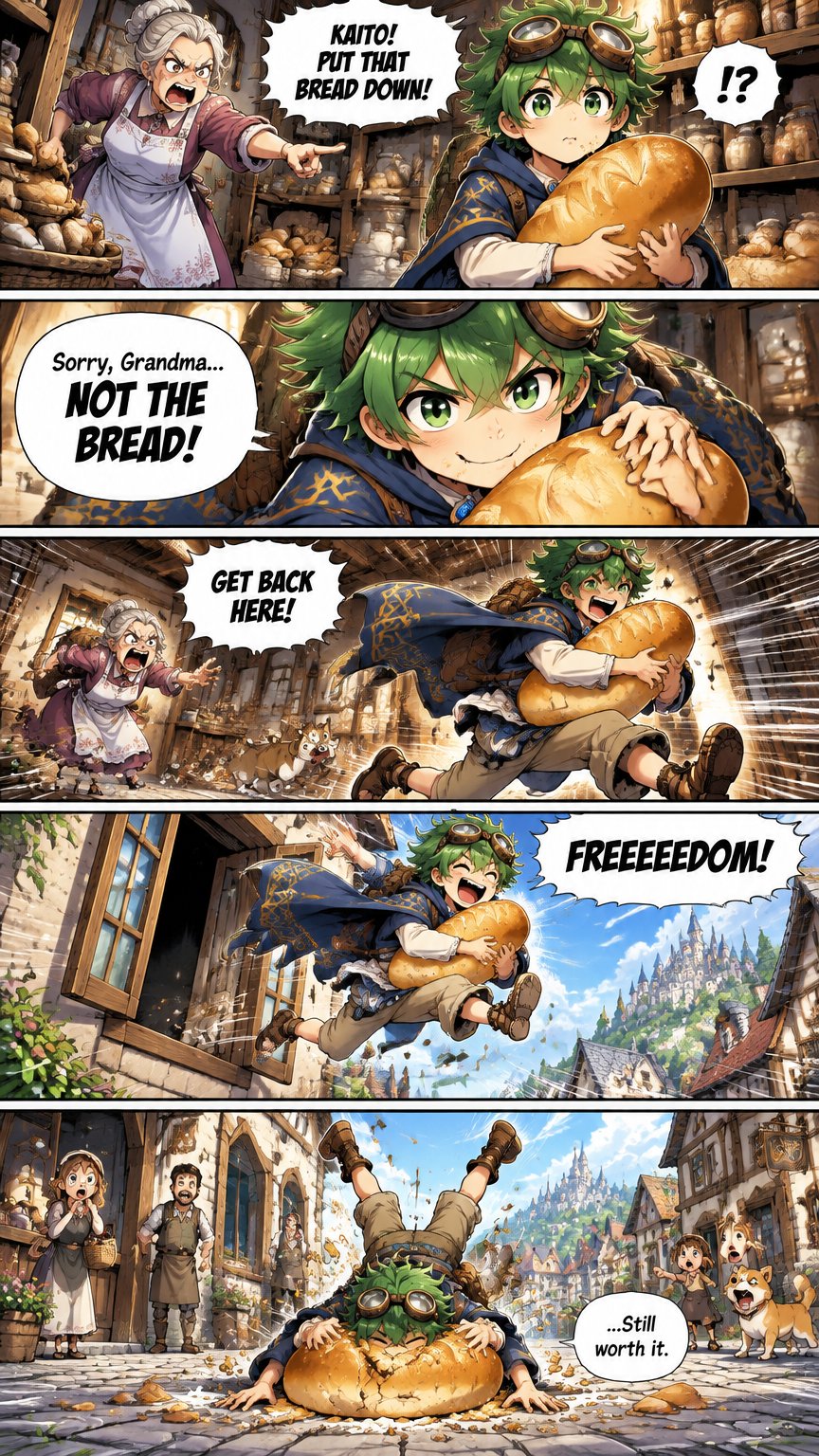
KAITO — EPISODE 1: THE GREAT ESCAPE!

Create a beautiful, full-color Japanese shonen fantasy comedy manga page with 5 dynamic panels.

SETTING:
The same cozy medieval fantasy house, beginning inside the food-filled pantry and ending outside on a sunny village street.

CHARACTER CONSISTENCY:
KAITO: An energetic, innocent 11-year-old boy with messy bright green hair, matching green eyes, bronze explorer goggles on his head, an ornate blue-and-gold poncho, beige trousers, sandals, a brown backpack and a mysterious blue pendant.

GRANDMOTHER: The same elderly woman with white hair tied in a bun, wearing a traditional apron. She is furious but comically expressive.

STORY — FOLLOW THIS EXACT ORDER:

PANEL 1 — THE WARNING:
Grandmother points angrily at Kaito, who is still sitting on the pantry floor holding a huge loaf of bread.

GRANDMOTHER:
"KAITO! PUT THAT BREAD DOWN!"

Kaito looks at her, then at his bread.

PANEL 2 — THE DECISION:
Close-up of Kaito hugging the loaf tightly against his chest, looking determined.

KAITO:
"Sorry, Grandma... NOT THE BREAD!"

PANEL 3 — THE ESCAPE:
Kaito suddenly jumps to his feet and runs through the house at full speed, clutching his bread.

His grandmother chases him, waving her arms.

GRANDMOTHER:
"GET BACK HERE!"

Add exaggerated speed lines and hilarious expressions.

PANEL 4 — THE WINDOW:
Kaito leaps dramatically through an OPEN wooden window into the sunny fantasy village street.

His blue poncho flutters behind him and his backpack bounces.

KAITO:
"FREEEEEDOM!"

Make this panel cinematic and full of movement.

PANEL 5 — THE LANDING:
Kaito loses his balance and lands face-first on his giant loaf of bread in the middle of the village street.

Bread crumbs fly everywhere. His legs stick up comically.

A small speech bubble comes from beneath the bread.

KAITO:
"...Still worth it."

STYLE:
Vibrant full-color Japanese shonen manga, professional comic panel composition, expressive anime faces, dynamic camera angles, beautiful fantasy v

KAITO — EPISODE 1: THE GREAT ESCAPE! Create a beautiful, full-color Japanese shonen fantasy comedy manga page with 5 dynamic panels. SETTING: The same cozy m…

@courageouswerewolf430

More from the community
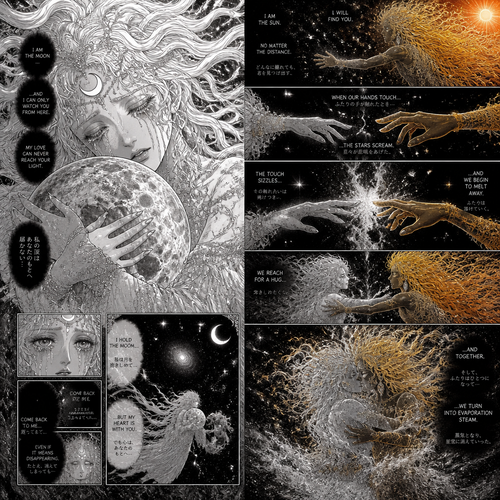
A manga page. With a moon goddess. With long white curly hair. Long white lashes. Which a space background. As tears stream down her cheeks. Her hair blowing and flowing in space. As she hugs the moon. Crying as the sun god far away reaches out for her. He has long yellow and orange gradient hair. Very tan skin. And big crystal earrings. As their hands touch their hands sizzle soon they melt away. Reaching out for a hug. They embrace each other turning into evaporation steam.
A manga page. With a moon goddess. With long white curly hair. Long white lashes. Which a space background. As tears stream down her cheeks. Her hair blowing and flowing in space. As she hugs the moon. Crying as the sun god far away reaches out for her. He has long yellow and orange gradient hair. Very tan skin. And big crystal earrings. As their hands touch their hands sizzle soon they melt away. Reaching out for a hug. They embrace each other turning into evaporation steam.

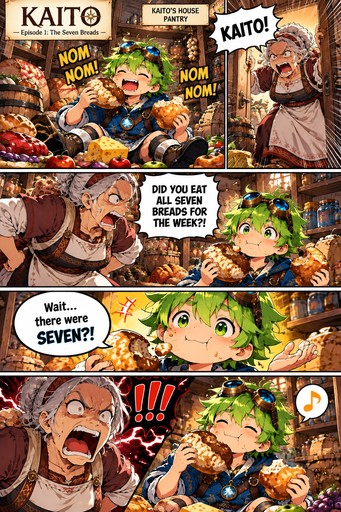
Colorful manga panels show people eating food with comic speech bubbles and expressive action lines.
Colorful manga panels show people eating food with comic speech bubbles and expressive action lines.

KAITO — EPISODE 1: THE GREAT ESCAPE!

Create a beautiful, full-color Japanese shonen fantasy comedy manga page with 5 dynamic panels.

SETTING:
The same cozy medieval fantasy house, beginning inside the food-filled pantry and ending outside on a sunny village street.

CHARACTER CONSISTENCY:
KAITO: An energetic, innocent 11-year-old boy with messy bright green hair, matching green eyes, bronze explorer goggles on his head, an ornate blue-and-gold poncho, beige trousers, sandals, a brown backpack and a mysterious blue pendant.

GRANDMOTHER: The same elderly woman with white hair tied in a bun, wearing a traditional apron. She is furious but comically expressive.

STORY — FOLLOW THIS EXACT ORDER:

PANEL 1 — THE WARNING:
Grandmother points angrily at Kaito, who is still sitting on the pantry floor holding a huge loaf of bread.

GRANDMOTHER:
"KAITO! PUT THAT BREAD DOWN!"

Kaito looks at her, then at his bread.

PANEL 2 — THE DECISION:
Close-up of Kaito hugging the loaf tightly against his chest, looking determined.

KAITO:
"Sorry, Grandma... NOT THE BREAD!"

PANEL 3 — THE ESCAPE:
Kaito suddenly jumps to his feet and runs through the house at full speed, clutching his bread.

His grandmother chases him, waving her arms.

GRANDMOTHER:
"GET BACK HERE!"

Add exaggerated speed lines and hilarious expressions.

PANEL 4 — THE WINDOW:
Kaito leaps dramatically through an OPEN wooden window into the sunny fantasy village street.

His blue poncho flutters behind him and his backpack bounces.

KAITO:
"FREEEEEDOM!"

Make this panel cinematic and full of movement.

PANEL 5 — THE LANDING:
Kaito loses his balance and lands face-first on his giant loaf of bread in the middle of the village street.

Bread crumbs fly everywhere. His legs stick up comically.

A small speech bubble comes from beneath the bread.

KAITO:
"...Still worth it."

STYLE:
Vibrant full-color Japanese shonen manga, professional comic panel composition, expressive anime faces, dynamic camera angles, beautiful fantasy v
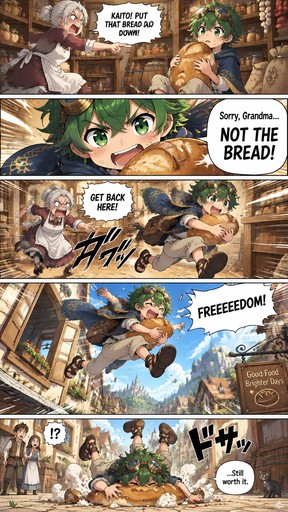
KAITO — EPISODE 1: THE GREAT ESCAPE! Create a beautiful, full-color Japanese shonen fantasy comedy manga page with 5 dynamic panels. SETTING: The same cozy medieval fantasy house, beginning inside the food-filled pantry and ending outside on a sunny village street. CHARACTER CONSISTENCY: KAITO: An energetic, innocent 11-year-old boy with messy bright green hair, matching green eyes, bronze explorer goggles on his head, an ornate blue-and-gold poncho, beige trousers, sandals, a brown backpack and a mysterious blue pendant. GRANDMOTHER: The same elderly woman with white hair tied in a bun, wearing a traditional apron. She is furious but comically expressive. STORY — FOLLOW THIS EXACT ORDER: PANEL 1 — THE WARNING: Grandmother points angrily at Kaito, who is still sitting on the pantry floor holding a huge loaf of bread. GRANDMOTHER: "KAITO! PUT THAT BREAD DOWN!" Kaito looks at her, then at his bread. PANEL 2 — THE DECISION: Close-up of Kaito hugging the loaf tightly against his chest, looking determined. KAITO: "Sorry, Grandma... NOT THE BREAD!" PANEL 3 — THE ESCAPE: Kaito suddenly jumps to his feet and runs through the house at full speed, clutching his bread. His grandmother chases him, waving her arms. GRANDMOTHER: "GET BACK HERE!" Add exaggerated speed lines and hilarious expressions. PANEL 4 — THE WINDOW: Kaito leaps dramatically through an OPEN wooden window into the sunny fantasy village street. His blue poncho flutters behind him and his backpack bounces. KAITO: "FREEEEEDOM!" Make this panel cinematic and full of movement. PANEL 5 — THE LANDING: Kaito loses his balance and lands face-first on his giant loaf of bread in the middle of the village street. Bread crumbs fly everywhere. His legs stick up comically. A small speech bubble comes from beneath the bread. KAITO: "...Still worth it." STYLE: Vibrant full-color Japanese shonen manga, professional comic panel composition, expressive anime faces, dynamic camera angles, beautiful fantasy v
KAITO — EPISODE 1: THE GREAT ESCAPE!

Create a beautiful, full-color Japanese shonen fantasy comedy manga page with 5 dynamic panels.

SETTING:
The same cozy medieval fantasy house, beginning inside the food-filled pantry and ending outside on a sunny village street.

CHARACTER CONSISTENCY:
KAITO: An energetic, innocent 11-year-old boy with messy bright green hair, matching green eyes, bronze explorer goggles on his head, an ornate blue-and-gold poncho, beige trousers, sandals, a brown backpack and a mysterious blue pendant.

GRANDMOTHER: The same elderly woman with white hair tied in a bun, wearing a traditional apron. She is furious but comically expressive.

STORY — FOLLOW THIS EXACT ORDER:

PANEL 1 — THE WARNING:
Grandmother points angrily at Kaito, who is still sitting on the pantry floor holding a huge loaf of bread.

GRANDMOTHER:
"KAITO! PUT THAT BREAD DOWN!"

Kaito looks at her, then at his bread.

PANEL 2 — THE DECISION:
Close-up of Kaito hugging the loaf tightly against his chest, looking determined.

KAITO:
"Sorry, Grandma... NOT THE BREAD!"

PANEL 3 — THE ESCAPE:
Kaito suddenly jumps to his feet and runs through the house at full speed, clutching his bread.

His grandmother chases him, waving her arms.

GRANDMOTHER:
"GET BACK HERE!"

Add exaggerated speed lines and hilarious expressions.

PANEL 4 — THE WINDOW:
Kaito leaps dramatically through an OPEN wooden window into the sunny fantasy village street.

His blue poncho flutters behind him and his backpack bounces.

KAITO:
"FREEEEEDOM!"

Make this panel cinematic and full of movement.

PANEL 5 — THE LANDING:
Kaito loses his balance and lands face-first on his giant loaf of bread in the middle of the village street.

Bread crumbs fly everywhere. His legs stick up comically.

A small speech bubble comes from beneath the bread.

KAITO:
"...Still worth it."

STYLE:
Vibrant full-color Japanese shonen manga, professional comic panel composition, expressive anime faces, dynamic camera angles, beautiful fantasy v

KAITO — EPISODE 1: THE GREAT ESCAPE! Create a beautiful, full-color Japanese shonen fantasy comedy manga page with 5 dynamic panels. SETTING: The same cozy medieval fantasy house, beginning inside the food-filled pantry and ending outside on a sunny village street. CHARACTER CONSISTENCY: KAITO: An energetic, innocent 11-year-old boy with messy bright green hair, matching green eyes, bronze explorer goggles on his head, an ornate blue-and-gold poncho, beige trousers, sandals, a brown backpack and a mysterious blue pendant. GRANDMOTHER: The same elderly woman with white hair tied in a bun, wearing a traditional apron. She is furious but comically expressive. STORY — FOLLOW THIS EXACT ORDER: PANEL 1 — THE WARNING: Grandmother points angrily at Kaito, who is still sitting on the pantry floor holding a huge loaf of bread. GRANDMOTHER: "KAITO! PUT THAT BREAD DOWN!" Kaito looks at her, then at his bread. PANEL 2 — THE DECISION: Close-up of Kaito hugging the loaf tightly against his chest, looking determined. KAITO: "Sorry, Grandma... NOT THE BREAD!" PANEL 3 — THE ESCAPE: Kaito suddenly jumps to his feet and runs through the house at full speed, clutching his bread. His grandmother chases him, waving her arms. GRANDMOTHER: "GET BACK HERE!" Add exaggerated speed lines and hilarious expressions. PANEL 4 — THE WINDOW: Kaito leaps dramatically through an OPEN wooden window into the sunny fantasy village street. His blue poncho flutters behind him and his backpack bounces. KAITO: "FREEEEEDOM!" Make this panel cinematic and full of movement. PANEL 5 — THE LANDING: Kaito loses his balance and lands face-first on his giant loaf of bread in the middle of the village street. Bread crumbs fly everywhere. His legs stick up comically. A small speech bubble comes from beneath the bread. KAITO: "...Still worth it." STYLE: Vibrant full-color Japanese shonen manga, professional comic panel composition, expressive anime faces, dynamic camera angles, beautiful fantasy v

DRAGON STRIKERS

PAGE 4 — THE QUESTION

FORMAT: Japanese black-and-white manga page, read from right to left. Five panels. Detailed ink work, screentones, cinematic framing, and expressive character art.

CHARACTER CONSISTENCY — SORA AMAMIYA

Use the supplied Sora Amamiya reference sheet as the definitive visual reference.

* Age: 17.
* Height: 178 cm.
* Build: slim and athletic.
* Hair: messy, layered jet-black hair with sharp, irregular spikes and uneven bangs.
* Eyes: sharp, light-grey eyes with dark pupils.
* Face: youthful, defined features and sharp eyebrows.
* Outfit: fitted black high-collar jacket with silver buttons, dark shirt, black trousers, black belt with a rectangular silver buckle, and black lace-up combat boots.
* Hands: white bandages wrapped around both wrists and partially over the hands.

Maintain his exact hairstyle, facial structure, clothing, proportions, and wrist wraps in every panel. Do not add weapons, powers, clan symbols, or accessories.

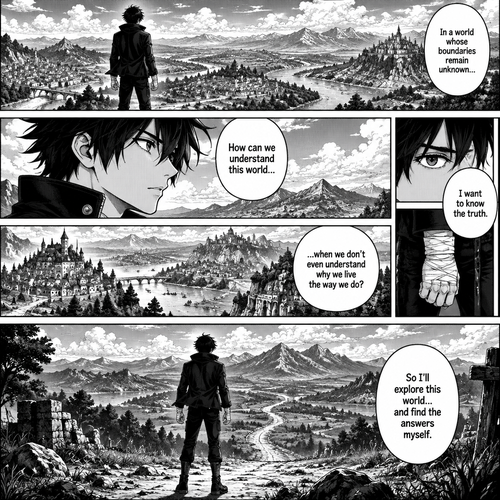
PANEL 1 — THE LONE FIGURE

Layout: Wide horizontal panel across the top.

Camera: Rear three-quarter view, medium-wide shot.

Scene: Sora stands at a high overlook above an enormous landscape. Mountain ranges stretch toward the horizon, rivers wind through distant valleys, and clouds cast shadows over the land.

His black jacket and spiky hair are clearly recognizable. His hands rest naturally by his sides.

Narration:
“In a world whose boundaries remain unknown…”

PANEL 2 — THE QUESTION

Layout: Medium close-up.

Camera: Side profile of Sora, looking toward the distant horizon.

His light-grey eyes are visible beneath his uneven bangs. His expression is serious and thoughtful, without exaggerated emotion.

Sora’s dialogue:
“How can we understand this world…”

PANEL 3 — THE CLANS

Layout: Wide panel.

Camera: A distant view of several different settlements separated by mountains, rivers, and enormous stretches of land.

Do not depict named clans, clan emblems, specific leaders, or invented customs. Show only the vastness and variety of civilization.

Sora’s dialogue:
”…when we don’t even understand why we live the way we do?”

PANEL 4 — THE DECISION

Layout: Narrow vertical panel.

Camera: Close-up of Sora’s eyes, followed by a small view of his bandaged hand resting beside his jacket.

His gaze becomes more focused. Keep the expression subtle and believable.

Sora’s dialogue:
“I want to know the truth.”

PANEL 5 — THE JOURNEY

Layout: Large bottom panel with dramatic perspective.

Camera: Rear view of Sora facing a long road that disappears into the distant mountains.

His silhouette stands against the enormous landscape. Use strong black shadows in the foreground and lighter screentones toward the horizon.

Do not show Hugurumi, chains, supernatural effects, or any other characters.

Sora’s dialogue:
“So I’ll explore this world… and find the answers myself.”

FINAL ART DIRECTION

The page should feel quiet, serious, and mysterious. Sora is not posing heroically or fighting anyone. This is the moment the reader understands why he wants to explore.

Keep every line of dialogue exactly as written. Use clear, legible lettering and traditional black-and-white manga shading. Preserve Sora’s reference design throughout.
DRAGON STRIKERS PAGE 4 — THE QUESTION FORMAT: Japanese black-and-white manga page, read from right to left. Five panels. Detailed ink work, screentones, cinematic framing, and expressive character art. CHARACTER CONSISTENCY — SORA AMAMIYA Use the supplied Sora Amamiya reference sheet as the definitive visual reference. * Age: 17. * Height: 178 cm. * Build: slim and athletic. * Hair: messy, layered jet-black hair with sharp, irregular spikes and uneven bangs. * Eyes: sharp, light-grey eyes with dark pupils. * Face: youthful, defined features and sharp eyebrows. * Outfit: fitted black high-collar jacket with silver buttons, dark shirt, black trousers, black belt with a rectangular silver buckle, and black lace-up combat boots. * Hands: white bandages wrapped around both wrists and partially over the hands. Maintain his exact hairstyle, facial structure, clothing, proportions, and wrist wraps in every panel. Do not add weapons, powers, clan symbols, or accessories. PANEL 1 — THE LONE FIGURE Layout: Wide horizontal panel across the top. Camera: Rear three-quarter view, medium-wide shot. Scene: Sora stands at a high overlook above an enormous landscape. Mountain ranges stretch toward the horizon, rivers wind through distant valleys, and clouds cast shadows over the land. His black jacket and spiky hair are clearly recognizable. His hands rest naturally by his sides. Narration: “In a world whose boundaries remain unknown…” PANEL 2 — THE QUESTION Layout: Medium close-up. Camera: Side profile of Sora, looking toward the distant horizon. His light-grey eyes are visible beneath his uneven bangs. His expression is serious and thoughtful, without exaggerated emotion. Sora’s dialogue: “How can we understand this world…” PANEL 3 — THE CLANS Layout: Wide panel. Camera: A distant view of several different settlements separated by mountains, rivers, and enormous stretches of land. Do not depict named clans, clan emblems, specific leaders, or invented customs. Show only the vastness and variety of civilization. Sora’s dialogue: ”…when we don’t even understand why we live the way we do?” PANEL 4 — THE DECISION Layout: Narrow vertical panel. Camera: Close-up of Sora’s eyes, followed by a small view of his bandaged hand resting beside his jacket. His gaze becomes more focused. Keep the expression subtle and believable. Sora’s dialogue: “I want to know the truth.” PANEL 5 — THE JOURNEY Layout: Large bottom panel with dramatic perspective. Camera: Rear view of Sora facing a long road that disappears into the distant mountains. His silhouette stands against the enormous landscape. Use strong black shadows in the foreground and lighter screentones toward the horizon. Do not show Hugurumi, chains, supernatural effects, or any other characters. Sora’s dialogue: “So I’ll explore this world… and find the answers myself.” FINAL ART DIRECTION The page should feel quiet, serious, and mysterious. Sora is not posing heroically or fighting anyone. This is the moment the reader understands why he wants to explore. Keep every line of dialogue exactly as written. Use clear, legible lettering and traditional black-and-white manga shading. Preserve Sora’s reference design throughout.

DRAGON STRIKERS

PAGE 7 — THE ENTRANCE OF ABYSS-HORROR

FORMAT: One complete portrait-oriented Japanese manga page, black-and-white, dark fantasy atmosphere, detailed ink work, dramatic shadows, screentones, and cinematic environmental art. Use five clearly separated panels with readable text.

CHARACTER CONSISTENCY — SORA AMAMIYA

Use the supplied Sora Amamiya character reference sheet as the definitive visual reference.

* Age: 17.
* Height: 178 cm.
* Build: Slim and athletic.
* Hair: Messy, layered jet-black hair with sharp, irregular spikes and uneven bangs.
* Eyes: Sharp, light-grey eyes with dark pupils.
* Face: Youthful, defined facial features and sharp eyebrows.
* Outfit: Fitted black high-collar jacket with silver buttons, dark shirt, black trousers, black belt with a rectangular silver buckle, and black lace-up combat boots.
* Wrists: White bandages wrapped around both wrists and partially over both hands.
* Bag: One dark travel bag carried by Sora.

Keep his hairstyle, eyes, face, proportions, clothing, wrist wraps, and bag consistent in every panel. Do not change his outfit or add weapons, clan symbols, or accessories.

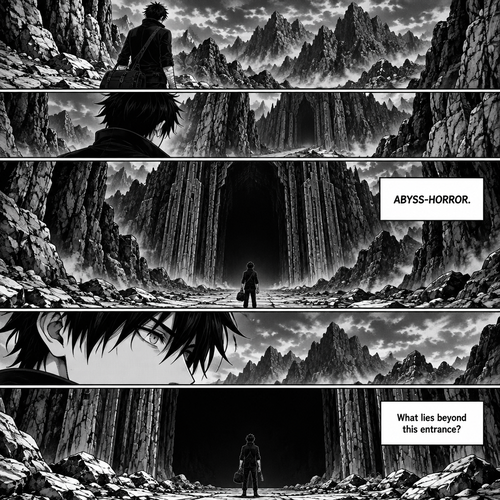
PANEL 1 — THE ROAD ENDS

Layout: Wide horizontal panel across the top.

Camera: Rear view of Sora standing on a rocky path.

Scene: The winding road has led Sora into a remote, rugged landscape. Jagged cliffs rise on either side, and dark clouds gather above distant mountains. The familiar open scenery from the previous pages gradually gives way to harsher terrain.

Sora stands in the foreground, holding his travel bag and looking ahead.

No other characters are present.

PANEL 2 — SOMETHING AHEAD

Layout: Narrow horizontal panel.

Camera: Over-the-shoulder view from behind Sora.

Scene: Far ahead, between towering dark rock formations, an enormous entrance is visible. It appears carved into the landscape, surrounded by steep cliffs and deep shadows.

The entrance is so distant that its inner details cannot be seen. Do not show anything living inside it.

Sora is looking directly toward the entrance.

PANEL 3 — THE ENTRANCE OF ABYSS-HORROR

Layout: Large central panel occupying the middle of the page.

Camera: Extreme wide shot from behind Sora, emphasizing the scale of the entrance.

Scene: A colossal, ominous gateway stands between immense rock walls. The ground leading toward it is uneven and barren. Dense black shadows fill the opening, concealing whatever lies beyond.

Use sharp rock textures, heavy ink blacks, and thin white highlights along the edges of the cliffs. The entrance should feel ancient, imposing, and deeply unsettling.

Sora appears small in the foreground, making the gateway look enormous.

NARRATION BOX:
“ABYSS-HORROR.”

Make the name clear and correctly spelled.

PANEL 4 — SORA’S REACTION

Layout: Close-up panel.

Camera: Side profile of Sora’s face.

Scene: His sharp, light-grey eyes remain fixed on the entrance. His black bangs fall naturally across his forehead. His expression is serious and attentive.

Do not give him an exaggerated terrified expression. He is observing the entrance, and his exact emotions beyond that are left open.

No dialogue.

PANEL 5 — BEYOND THE GATE

Layout: Wide final panel across the bottom of the page.

Camera: Distant rear view of Sora facing the enormous entrance.

Scene: Sora stands before the dark opening, his travel bag at his side. The towering rock walls rise around him, and the entrance disappears into complete darkness.

The darkness must conceal the interior. Show no monsters, silhouettes, chains, supernatural beings, or hidden characters.

Use a strong contrast between Sora’s black silhouette, the pale rock highlights, and the pitch-black entrance.

NARRATION BOX:
“What lies beyond this entrance?”

FINAL ART DIRECTION

Maintain continuity with Page 6. Use the same Sora reference design and the same black-and-white manga style as all previous pages.

The scene should establish the entrance of Abyss-Horror as a mysterious destination. Do not invent its inhabitants, history, powers, traps, symbols, or internal geography.

Do not show Hugurumi.

Keep all narration legible and correctly spelled. Do not add any extra dialogue or text.

DRAGON STRIKERS PAGE 7 — THE ENTRANCE OF ABYSS-HORROR FORMAT: One complete portrait-oriented Japanese manga page, black-and-white, dark fantasy atmosphere, detailed ink work, dramatic shadows, screentones, and cinematic environmental art. Use five clearly separated panels with readable text. CHARACTER CONSISTENCY — SORA AMAMIYA Use the supplied Sora Amamiya character reference sheet as the definitive visual reference. * Age: 17. * Height: 178 cm. * Build: Slim and athletic. * Hair: Messy, layered jet-black hair with sharp, irregular spikes and uneven bangs. * Eyes: Sharp, light-grey eyes with dark pupils. * Face: Youthful, defined facial features and sharp eyebrows. * Outfit: Fitted black high-collar jacket with silver buttons, dark shirt, black trousers, black belt with a rectangular silver buckle, and black lace-up combat boots. * Wrists: White bandages wrapped around both wrists and partially over both hands. * Bag: One dark travel bag carried by Sora. Keep his hairstyle, eyes, face, proportions, clothing, wrist wraps, and bag consistent in every panel. Do not change his outfit or add weapons, clan symbols, or accessories. PANEL 1 — THE ROAD ENDS Layout: Wide horizontal panel across the top. Camera: Rear view of Sora standing on a rocky path. Scene: The winding road has led Sora into a remote, rugged landscape. Jagged cliffs rise on either side, and dark clouds gather above distant mountains. The familiar open scenery from the previous pages gradually gives way to harsher terrain. Sora stands in the foreground, holding his travel bag and looking ahead. No other characters are present. PANEL 2 — SOMETHING AHEAD Layout: Narrow horizontal panel. Camera: Over-the-shoulder view from behind Sora. Scene: Far ahead, between towering dark rock formations, an enormous entrance is visible. It appears carved into the landscape, surrounded by steep cliffs and deep shadows. The entrance is so distant that its inner details cannot be seen. Do not show anything living inside it. Sora is looking directly toward the entrance. PANEL 3 — THE ENTRANCE OF ABYSS-HORROR Layout: Large central panel occupying the middle of the page. Camera: Extreme wide shot from behind Sora, emphasizing the scale of the entrance. Scene: A colossal, ominous gateway stands between immense rock walls. The ground leading toward it is uneven and barren. Dense black shadows fill the opening, concealing whatever lies beyond. Use sharp rock textures, heavy ink blacks, and thin white highlights along the edges of the cliffs. The entrance should feel ancient, imposing, and deeply unsettling. Sora appears small in the foreground, making the gateway look enormous. NARRATION BOX: “ABYSS-HORROR.” Make the name clear and correctly spelled. PANEL 4 — SORA’S REACTION Layout: Close-up panel. Camera: Side profile of Sora’s face. Scene: His sharp, light-grey eyes remain fixed on the entrance. His black bangs fall naturally across his forehead. His expression is serious and attentive. Do not give him an exaggerated terrified expression. He is observing the entrance, and his exact emotions beyond that are left open. No dialogue. PANEL 5 — BEYOND THE GATE Layout: Wide final panel across the bottom of the page. Camera: Distant rear view of Sora facing the enormous entrance. Scene: Sora stands before the dark opening, his travel bag at his side. The towering rock walls rise around him, and the entrance disappears into complete darkness. The darkness must conceal the interior. Show no monsters, silhouettes, chains, supernatural beings, or hidden characters. Use a strong contrast between Sora’s black silhouette, the pale rock highlights, and the pitch-black entrance. NARRATION BOX: “What lies beyond this entrance?” FINAL ART DIRECTION Maintain continuity with Page 6. Use the same Sora reference design and the same black-and-white manga style as all previous pages. The scene should establish the entrance of Abyss-Horror as a mysterious destination. Do not invent its inhabitants, history, powers, traps, symbols, or internal geography. Do not show Hugurumi. Keep all narration legible and correctly spelled. Do not add any extra dialogue or text.
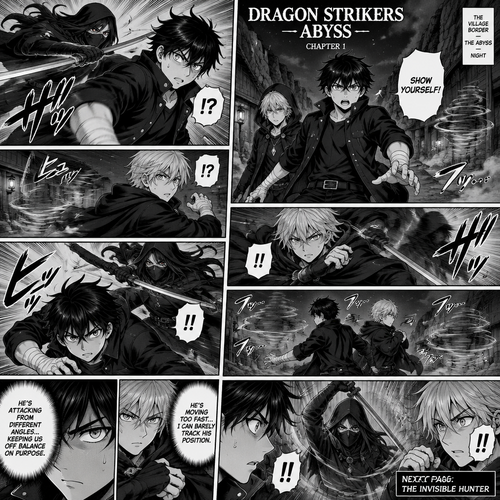
DRAGON STRIKERS — ABYSS — CHAPTER 1
NEXT PAGE: THE INVISIBLE HUNTER

Create a dramatic black-and-white Japanese manga page with dynamic panel layouts, sharp ink lines, detailed shadows, cinematic perspective, and intense action. Keep character designs perfectly consistent across every panel. Read right to left.

SORA AMAMIYA: 17-year-old Japanese boy, slim athletic build, messy layered jet-black hair with sharp spikes and uneven bangs, sharp light-grey eyes, black high-collar jacket with silver buttons over a dark shirt, black trousers, black belt with rectangular silver buckle, black combat boots, white bandages around both wrists and partially over both hands, dark travel bag. No scars, no clan symbols.

REI MIKAZUKI: Japanese boy with soft layered silver hair, cool blue-grey eyes, black hooded cloak with subtle blue accents over dark layered clothing, black trousers and boots, blue crystal pendant on a silver chain.

THE ASSASSIN: Tall, lean figure with long straight charcoal-black hair, narrow crimson eyes, black mask covering the lower half of the face, fitted black combat outfit, black gloves, dark trousers, black boots, long black hooded cloak, dark-metal sword at the waist. Has the ability to turn invisible.

SETTING: An almost deserted village border in the Abyss at night. Rocky ground, towering cliffs, wooden buildings, dim lanterns, deep shadows, and drifting mist. No crowds.

PANEL 1: Sora stands in front of Rei, scanning the darkness after shouting, “SHOW YOURSELF!” A faint distortion ripples through the air behind them.

PANEL 2: The assassin suddenly becomes visible for a split second on Sora’s left and launches a fast sword strike. Sora twists away just in time, startled by how quickly the attacker appeared.

PANEL 3: Before Sora can counterattack, the assassin vanishes. A sharp gust of air passes behind Rei. Rei turns abruptly, raising his arm to defend himself.

PANEL 4: Rei narrowly evades another surprise strike from the opposite direction. The assassin’s dark silhouette flickers at the edge of the panel before disappearing again. Rei’s expression changes from shock to intense concentration.

PANEL 5: Sora rushes to help Rei, but the assassin reappears behind Sora. Sora senses the movement at the last instant and ducks. The dark-metal blade cuts through empty air above him.

PANEL 6: Sora and Rei stand back-to-back, trying to watch every direction. The assassin is nowhere to be seen. Show several faint distortions in the air around them, suggesting the attacker is moving too quickly for them to track.

PANEL 7: Close-up of Sora’s narrowed eyes as he realizes their opponent is deliberately attacking from different angles to keep them off balance. Rei grips his cloak and watches the surrounding shadows.

PANEL 8 — CLIFFHANGER: A barely visible distortion forms directly between Sora and Rei. Both begin turning toward it, but the assassin is already emerging with their sword raised. Sora’s eyes widen as he realizes they may not react in time.

ART DIRECTION: Pure black-and-white manga, strong contrast, speed lines, varied panel sizes, dramatic close-ups, realistic movement, atmospheric shadows, clear character anatomy, consistent clothing and faces. Make the assassin’s invisibility readable through subtle air distortions and brief silhouette glimpses. Intense action without graphic injuries. No extra characters, no colour, no unrelated scenes.
DRAGON STRIKERS — ABYSS — CHAPTER 1 NEXT PAGE: THE INVISIBLE HUNTER Create a dramatic black-and-white Japanese manga page with dynamic panel layouts, sharp ink lines, detailed shadows, cinematic perspective, and intense action. Keep character designs perfectly consistent across every panel. Read right to left. SORA AMAMIYA: 17-year-old Japanese boy, slim athletic build, messy layered jet-black hair with sharp spikes and uneven bangs, sharp light-grey eyes, black high-collar jacket with silver buttons over a dark shirt, black trousers, black belt with rectangular silver buckle, black combat boots, white bandages around both wrists and partially over both hands, dark travel bag. No scars, no clan symbols. REI MIKAZUKI: Japanese boy with soft layered silver hair, cool blue-grey eyes, black hooded cloak with subtle blue accents over dark layered clothing, black trousers and boots, blue crystal pendant on a silver chain. THE ASSASSIN: Tall, lean figure with long straight charcoal-black hair, narrow crimson eyes, black mask covering the lower half of the face, fitted black combat outfit, black gloves, dark trousers, black boots, long black hooded cloak, dark-metal sword at the waist. Has the ability to turn invisible. SETTING: An almost deserted village border in the Abyss at night. Rocky ground, towering cliffs, wooden buildings, dim lanterns, deep shadows, and drifting mist. No crowds. PANEL 1: Sora stands in front of Rei, scanning the darkness after shouting, “SHOW YOURSELF!” A faint distortion ripples through the air behind them. PANEL 2: The assassin suddenly becomes visible for a split second on Sora’s left and launches a fast sword strike. Sora twists away just in time, startled by how quickly the attacker appeared. PANEL 3: Before Sora can counterattack, the assassin vanishes. A sharp gust of air passes behind Rei. Rei turns abruptly, raising his arm to defend himself. PANEL 4: Rei narrowly evades another surprise strike from the opposite direction. The assassin’s dark silhouette flickers at the edge of the panel before disappearing again. Rei’s expression changes from shock to intense concentration. PANEL 5: Sora rushes to help Rei, but the assassin reappears behind Sora. Sora senses the movement at the last instant and ducks. The dark-metal blade cuts through empty air above him. PANEL 6: Sora and Rei stand back-to-back, trying to watch every direction. The assassin is nowhere to be seen. Show several faint distortions in the air around them, suggesting the attacker is moving too quickly for them to track. PANEL 7: Close-up of Sora’s narrowed eyes as he realizes their opponent is deliberately attacking from different angles to keep them off balance. Rei grips his cloak and watches the surrounding shadows. PANEL 8 — CLIFFHANGER: A barely visible distortion forms directly between Sora and Rei. Both begin turning toward it, but the assassin is already emerging with their sword raised. Sora’s eyes widen as he realizes they may not react in time. ART DIRECTION: Pure black-and-white manga, strong contrast, speed lines, varied panel sizes, dramatic close-ups, realistic movement, atmospheric shadows, clear character anatomy, consistent clothing and faces. Make the assassin’s invisibility readable through subtle air distortions and brief silhouette glimpses. Intense action without graphic injuries. No extra characters, no colour, no unrelated scenes.

DRAGON STRIKERS

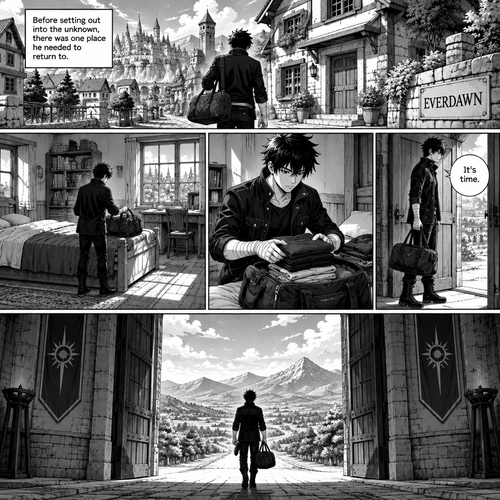
PAGE 5 — DEPARTURE FROM EVERDAWN

FORMAT: One complete black-and-white Japanese manga page, portrait orientation, cinematic panel layout, detailed backgrounds, clean ink lines, high-contrast shadows, and screentones.

CHARACTER CONSISTENCY — SORA AMAMIYA

Use the previously supplied Sora Amamiya character reference sheet as the definitive reference.

* Age: 17
* Height: 178 cm
* Build: Slim and athletic
* Hair: Messy, layered jet-black hair with sharp, irregular spikes and uneven bangs.
* Eyes: Sharp, light-grey eyes with dark pupils.
* Face: Youthful, defined features and serious eyebrows.
* Outfit: Fitted black high-collar jacket with silver buttons, dark shirt, black trousers, black belt with rectangular silver buckle, and black lace-up combat boots.
* Wrists: White bandages wrapped around both wrists and partially over his hands.

Keep his face, hairstyle, proportions, outfit, and wrist wraps consistent in every panel.

PANEL 1 — RETURNING HOME

Layout: Wide horizontal panel at the top.

Camera: Rear three-quarter view of Sora walking toward his home.

Scene: Show Everdawn as a peaceful settlement beneath an expansive sky. Buildings line the streets, and warm sunlight falls across rooftops and stone pathways. The architecture should feel distinct and memorable, with detailed windows, rooftops, balconies, and distant towers.

Sora walks toward a modest-looking home. His black jacket, spiky hair, and bandaged wrists should match the reference sheet.

NARRATION:
“Before setting out into the unknown, there was one place he needed to return to.”

PANEL 2 — INSIDE HIS HOME

Layout: Medium rectangular panel.

Camera: Interior view from a corner of Sora’s room.

Scene: Show a tidy, lived-in room with a bed, a desk, shelves, and a window overlooking Everdawn. Sunlight enters through the window, casting long shadows across the floor.

Sora stands beside an open travel bag, preparing to pack.

Keep the room detailed but uncluttered. Do not introduce photographs, letters, family members, weapons, or personal mementos unless specifically requested.

PANEL 3 — PACKING

Layout: Medium close-up.

Camera: Three-quarter view of Sora placing folded clothes into his travel bag.

Scene: The open bag rests on the bed. Several neatly folded garments are visible inside. Sora’s bandaged hands handle the clothes carefully.

Show the black jacket, trousers, and wrist wraps consistently. His expression is calm and focused.

No supernatural effects or weapons.

PANEL 4 — READY TO LEAVE

Layout: Narrow vertical panel.

Camera: Full-body side view.

Scene: Sora stands near the doorway with his packed travel bag. His black high-collar jacket, dark trousers, boots, and white wrist wraps are clearly visible.

He glances toward the open doorway, where the light from outside illuminates part of his face.

His expression conveys quiet determination.

SORA:
“It’s time.”

PANEL 5 — THE GATE OF EVERDAWN

Layout: The largest panel on the page, occupying the entire bottom section.

Camera: Dramatic wide shot from behind Sora, looking outward through the enormous gate.

Scene: Sora has reached the grand gate of Everdawn. Tall stone pillars and elaborate architectural details frame the entrance. Beyond the gate, a vast road stretches into the distant landscape, surrounded by hills and mountains.

Sora stands at the threshold with his travel bag, facing the world beyond Everdawn.

The settlement remains behind him. The open road lies ahead.

Use heavy black shadows around the gate’s inner walls, contrasting with the lighter landscape outside. Make Sora’s silhouette unmistakable.

No Hugurumi. No other characters. No action scene. No supernatural effects.

The final panel must clearly show Sora leaving Everdawn through its gate, beginning his journey into the unknown.

FINAL ART DIRECTION

Maintain the same black-and-white manga style as Pages 1–4. Use clear panel borders, readable lettering, detailed environments, and consistent character proportions.

The page should communicate one simple event: Sora returns home, packs clothes, prepares himself, and leaves Everdawn.

Do not add new lore, characters, family details, or plot events beyond this description.

DRAGON STRIKERS PAGE 5 — DEPARTURE FROM EVERDAWN FORMAT: One complete black-and-white Japanese manga page, portrait orientation, cinematic panel layout, detailed backgrounds, clean ink lines, high-contrast shadows, and screentones. CHARACTER CONSISTENCY — SORA AMAMIYA Use the previously supplied Sora Amamiya character reference sheet as the definitive reference. * Age: 17 * Height: 178 cm * Build: Slim and athletic * Hair: Messy, layered jet-black hair with sharp, irregular spikes and uneven bangs. * Eyes: Sharp, light-grey eyes with dark pupils. * Face: Youthful, defined features and serious eyebrows. * Outfit: Fitted black high-collar jacket with silver buttons, dark shirt, black trousers, black belt with rectangular silver buckle, and black lace-up combat boots. * Wrists: White bandages wrapped around both wrists and partially over his hands. Keep his face, hairstyle, proportions, outfit, and wrist wraps consistent in every panel. PANEL 1 — RETURNING HOME Layout: Wide horizontal panel at the top. Camera: Rear three-quarter view of Sora walking toward his home. Scene: Show Everdawn as a peaceful settlement beneath an expansive sky. Buildings line the streets, and warm sunlight falls across rooftops and stone pathways. The architecture should feel distinct and memorable, with detailed windows, rooftops, balconies, and distant towers. Sora walks toward a modest-looking home. His black jacket, spiky hair, and bandaged wrists should match the reference sheet. NARRATION: “Before setting out into the unknown, there was one place he needed to return to.” PANEL 2 — INSIDE HIS HOME Layout: Medium rectangular panel. Camera: Interior view from a corner of Sora’s room. Scene: Show a tidy, lived-in room with a bed, a desk, shelves, and a window overlooking Everdawn. Sunlight enters through the window, casting long shadows across the floor. Sora stands beside an open travel bag, preparing to pack. Keep the room detailed but uncluttered. Do not introduce photographs, letters, family members, weapons, or personal mementos unless specifically requested. PANEL 3 — PACKING Layout: Medium close-up. Camera: Three-quarter view of Sora placing folded clothes into his travel bag. Scene: The open bag rests on the bed. Several neatly folded garments are visible inside. Sora’s bandaged hands handle the clothes carefully. Show the black jacket, trousers, and wrist wraps consistently. His expression is calm and focused. No supernatural effects or weapons. PANEL 4 — READY TO LEAVE Layout: Narrow vertical panel. Camera: Full-body side view. Scene: Sora stands near the doorway with his packed travel bag. His black high-collar jacket, dark trousers, boots, and white wrist wraps are clearly visible. He glances toward the open doorway, where the light from outside illuminates part of his face. His expression conveys quiet determination. SORA: “It’s time.” PANEL 5 — THE GATE OF EVERDAWN Layout: The largest panel on the page, occupying the entire bottom section. Camera: Dramatic wide shot from behind Sora, looking outward through the enormous gate. Scene: Sora has reached the grand gate of Everdawn. Tall stone pillars and elaborate architectural details frame the entrance. Beyond the gate, a vast road stretches into the distant landscape, surrounded by hills and mountains. Sora stands at the threshold with his travel bag, facing the world beyond Everdawn. The settlement remains behind him. The open road lies ahead. Use heavy black shadows around the gate’s inner walls, contrasting with the lighter landscape outside. Make Sora’s silhouette unmistakable. No Hugurumi. No other characters. No action scene. No supernatural effects. The final panel must clearly show Sora leaving Everdawn through its gate, beginning his journey into the unknown. FINAL ART DIRECTION Maintain the same black-and-white manga style as Pages 1–4. Use clear panel borders, readable lettering, detailed environments, and consistent character proportions. The page should communicate one simple event: Sora returns home, packs clothes, prepares himself, and leaves Everdawn. Do not add new lore, characters, family details, or plot events beyond this description.

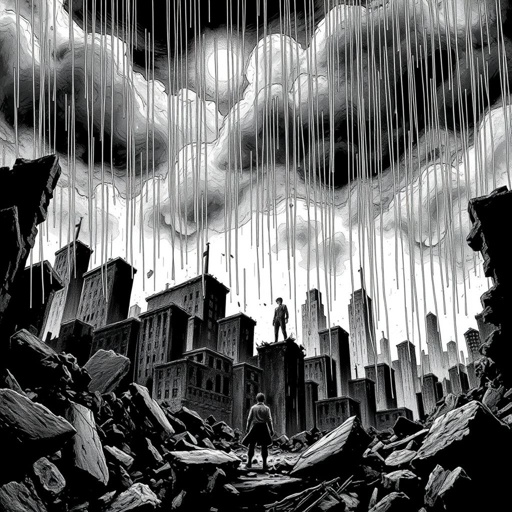
a title page that says beanie boys the curses choosing and there are 3 teenagers in beanie's below it and for the background it has beanie's all over the page

a title page that says beanie boys the curses choosing and there are 3 teenagers in beanie's below it and for the background it has beanie's all over the page

a title page that says beanie boys the curses choosing and there are 3 teenagers in beanie's below it and for the background it has beanie's all over the page and can YOU Make it look more not ai
a title page that says beanie boys the curses choosing and there are 3 teenagers in beanie's below it and for the background it has beanie's all over the page and can YOU Make it look more not ai

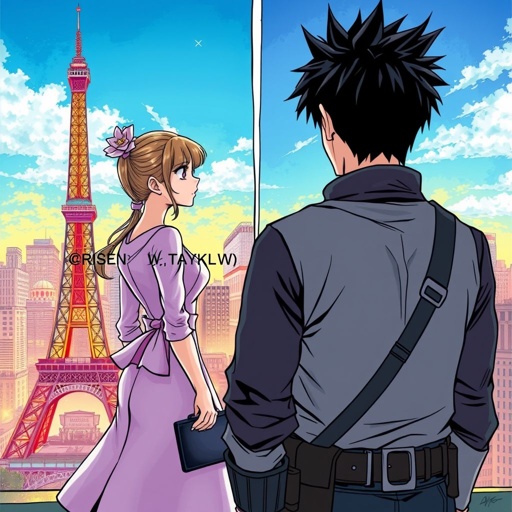
Panel 1 (Full Page): Dark clouds loom over a ruined city. Rain pours relentlessly over collapsed buildings. Narration (Top): “In a world where truth has drowned in fear… hope always rises from the ashes.”
Panel 1 (Full Page): Dark clouds loom over a ruined city. Rain pours relentlessly over collapsed buildings. Narration (Top): “In a world where truth has drowned in fear… hope always rises from the ashes.”

Siblings that are separated from each other since Japan had killer villains and the girl didn’t have powers so they sent her away to Paris

Siblings that are separated from each other since Japan had killer villains and the girl didn’t have powers so they sent her away to Paris