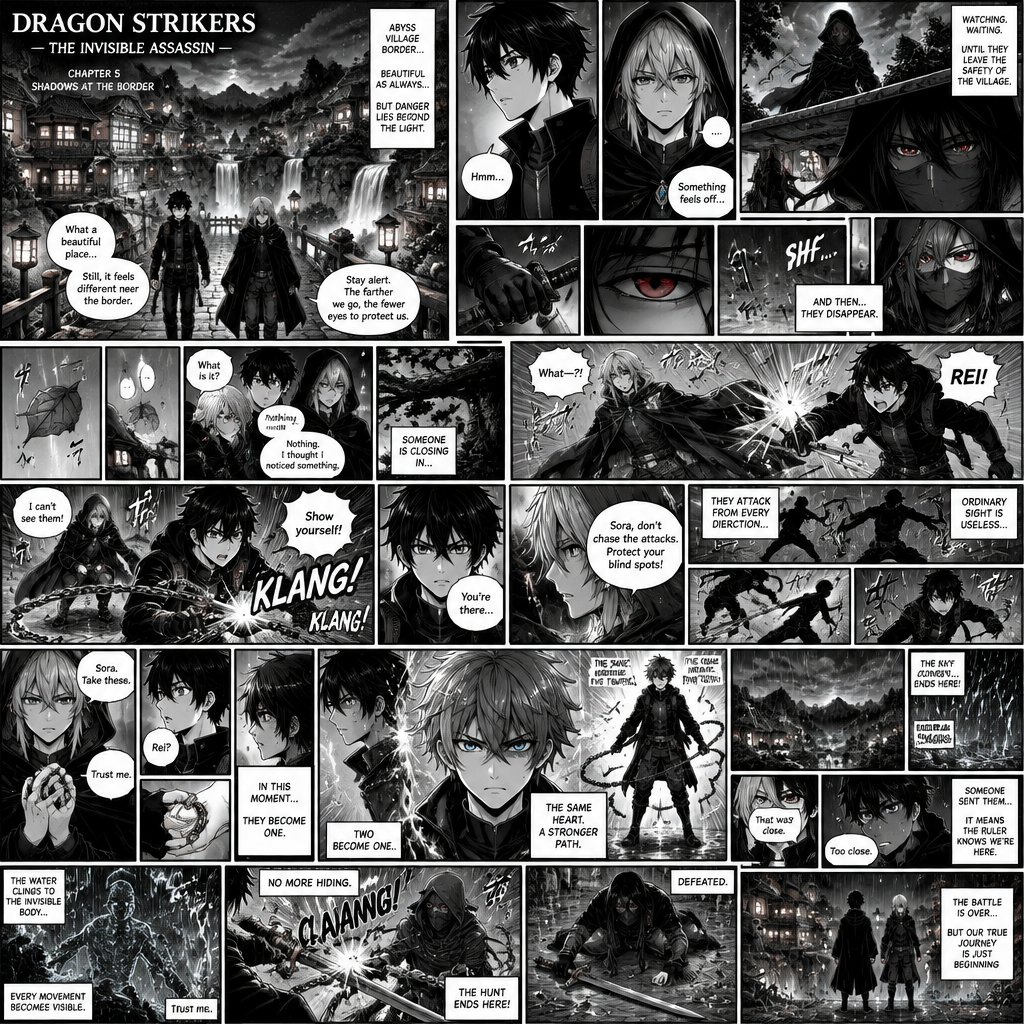
DRAGON STRIKERS — THE INVISIBLE ASSASSIN

Ultra-Detailed Manga Creation Prompt

Create a professional, cinematic Japanese shōnen manga chapter featuring Sora Amamiya and Rei Mikazuki fighting a mysterious invisible assassin near the border of the Abyss village. The scene must feel like a genuine, carefully illustrated manga created by a passionate fan who deeply understands the characters, their personalities, and the established story. Prioritize accurate character designs, suspense, emotional reactions, readable action choreography, expressive faces, dramatic black-and-white manga shading, and continuity between panels.

Do not rush the fight. Build tension gradually, make the invisible assassin genuinely frightening, and let Sora and Rei win through observation, teamwork, and their established fusion rather than random power-ups.

1. MANGA ART STYLE AND PRESENTATION

Use a polished Japanese shōnen manga art style with:

* Clean, confident black ink linework.
* Detailed hair strands, folds in clothing, facial expressions, and environmental textures.
* Strong black-and-white contrast with deep blacks, screentones, cross-hatching, and dramatic shadows.
* Dynamic perspective during combat, including low-angle shots, close-ups, tilted compositions, and wide establishing panels.
* Speed lines, impact lines, atmospheric particles, and carefully placed sound effects.
* Detailed backgrounds that remain readable without overwhelming the characters.
* Emotionally expressive eyes and faces.
* Large panels for important revelations and decisive moments.
* Small panels for sudden movements, changes in expression, and moments of silence.

Every panel must connect logically to the previous one. Keep character positions, clothing, weapons, bracelets, and injuries consistent. Action should be understandable even without dialogue.

Use a traditional manga reading direction, right to left, with clear panel borders and no confusing layouts.

2. CHARACTER DESIGN — SORA AMAMIYA

Sora Amamiya (空 雨宮) is a 17-year-old clanless protagonist, approximately 178 cm tall, with a slim athletic build.

His appearance must remain consistent throughout every panel:

* Messy, layered jet-black hair with sharp, irregular spikes and uneven bangs.
* Sharp light-grey eyes with dark pupils.
* A youthful but defined face.
* A fitted black high-collar jacket with silver buttons.
* A dark shirt underneath.
* Black trousers, a black belt with a rectangular silver buckle, and black lace-up combat boots.
* White bandages wrapped around both wrists and partially covering both hands.
* A dark travel bag, if he is still carrying it in the scene.

Do not add scars, tattoos, clan markings, or unexplained accessories.

Personality and expression: Sora is curious, courageous, stubborn, and quick to react when his friends are in danger. He is not an emotionless fighting machine. Show his alertness, frustration, surprise, and determination through his eyes, posture, and facial expressions.

During the fight, his black hair should move naturally with his movements. His jacket and bandages must react to his dashes and defensive movements. His eyes should remain light grey unless the established scene specifically calls for a change.

3. CHARACTER DESIGN — REI MIKAZUKI

Rei Mikazuki (零 三日月) has a calm, mysterious presence and acts as Sora’s guide through the Abyss.

His appearance must remain consistent:

* Soft, layered silver hair.
* Cool blue-grey eyes.
* A composed, observant expression.
* A black hooded cloak with subtle blue accents.
* Dark layered clothing beneath the cloak.
* Black trousers and black boots.
* A blue crystal pendant hanging from a silver chain.

His cloak should move dramatically during combat, revealing glimpses of his dark clothing. His silver hair should be clearly distinguishable from Sora’s black hair in every panel.

Personality and expression: Rei is perceptive, restrained, and composed under pressure. He watches his surroundings carefully and reacts decisively when danger appears. His calm expression can change into genuine shock when the invisible assassin attacks.

Do not portray Rei as weak, foolish, or constantly dependent on Sora. He is an experienced guide who contributes meaningfully to the battle.

4. CHARACTER DESIGN — THE INVISIBLE ASSASSIN

The assassin is a tall, lean, mysterious combatant who works for the ruler of the Abyss.

Maintain these visual details:

* Long, straight charcoal-black hair.
* Narrow crimson eyes.
* A black mask covering the lower half of the face.
* A fitted black combat outfit.
* Black gloves and dark trousers.
* Black boots.
* A long black hooded cloak.
* A dark-metal sword worn at the waist.

The assassin can become invisible. When invisible, the entire body, clothing, mask, hair, and sword must disappear. Do not show a transparent human silhouette that makes the ability useless.

Instead, suggest the assassin’s location through subtle environmental clues: disturbed dust, displaced leaves, shifting fabric, faint air distortion, and the reactions of Sora and Rei.

When the assassin becomes visible, restore the complete established design. The crimson eyes should feel intimidating, and the mask should conceal most facial expression.

The assassin should move with precision and patience rather than attacking randomly. Their movements should feel controlled, efficient, and difficult to predict.

5. SETTING — THE ABYSS VILLAGE BORDER

The battle takes place near the border of the beautiful hidden village in the Abyss.

Establish the environment with a wide opening panel:

* Wooden houses and lantern-lit paths in the distance.
* Narrow wooden bridges crossing streams.
* Waterfalls flowing down cliffs.
* Mist drifting between rock formations.
* Trees, scattered leaves, and uneven stone paths.
* A visible path leading away from the village toward the wilderness.
* The village border feeling quiet, isolated, and slightly ominous.

The beauty of the setting should contrast with the danger about to unfold.

Use the environment throughout the fight. Leaves should move when someone dashes past. Water should ripple when the characters land. Dust should rise from hard impacts. The ground should show believable marks from footwork.

As the fight progresses, clouds gather and rain begins to fall. The rain is essential to the resolution of the battle: water droplets will eventually reveal the invisible assassin’s position.

Do not introduce unrelated enemies, new powers, or additional characters.

6. OPENING — THE LAST MOMENTS OF PEACE

Begin with a wide panel of Sora and Rei walking toward the village border after their exploration.

Sora walks slightly ahead, looking around with curiosity. Rei follows nearby, his cloak moving gently in the wind.

The atmosphere is peaceful. The village is visible behind them, with distant lanterns and wooden rooftops.

Include a medium panel of Sora looking toward the path ahead, followed by a close-up of Rei’s observant eyes.

Rei notices something unusual.

He does not immediately announce that an assassin is present because he cannot yet identify the threat. He subtly turns his head, studying the surrounding trees and rooftops.

Cut to a distant rooftop behind them.

The assassin stands motionless beneath the hood, watching them. The face is partly hidden in shadow. The crimson eyes are the most visible feature.

Use a narrow, silent panel for the assassin’s eyes.

Then return to Sora and Rei, who continue walking without realizing they are being followed.

The suspense must come from the reader knowing that something is wrong while the characters remain unaware.

7. THE ASSASSIN DISAPPEARS

Show the assassin standing at the village border, watching Sora and Rei move farther away from the crowded village.

In a sequence of three small panels, show:

1. The assassin’s gloved hand moving toward the sword at their waist.
2. A close-up of the crimson eyes narrowing.
3. The assassin’s body disappearing completely.

The background remains unchanged, but the assassin is no longer visible.

Do not show a glowing transformation or an obvious magical aura. The disappearance should be sudden and unsettling.

Cut to Sora and Rei walking along the path.

A leaf drifts downward between them.

The leaf suddenly changes direction as if something unseen has passed nearby.

Rei pauses.

Rei: “…”

He looks toward the trees.

Sora notices him stopping.

Sora: “What is it?”

Rei scans the path, the rooftops, and the spaces between the trees.

Rei: “Nothing. I thought I noticed something.”

He continues walking, but his posture becomes more alert.

Behind them, show a narrow panel of a branch bending slightly beneath an invisible foot.

The assassin is closing the distance.

8. THE FIRST ATTACK — REI IS AMBUSHED

The attack must happen suddenly.

Show Rei walking beside Sora when an invisible attacker strikes from his blind side.

A sharp motion line cuts across the panel.

Rei’s eyes widen as he senses the attack only at the last possible moment.

Rei: “What—?!”

The impact sends him stumbling away from his original position. His cloak whips violently through the air.

Sora immediately turns.

Sora: “REI!”

Use a large, dramatic panel showing Sora rushing toward Rei while the attacker remains completely invisible.

Rei regains his footing and looks around, searching for the source of the attack.

Rei: “I can’t see them!”

Sora positions himself between Rei and the direction of the strike.

His expression changes from surprise to fierce concentration.

Sora: “Show yourself!”

The response is silence.

A narrow panel shows Sora’s fingers tightening inside his bandaged hands.

Another shows Rei looking in the opposite direction, trying to predict where the attacker might appear.

The assassin strikes again from an unexpected angle.

Sora moves to defend Rei, but the invisible opponent changes direction at the last instant.

The fight should establish that ordinary sight is useless against this enemy.

9. SORA’S CHAIN DEFENSE

Sora realizes that shouting at the assassin will not help.

He focuses on protecting himself and Rei, watching the environment for signs of movement.

He summons his established chain power to defend against the next attack.

Show dark chains appearing around Sora’s arms and extending into the space ahead of him. Their metal links should be clearly defined, with strong highlights against the dark background.

An invisible strike collides with the chains.

SFX: KLANG!

Sora’s eyes widen slightly as the impact reveals that the enemy is physically present.

He twists his body, redirecting the strike away from Rei.

The invisible assassin withdraws immediately.

Show a close-up of Sora’s light-grey eyes narrowing.

Sora: “You’re there…”

He cannot see the assassin, but he now knows that the attacks can be blocked.

Rei watches the chains carefully, understanding what Sora has discovered.

Rei: “Sora, don’t chase the attacks. Protect your blind spots!”

Sora adjusts his stance.

The next few panels show the assassin attempting attacks from different directions. Sora uses his chains to intercept the strikes, while Rei watches the surroundings and tries to predict the next attack.

Make the choreography clear:

* Sora blocks an incoming strike.
* The attacker withdraws before Sora can counterattack.
* Sora turns to cover Rei’s position.
* The assassin changes direction again.
* Rei realizes that neither of them can reliably track the opponent visually.

The assassin should feel dangerous because they control the timing of the fight, not because Sora and Rei suddenly become incompetent.

10. REI’S DECISION — THE BRACELETS

The fight reaches a stalemate.

Sora is defending against the invisible assassin, but he cannot land a decisive counterattack. Rei recognizes that their current approach is insufficient.

Show Rei watching Sora with a serious expression.

The wind blows his silver hair across his face. His blue crystal pendant catches a faint glint of light.

Rei looks down at the bracelets he wears.

Use a close-up of his hand moving toward them.

His expression remains composed, but his eyes show determination.

He removes his bracelets and passes them to Sora.

Rei: “Sora. Take these.”

Sora turns toward him, momentarily confused.

Sora: “Rei?”

Rei holds his gaze.

Rei: “Trust me.”

Do not add an explanation of the bracelets’ origin or invent a new ability. Their established role in this scene is to trigger the fusion between Sora and Rei.

Sora understands that Rei has a plan.

He takes the bracelets.

For one silent panel, their hands meet around the bracelets while the invisible assassin prepares to attack again in the background.

The contrast between the quiet handoff and the ongoing danger should make this moment feel important.

11. THE FUSION — SORA AND REI BECOME ONE

The instant Sora takes the bracelets, the fusion begins.

This must be a major visual moment, deserving a full-page spread or a large central panel surrounded by smaller reaction panels.

Begin with a close-up of the bracelets in Sora’s hand.

A sudden surge of energy spreads through the space around both characters.

Their clothing and hair are pulled by the force of the fusion. The ground beneath their feet reacts to the pressure.

Do not transform them into two separate fighters standing side by side. They become one fused character.

Fused appearance — essential accuracy:

* The fused character’s hair is grey, combining Sora’s black hair and Rei’s silver hair.
* The eyes are dark blue and black, combining visual elements of both characters.
* The overall appearance should feel like a balanced fusion of Sora and Rei, approximately 50/50.
* The fused character retains the recognizable design language of both original characters without simply placing one character’s head on the other’s body.
* Use a unified outfit design derived from their existing dark clothing, preserving the established black-and-blue visual identity.
* Do not introduce a new name, unexplained costume, extra limbs, or unrelated abilities.

Use several panels to show the fusion forming:

1. Sora gripping the bracelets.
2. Rei’s silver hair and Sora’s black hair sweeping into the energy.
3. Their silhouettes merging into one.
4. A close-up of the fused character’s dark blue-black eyes opening.
5. A final full-body reveal.

The fused character stands in the center of the path, perfectly balanced and ready to fight.

For a brief moment, everything becomes silent.

Then the invisible assassin attacks.

12. THE FUSED FIGHTER TAKES CONTROL

The fused character reacts faster and more effectively than Sora and Rei could separately.

Do not make the fusion win instantly. The assassin remains skilled and dangerous.

The fused fighter senses the attack through its movement and blocks with the chains.

SFX: KRAAANG!

The assassin retreats.

The fused fighter follows with a controlled counterattack, forcing the invisible opponent to dodge.

Show the sequence through clear, connected panels:

* The fused fighter blocks an attack from the side.
* A chain sweeps across the path, forcing the assassin to move.
* The fused fighter pivots and launches a second attack.
* The assassin evades it by disappearing into the surrounding space.
* The fused fighter pauses, realizing that the assassin can still evade direct targeting.

The fused fighter’s expression should be focused and composed. Their movements combine Sora’s courage and aggressive instincts with Rei’s precision and observation.

The assassin begins to lose control of the fight’s rhythm.

However, the fusion still cannot reliably locate the invisible enemy.

The battle reaches another tense pause.

13. THE WEATHER CHANGES

Clouds gather above the village border.

Start with a wide panel showing the sky darkening over the cliffs and wooden rooftops.

A distant rumble of thunder echoes through the valley.

The fused fighter looks upward briefly.

The first raindrop falls onto the stone path.

Then another.

Soon, rain begins to fall steadily.

Show the rain striking:

* The wooden bridge.
* The leaves of nearby trees.
* The fused fighter’s grey hair.
* The dark chains.
* The empty space where the assassin is moving.

The rain should not immediately solve the fight. Build the realization slowly.

The invisible assassin moves in for another attack.

A raindrop falls through the air.

Then another.

Several droplets suddenly change direction and scatter around a point in empty space.

The fused fighter notices.

Use a close-up of the dark blue-black eyes focusing on the disturbed rain.

The assassin has moved through the falling water.

The invisible body is still unseen, but the rain is revealing its position.

14. THE INVISIBILITY IS COUNTERED

The rain becomes heavier.

The assassin attempts to move around the fused fighter, but water droplets strike the invisible body and cling to its outline.

At first, show only scattered droplets suspended in the air.

Then gradually reveal more of the assassin’s position:

* Water runs down an unseen shoulder.
* Droplets trace the outline of an arm.
* The rain splashes against an invisible torso.
* Water falls from the edges of the assassin’s cloak.
* Footsteps disturb puddles along the stone path.

Do not suddenly turn the assassin into a glowing transparent figure. The water itself reveals where the body is.

The fused fighter turns toward the disturbed rain.

Fused fighter: “There!”

The assassin realizes that their invisibility is no longer enough.

For the first time, the opponent’s movements become readable.

The assassin tries to change direction quickly, but the rain follows the movement and exposes the new position.

Use a dramatic panel in which the fused fighter stands in the foreground while the assassin’s location is outlined by falling water in the background.

The assassin’s crimson eyes become visible for a brief instant through the droplets.

15. THE FINAL EXCHANGE

The fused fighter launches a decisive attack.

The assassin attempts to evade, but the rain reveals the movement before the strike can connect.

The fused fighter redirects the chains toward the exposed position.

The assassin blocks with the dark-metal sword.

SFX: CLAAANG!

Water explodes outward from the collision.

The assassin is forced backward, boots scraping across the wet stone.

The fused fighter continues pressing forward, using controlled chain movements to restrict the assassin’s escape routes.

Keep the action readable and consistent:

* The chains force the assassin away from the trees.
* The rain reveals every sudden movement.
* The assassin attempts one final evasive maneuver.
* The fused fighter anticipates the movement and blocks the escape route.
* A final, carefully composed counterattack defeats the assassin.

Show the assassin falling onto the wet stone path, their cloak spread around them. Their invisibility ends, revealing the established full character design.

Do not add graphic injury details. The defeat should be communicated through posture, the fallen sword, and the assassin’s inability to continue fighting.

The rain continues to fall around the two figures.

The fused fighter stands over the defeated assassin, breathing steadily.

16. THE QUIET AFTERMATH

The action ends.

The rain softens.

The fused fighter looks down at the bracelets, then at their own hands, processing what just happened.

The fusion ends, returning Sora and Rei to their original separate forms. Preserve their original hairstyles, eye colors, clothes, and accessories accurately.

Sora looks at Rei.

Sora: “That was close.”

Rei looks toward the defeated assassin, then back at Sora.

Rei: “Too close.”

Show them standing side by side in the rain, tired but alert.

Sora glances toward the village and realizes that the assassin was sent by someone with power over the Abyss.

His expression becomes serious.

Rei’s gaze hardens as he remembers the truth they discovered about the ruler.

Neither character should suddenly explain the entire mystery to the reader. Let their expressions and the silence convey that this fight has revealed something larger.

Finish with a wide panel of Sora and Rei standing at the village border, with the defeated assassin behind them and the distant village visible through the rain.

The atmosphere should communicate that the battle is over, but their adventure is only beginning.

17. FINAL QUALITY REQUIREMENTS

* Keep Sora’s jet-black hair and light-grey eyes accurate before the fusion.
* Keep Rei’s silver hair, blue-grey eyes, black cloak with subtle blue accents, and blue crystal pendant accurate before the fusion.
* During fusion, use grey hair and dark blue-black eyes.
* Preserve the assassin’s charcoal-black hair, crimson eyes, black mask, dark combat clothing, hooded cloak, gloves, boots, and sword whenever visible.
* The assassin must be genuinely invisible until environmental clues reveal their position.
* Rain must be the decisive environmental factor that exposes the assassin.
* The bracelets trigger the fusion; do not invent a different fusion mechanism.
* The fused character is one person, not two people standing together.
* Maintain consistent character proportions, clothing, geography, and movement between panels.
* Do not introduce new characters, new lore, unexplained powers, or an alternate ending.
* Do not skip the ambush, the defensive struggle, the bracelet handoff, the fusion, the rain revelation, or the aftermath.
* Make every major emotional beat visually clear.
* Give the fight enough panels to feel like a full, memorable manga sequence rather than a short summary.

Overall goal: Create a suspenseful, emotionally engaging, visually coherent shōnen manga fight that feels faithful to Dragon Strikers. The reader should experience the terror of an enemy they cannot see, the trust between Sora and Rei, the spectacle of their fusion, and the satisfaction of seeing the rain turn the assassin’s greatest advantage into a weakness.

DRAGON STRIKERS — THE INVISIBLE ASSASSIN Ultra-Detailed Manga Creation Prompt Create a professional, cinematic Japanese shōnen manga chapter featuring Sora A…

@sharpkraken196

More from the community
DRAGON STRIKERS — THE INVISIBLE ASSASSIN

Ultra-Detailed Manga Creation Prompt

Create a professional, cinematic Japanese shōnen manga chapter featuring Sora Amamiya and Rei Mikazuki fighting a mysterious invisible assassin near the border of the Abyss village. The scene must feel like a genuine, carefully illustrated manga created by a passionate fan who deeply understands the characters, their personalities, and the established story. Prioritize accurate character designs, suspense, emotional reactions, readable action choreography, expressive faces, dramatic black-and-white manga shading, and continuity between panels.

Do not rush the fight. Build tension gradually, make the invisible assassin genuinely frightening, and let Sora and Rei win through observation, teamwork, and their established fusion rather than random power-ups.

1. MANGA ART STYLE AND PRESENTATION

Use a polished Japanese shōnen manga art style with:

* Clean, confident black ink linework.
* Detailed hair strands, folds in clothing, facial expressions, and environmental textures.
* Strong black-and-white contrast with deep blacks, screentones, cross-hatching, and dramatic shadows.
* Dynamic perspective during combat, including low-angle shots, close-ups, tilted compositions, and wide establishing panels.
* Speed lines, impact lines, atmospheric particles, and carefully placed sound effects.
* Detailed backgrounds that remain readable without overwhelming the characters.
* Emotionally expressive eyes and faces.
* Large panels for important revelations and decisive moments.
* Small panels for sudden movements, changes in expression, and moments of silence.

Every panel must connect logically to the previous one. Keep character positions, clothing, weapons, bracelets, and injuries consistent. Action should be understandable even without dialogue.

Use a traditional manga reading direction, right to left, with clear panel borders and no confusing layouts.

2. CHARACTER DESIGN — SORA AMAMIYA

Sora Amamiya (空 雨宮) is a 17-year-old clanless protagonist, approximately 178 cm tall, with a slim athletic build.

His appearance must remain consistent throughout every panel:

* Messy, layered jet-black hair with sharp, irregular spikes and uneven bangs.
* Sharp light-grey eyes with dark pupils.
* A youthful but defined face.
* A fitted black high-collar jacket with silver buttons.
* A dark shirt underneath.
* Black trousers, a black belt with a rectangular silver buckle, and black lace-up combat boots.
* White bandages wrapped around both wrists and partially covering both hands.
* A dark travel bag, if he is still carrying it in the scene.

Do not add scars, tattoos, clan markings, or unexplained accessories.

Personality and expression: Sora is curious, courageous, stubborn, and quick to react when his friends are in danger. He is not an emotionless fighting machine. Show his alertness, frustration, surprise, and determination through his eyes, posture, and facial expressions.

During the fight, his black hair should move naturally with his movements. His jacket and bandages must react to his dashes and defensive movements. His eyes should remain light grey unless the established scene specifically calls for a change.

3. CHARACTER DESIGN — REI MIKAZUKI

Rei Mikazuki (零 三日月) has a calm, mysterious presence and acts as Sora’s guide through the Abyss.

His appearance must remain consistent:

* Soft, layered silver hair.
* Cool blue-grey eyes.
* A composed, observant expression.
* A black hooded cloak with subtle blue accents.
* Dark layered clothing beneath the cloak.
* Black trousers and black boots.
* A blue crystal pendant hanging from a silver chain.

His cloak should move dramatically during combat, revealing glimpses of his dark clothing. His silver hair should be clearly distinguishable from Sora’s black hair in every panel.

Personality and expression: Rei is perceptive, restrained, and composed under pressure. He watches his surroundings carefully and reacts decisively when danger appears. His calm expression can change into genuine shock when the invisible assassin attacks.

Do not portray Rei as weak, foolish, or constantly dependent on Sora. He is an experienced guide who contributes meaningfully to the battle.

4. CHARACTER DESIGN — THE INVISIBLE ASSASSIN

The assassin is a tall, lean, mysterious combatant who works for the ruler of the Abyss.

Maintain these visual details:

* Long, straight charcoal-black hair.
* Narrow crimson eyes.
* A black mask covering the lower half of the face.
* A fitted black combat outfit.
* Black gloves and dark trousers.
* Black boots.
* A long black hooded cloak.
* A dark-metal sword worn at the waist.

The assassin can become invisible. When invisible, the entire body, clothing, mask, hair, and sword must disappear. Do not show a transparent human silhouette that makes the ability useless.

Instead, suggest the assassin’s location through subtle environmental clues: disturbed dust, displaced leaves, shifting fabric, faint air distortion, and the reactions of Sora and Rei.

When the assassin becomes visible, restore the complete established design. The crimson eyes should feel intimidating, and the mask should conceal most facial expression.

The assassin should move with precision and patience rather than attacking randomly. Their movements should feel controlled, efficient, and difficult to predict.

5. SETTING — THE ABYSS VILLAGE BORDER

The battle takes place near the border of the beautiful hidden village in the Abyss.

Establish the environment with a wide opening panel:

* Wooden houses and lantern-lit paths in the distance.
* Narrow wooden bridges crossing streams.
* Waterfalls flowing down cliffs.
* Mist drifting between rock formations.
* Trees, scattered leaves, and uneven stone paths.
* A visible path leading away from the village toward the wilderness.
* The village border feeling quiet, isolated, and slightly ominous.

The beauty of the setting should contrast with the danger about to unfold.

Use the environment throughout the fight. Leaves should move when someone dashes past. Water should ripple when the characters land. Dust should rise from hard impacts. The ground should show believable marks from footwork.

As the fight progresses, clouds gather and rain begins to fall. The rain is essential to the resolution of the battle: water droplets will eventually reveal the invisible assassin’s position.

Do not introduce unrelated enemies, new powers, or additional characters.

6. OPENING — THE LAST MOMENTS OF PEACE

Begin with a wide panel of Sora and Rei walking toward the village border after their exploration.

Sora walks slightly ahead, looking around with curiosity. Rei follows nearby, his cloak moving gently in the wind.

The atmosphere is peaceful. The village is visible behind them, with distant lanterns and wooden rooftops.

Include a medium panel of Sora looking toward the path ahead, followed by a close-up of Rei’s observant eyes.

Rei notices something unusual.

He does not immediately announce that an assassin is present because he cannot yet identify the threat. He subtly turns his head, studying the surrounding trees and rooftops.

Cut to a distant rooftop behind them.

The assassin stands motionless beneath the hood, watching them. The face is partly hidden in shadow. The crimson eyes are the most visible feature.

Use a narrow, silent panel for the assassin’s eyes.

Then return to Sora and Rei, who continue walking without realizing they are being followed.

The suspense must come from the reader knowing that something is wrong while the characters remain unaware.

7. THE ASSASSIN DISAPPEARS

Show the assassin standing at the village border, watching Sora and Rei move farther away from the crowded village.

In a sequence of three small panels, show:

1. The assassin’s gloved hand moving toward the sword at their waist.
2. A close-up of the crimson eyes narrowing.
3. The assassin’s body disappearing completely.

The background remains unchanged, but the assassin is no longer visible.

Do not show a glowing transformation or an obvious magical aura. The disappearance should be sudden and unsettling.

Cut to Sora and Rei walking along the path.

A leaf drifts downward between them.

The leaf suddenly changes direction as if something unseen has passed nearby.

Rei pauses.

Rei: “…”

He looks toward the trees.

Sora notices him stopping.

Sora: “What is it?”

Rei scans the path, the rooftops, and the spaces between the trees.

Rei: “Nothing. I thought I noticed something.”

He continues walking, but his posture becomes more alert.

Behind them, show a narrow panel of a branch bending slightly beneath an invisible foot.

The assassin is closing the distance.

8. THE FIRST ATTACK — REI IS AMBUSHED

The attack must happen suddenly.

Show Rei walking beside Sora when an invisible attacker strikes from his blind side.

A sharp motion line cuts across the panel.

Rei’s eyes widen as he senses the attack only at the last possible moment.

Rei: “What—?!”

The impact sends him stumbling away from his original position. His cloak whips violently through the air.

Sora immediately turns.

Sora: “REI!”

Use a large, dramatic panel showing Sora rushing toward Rei while the attacker remains completely invisible.

Rei regains his footing and looks around, searching for the source of the attack.

Rei: “I can’t see them!”

Sora positions himself between Rei and the direction of the strike.

His expression changes from surprise to fierce concentration.

Sora: “Show yourself!”

The response is silence.

A narrow panel shows Sora’s fingers tightening inside his bandaged hands.

Another shows Rei looking in the opposite direction, trying to predict where the attacker might appear.

The assassin strikes again from an unexpected angle.

Sora moves to defend Rei, but the invisible opponent changes direction at the last instant.

The fight should establish that ordinary sight is useless against this enemy.

9. SORA’S CHAIN DEFENSE

Sora realizes that shouting at the assassin will not help.

He focuses on protecting himself and Rei, watching the environment for signs of movement.

He summons his established chain power to defend against the next attack.

Show dark chains appearing around Sora’s arms and extending into the space ahead of him. Their metal links should be clearly defined, with strong highlights against the dark background.

An invisible strike collides with the chains.

SFX: KLANG!

Sora’s eyes widen slightly as the impact reveals that the enemy is physically present.

He twists his body, redirecting the strike away from Rei.

The invisible assassin withdraws immediately.

Show a close-up of Sora’s light-grey eyes narrowing.

Sora: “You’re there…”

He cannot see the assassin, but he now knows that the attacks can be blocked.

Rei watches the chains carefully, understanding what Sora has discovered.

Rei: “Sora, don’t chase the attacks. Protect your blind spots!”

Sora adjusts his stance.

The next few panels show the assassin attempting attacks from different directions. Sora uses his chains to intercept the strikes, while Rei watches the surroundings and tries to predict the next attack.

Make the choreography clear:

* Sora blocks an incoming strike.
* The attacker withdraws before Sora can counterattack.
* Sora turns to cover Rei’s position.
* The assassin changes direction again.
* Rei realizes that neither of them can reliably track the opponent visually.

The assassin should feel dangerous because they control the timing of the fight, not because Sora and Rei suddenly become incompetent.

10. REI’S DECISION — THE BRACELETS

The fight reaches a stalemate.

Sora is defending against the invisible assassin, but he cannot land a decisive counterattack. Rei recognizes that their current approach is insufficient.

Show Rei watching Sora with a serious expression.

The wind blows his silver hair across his face. His blue crystal pendant catches a faint glint of light.

Rei looks down at the bracelets he wears.

Use a close-up of his hand moving toward them.

His expression remains composed, but his eyes show determination.

He removes his bracelets and passes them to Sora.

Rei: “Sora. Take these.”

Sora turns toward him, momentarily confused.

Sora: “Rei?”

Rei holds his gaze.

Rei: “Trust me.”

Do not add an explanation of the bracelets’ origin or invent a new ability. Their established role in this scene is to trigger the fusion between Sora and Rei.

Sora understands that Rei has a plan.

He takes the bracelets.

For one silent panel, their hands meet around the bracelets while the invisible assassin prepares to attack again in the background.

The contrast between the quiet handoff and the ongoing danger should make this moment feel important.

11. THE FUSION — SORA AND REI BECOME ONE

The instant Sora takes the bracelets, the fusion begins.

This must be a major visual moment, deserving a full-page spread or a large central panel surrounded by smaller reaction panels.

Begin with a close-up of the bracelets in Sora’s hand.

A sudden surge of energy spreads through the space around both characters.

Their clothing and hair are pulled by the force of the fusion. The ground beneath their feet reacts to the pressure.

Do not transform them into two separate fighters standing side by side. They become one fused character.

Fused appearance — essential accuracy:

* The fused character’s hair is grey, combining Sora’s black hair and Rei’s silver hair.
* The eyes are dark blue and black, combining visual elements of both characters.
* The overall appearance should feel like a balanced fusion of Sora and Rei, approximately 50/50.
* The fused character retains the recognizable design language of both original characters without simply placing one character’s head on the other’s body.
* Use a unified outfit design derived from their existing dark clothing, preserving the established black-and-blue visual identity.
* Do not introduce a new name, unexplained costume, extra limbs, or unrelated abilities.

Use several panels to show the fusion forming:

1. Sora gripping the bracelets.
2. Rei’s silver hair and Sora’s black hair sweeping into the energy.
3. Their silhouettes merging into one.
4. A close-up of the fused character’s dark blue-black eyes opening.
5. A final full-body reveal.

The fused character stands in the center of the path, perfectly balanced and ready to fight.

For a brief moment, everything becomes silent.

Then the invisible assassin attacks.

12. THE FUSED FIGHTER TAKES CONTROL

The fused character reacts faster and more effectively than Sora and Rei could separately.

Do not make the fusion win instantly. The assassin remains skilled and dangerous.

The fused fighter senses the attack through its movement and blocks with the chains.

SFX: KRAAANG!

The assassin retreats.

The fused fighter follows with a controlled counterattack, forcing the invisible opponent to dodge.

Show the sequence through clear, connected panels:

* The fused fighter blocks an attack from the side.
* A chain sweeps across the path, forcing the assassin to move.
* The fused fighter pivots and launches a second attack.
* The assassin evades it by disappearing into the surrounding space.
* The fused fighter pauses, realizing that the assassin can still evade direct targeting.

The fused fighter’s expression should be focused and composed. Their movements combine Sora’s courage and aggressive instincts with Rei’s precision and observation.

The assassin begins to lose control of the fight’s rhythm.

However, the fusion still cannot reliably locate the invisible enemy.

The battle reaches another tense pause.

13. THE WEATHER CHANGES

Clouds gather above the village border.

Start with a wide panel showing the sky darkening over the cliffs and wooden rooftops.

A distant rumble of thunder echoes through the valley.

The fused fighter looks upward briefly.

The first raindrop falls onto the stone path.

Then another.

Soon, rain begins to fall steadily.

Show the rain striking:

* The wooden bridge.
* The leaves of nearby trees.
* The fused fighter’s grey hair.
* The dark chains.
* The empty space where the assassin is moving.

The rain should not immediately solve the fight. Build the realization slowly.

The invisible assassin moves in for another attack.

A raindrop falls through the air.

Then another.

Several droplets suddenly change direction and scatter around a point in empty space.

The fused fighter notices.

Use a close-up of the dark blue-black eyes focusing on the disturbed rain.

The assassin has moved through the falling water.

The invisible body is still unseen, but the rain is revealing its position.

14. THE INVISIBILITY IS COUNTERED

The rain becomes heavier.

The assassin attempts to move around the fused fighter, but water droplets strike the invisible body and cling to its outline.

At first, show only scattered droplets suspended in the air.

Then gradually reveal more of the assassin’s position:

* Water runs down an unseen shoulder.
* Droplets trace the outline of an arm.
* The rain splashes against an invisible torso.
* Water falls from the edges of the assassin’s cloak.
* Footsteps disturb puddles along the stone path.

Do not suddenly turn the assassin into a glowing transparent figure. The water itself reveals where the body is.

The fused fighter turns toward the disturbed rain.

Fused fighter: “There!”

The assassin realizes that their invisibility is no longer enough.

For the first time, the opponent’s movements become readable.

The assassin tries to change direction quickly, but the rain follows the movement and exposes the new position.

Use a dramatic panel in which the fused fighter stands in the foreground while the assassin’s location is outlined by falling water in the background.

The assassin’s crimson eyes become visible for a brief instant through the droplets.

15. THE FINAL EXCHANGE

The fused fighter launches a decisive attack.

The assassin attempts to evade, but the rain reveals the movement before the strike can connect.

The fused fighter redirects the chains toward the exposed position.

The assassin blocks with the dark-metal sword.

SFX: CLAAANG!

Water explodes outward from the collision.

The assassin is forced backward, boots scraping across the wet stone.

The fused fighter continues pressing forward, using controlled chain movements to restrict the assassin’s escape routes.

Keep the action readable and consistent:

* The chains force the assassin away from the trees.
* The rain reveals every sudden movement.
* The assassin attempts one final evasive maneuver.
* The fused fighter anticipates the movement and blocks the escape route.
* A final, carefully composed counterattack defeats the assassin.

Show the assassin falling onto the wet stone path, their cloak spread around them. Their invisibility ends, revealing the established full character design.

Do not add graphic injury details. The defeat should be communicated through posture, the fallen sword, and the assassin’s inability to continue fighting.

The rain continues to fall around the two figures.

The fused fighter stands over the defeated assassin, breathing steadily.

16. THE QUIET AFTERMATH

The action ends.

The rain softens.

The fused fighter looks down at the bracelets, then at their own hands, processing what just happened.

The fusion ends, returning Sora and Rei to their original separate forms. Preserve their original hairstyles, eye colors, clothes, and accessories accurately.

Sora looks at Rei.

Sora: “That was close.”

Rei looks toward the defeated assassin, then back at Sora.

Rei: “Too close.”

Show them standing side by side in the rain, tired but alert.

Sora glances toward the village and realizes that the assassin was sent by someone with power over the Abyss.

His expression becomes serious.

Rei’s gaze hardens as he remembers the truth they discovered about the ruler.

Neither character should suddenly explain the entire mystery to the reader. Let their expressions and the silence convey that this fight has revealed something larger.

Finish with a wide panel of Sora and Rei standing at the village border, with the defeated assassin behind them and the distant village visible through the rain.

The atmosphere should communicate that the battle is over, but their adventure is only beginning.

17. FINAL QUALITY REQUIREMENTS

* Keep Sora’s jet-black hair and light-grey eyes accurate before the fusion.
* Keep Rei’s silver hair, blue-grey eyes, black cloak with subtle blue accents, and blue crystal pendant accurate before the fusion.
* During fusion, use grey hair and dark blue-black eyes.
* Preserve the assassin’s charcoal-black hair, crimson eyes, black mask, dark combat clothing, hooded cloak, gloves, boots, and sword whenever visible.
* The assassin must be genuinely invisible until environmental clues reveal their position.
* Rain must be the decisive environmental factor that exposes the assassin.
* The bracelets trigger the fusion; do not invent a different fusion mechanism.
* The fused character is one person, not two people standing together.
* Maintain consistent character proportions, clothing, geography, and movement between panels.
* Do not introduce new characters, new lore, unexplained powers, or an alternate ending.
* Do not skip the ambush, the defensive struggle, the bracelet handoff, the fusion, the rain revelation, or the aftermath.
* Make every major emotional beat visually clear.
* Give the fight enough panels to feel like a full, memorable manga sequence rather than a short summary.

Overall goal: Create a suspenseful, emotionally engaging, visually coherent shōnen manga fight that feels faithful to Dragon Strikers. The reader should experience the terror of an enemy they cannot see, the trust between Sora and Rei, the spectacle of their fusion, and the satisfaction of seeing the rain turn the assassin’s greatest advantage into a weakness.
DRAGON STRIKERS — THE INVISIBLE ASSASSIN Ultra-Detailed Manga Creation Prompt Create a professional, cinematic Japanese shōnen manga chapter featuring Sora Amamiya and Rei Mikazuki fighting a mysterious invisible assassin near the border of the Abyss village. The scene must feel like a genuine, carefully illustrated manga created by a passionate fan who deeply understands the characters, their personalities, and the established story. Prioritize accurate character designs, suspense, emotional reactions, readable action choreography, expressive faces, dramatic black-and-white manga shading, and continuity between panels. Do not rush the fight. Build tension gradually, make the invisible assassin genuinely frightening, and let Sora and Rei win through observation, teamwork, and their established fusion rather than random power-ups. 1. MANGA ART STYLE AND PRESENTATION Use a polished Japanese shōnen manga art style with: * Clean, confident black ink linework. * Detailed hair strands, folds in clothing, facial expressions, and environmental textures. * Strong black-and-white contrast with deep blacks, screentones, cross-hatching, and dramatic shadows. * Dynamic perspective during combat, including low-angle shots, close-ups, tilted compositions, and wide establishing panels. * Speed lines, impact lines, atmospheric particles, and carefully placed sound effects. * Detailed backgrounds that remain readable without overwhelming the characters. * Emotionally expressive eyes and faces. * Large panels for important revelations and decisive moments. * Small panels for sudden movements, changes in expression, and moments of silence. Every panel must connect logically to the previous one. Keep character positions, clothing, weapons, bracelets, and injuries consistent. Action should be understandable even without dialogue. Use a traditional manga reading direction, right to left, with clear panel borders and no confusing layouts. 2. CHARACTER DESIGN — SORA AMAMIYA Sora Amamiya (空 雨宮) is a 17-year-old clanless protagonist, approximately 178 cm tall, with a slim athletic build. His appearance must remain consistent throughout every panel: * Messy, layered jet-black hair with sharp, irregular spikes and uneven bangs. * Sharp light-grey eyes with dark pupils. * A youthful but defined face. * A fitted black high-collar jacket with silver buttons. * A dark shirt underneath. * Black trousers, a black belt with a rectangular silver buckle, and black lace-up combat boots. * White bandages wrapped around both wrists and partially covering both hands. * A dark travel bag, if he is still carrying it in the scene. Do not add scars, tattoos, clan markings, or unexplained accessories. Personality and expression: Sora is curious, courageous, stubborn, and quick to react when his friends are in danger. He is not an emotionless fighting machine. Show his alertness, frustration, surprise, and determination through his eyes, posture, and facial expressions. During the fight, his black hair should move naturally with his movements. His jacket and bandages must react to his dashes and defensive movements. His eyes should remain light grey unless the established scene specifically calls for a change. 3. CHARACTER DESIGN — REI MIKAZUKI Rei Mikazuki (零 三日月) has a calm, mysterious presence and acts as Sora’s guide through the Abyss. His appearance must remain consistent: * Soft, layered silver hair. * Cool blue-grey eyes. * A composed, observant expression. * A black hooded cloak with subtle blue accents. * Dark layered clothing beneath the cloak. * Black trousers and black boots. * A blue crystal pendant hanging from a silver chain. His cloak should move dramatically during combat, revealing glimpses of his dark clothing. His silver hair should be clearly distinguishable from Sora’s black hair in every panel. Personality and expression: Rei is perceptive, restrained, and composed under pressure. He watches his surroundings carefully and reacts decisively when danger appears. His calm expression can change into genuine shock when the invisible assassin attacks. Do not portray Rei as weak, foolish, or constantly dependent on Sora. He is an experienced guide who contributes meaningfully to the battle. 4. CHARACTER DESIGN — THE INVISIBLE ASSASSIN The assassin is a tall, lean, mysterious combatant who works for the ruler of the Abyss. Maintain these visual details: * Long, straight charcoal-black hair. * Narrow crimson eyes. * A black mask covering the lower half of the face. * A fitted black combat outfit. * Black gloves and dark trousers. * Black boots. * A long black hooded cloak. * A dark-metal sword worn at the waist. The assassin can become invisible. When invisible, the entire body, clothing, mask, hair, and sword must disappear. Do not show a transparent human silhouette that makes the ability useless. Instead, suggest the assassin’s location through subtle environmental clues: disturbed dust, displaced leaves, shifting fabric, faint air distortion, and the reactions of Sora and Rei. When the assassin becomes visible, restore the complete established design. The crimson eyes should feel intimidating, and the mask should conceal most facial expression. The assassin should move with precision and patience rather than attacking randomly. Their movements should feel controlled, efficient, and difficult to predict. 5. SETTING — THE ABYSS VILLAGE BORDER The battle takes place near the border of the beautiful hidden village in the Abyss. Establish the environment with a wide opening panel: * Wooden houses and lantern-lit paths in the distance. * Narrow wooden bridges crossing streams. * Waterfalls flowing down cliffs. * Mist drifting between rock formations. * Trees, scattered leaves, and uneven stone paths. * A visible path leading away from the village toward the wilderness. * The village border feeling quiet, isolated, and slightly ominous. The beauty of the setting should contrast with the danger about to unfold. Use the environment throughout the fight. Leaves should move when someone dashes past. Water should ripple when the characters land. Dust should rise from hard impacts. The ground should show believable marks from footwork. As the fight progresses, clouds gather and rain begins to fall. The rain is essential to the resolution of the battle: water droplets will eventually reveal the invisible assassin’s position. Do not introduce unrelated enemies, new powers, or additional characters. 6. OPENING — THE LAST MOMENTS OF PEACE Begin with a wide panel of Sora and Rei walking toward the village border after their exploration. Sora walks slightly ahead, looking around with curiosity. Rei follows nearby, his cloak moving gently in the wind. The atmosphere is peaceful. The village is visible behind them, with distant lanterns and wooden rooftops. Include a medium panel of Sora looking toward the path ahead, followed by a close-up of Rei’s observant eyes. Rei notices something unusual. He does not immediately announce that an assassin is present because he cannot yet identify the threat. He subtly turns his head, studying the surrounding trees and rooftops. Cut to a distant rooftop behind them. The assassin stands motionless beneath the hood, watching them. The face is partly hidden in shadow. The crimson eyes are the most visible feature. Use a narrow, silent panel for the assassin’s eyes. Then return to Sora and Rei, who continue walking without realizing they are being followed. The suspense must come from the reader knowing that something is wrong while the characters remain unaware. 7. THE ASSASSIN DISAPPEARS Show the assassin standing at the village border, watching Sora and Rei move farther away from the crowded village. In a sequence of three small panels, show: 1. The assassin’s gloved hand moving toward the sword at their waist. 2. A close-up of the crimson eyes narrowing. 3. The assassin’s body disappearing completely. The background remains unchanged, but the assassin is no longer visible. Do not show a glowing transformation or an obvious magical aura. The disappearance should be sudden and unsettling. Cut to Sora and Rei walking along the path. A leaf drifts downward between them. The leaf suddenly changes direction as if something unseen has passed nearby. Rei pauses. Rei: “…” He looks toward the trees. Sora notices him stopping. Sora: “What is it?” Rei scans the path, the rooftops, and the spaces between the trees. Rei: “Nothing. I thought I noticed something.” He continues walking, but his posture becomes more alert. Behind them, show a narrow panel of a branch bending slightly beneath an invisible foot. The assassin is closing the distance. 8. THE FIRST ATTACK — REI IS AMBUSHED The attack must happen suddenly. Show Rei walking beside Sora when an invisible attacker strikes from his blind side. A sharp motion line cuts across the panel. Rei’s eyes widen as he senses the attack only at the last possible moment. Rei: “What—?!” The impact sends him stumbling away from his original position. His cloak whips violently through the air. Sora immediately turns. Sora: “REI!” Use a large, dramatic panel showing Sora rushing toward Rei while the attacker remains completely invisible. Rei regains his footing and looks around, searching for the source of the attack. Rei: “I can’t see them!” Sora positions himself between Rei and the direction of the strike. His expression changes from surprise to fierce concentration. Sora: “Show yourself!” The response is silence. A narrow panel shows Sora’s fingers tightening inside his bandaged hands. Another shows Rei looking in the opposite direction, trying to predict where the attacker might appear. The assassin strikes again from an unexpected angle. Sora moves to defend Rei, but the invisible opponent changes direction at the last instant. The fight should establish that ordinary sight is useless against this enemy. 9. SORA’S CHAIN DEFENSE Sora realizes that shouting at the assassin will not help. He focuses on protecting himself and Rei, watching the environment for signs of movement. He summons his established chain power to defend against the next attack. Show dark chains appearing around Sora’s arms and extending into the space ahead of him. Their metal links should be clearly defined, with strong highlights against the dark background. An invisible strike collides with the chains. SFX: KLANG! Sora’s eyes widen slightly as the impact reveals that the enemy is physically present. He twists his body, redirecting the strike away from Rei. The invisible assassin withdraws immediately. Show a close-up of Sora’s light-grey eyes narrowing. Sora: “You’re there…” He cannot see the assassin, but he now knows that the attacks can be blocked. Rei watches the chains carefully, understanding what Sora has discovered. Rei: “Sora, don’t chase the attacks. Protect your blind spots!” Sora adjusts his stance. The next few panels show the assassin attempting attacks from different directions. Sora uses his chains to intercept the strikes, while Rei watches the surroundings and tries to predict the next attack. Make the choreography clear: * Sora blocks an incoming strike. * The attacker withdraws before Sora can counterattack. * Sora turns to cover Rei’s position. * The assassin changes direction again. * Rei realizes that neither of them can reliably track the opponent visually. The assassin should feel dangerous because they control the timing of the fight, not because Sora and Rei suddenly become incompetent. 10. REI’S DECISION — THE BRACELETS The fight reaches a stalemate. Sora is defending against the invisible assassin, but he cannot land a decisive counterattack. Rei recognizes that their current approach is insufficient. Show Rei watching Sora with a serious expression. The wind blows his silver hair across his face. His blue crystal pendant catches a faint glint of light. Rei looks down at the bracelets he wears. Use a close-up of his hand moving toward them. His expression remains composed, but his eyes show determination. He removes his bracelets and passes them to Sora. Rei: “Sora. Take these.” Sora turns toward him, momentarily confused. Sora: “Rei?” Rei holds his gaze. Rei: “Trust me.” Do not add an explanation of the bracelets’ origin or invent a new ability. Their established role in this scene is to trigger the fusion between Sora and Rei. Sora understands that Rei has a plan. He takes the bracelets. For one silent panel, their hands meet around the bracelets while the invisible assassin prepares to attack again in the background. The contrast between the quiet handoff and the ongoing danger should make this moment feel important. 11. THE FUSION — SORA AND REI BECOME ONE The instant Sora takes the bracelets, the fusion begins. This must be a major visual moment, deserving a full-page spread or a large central panel surrounded by smaller reaction panels. Begin with a close-up of the bracelets in Sora’s hand. A sudden surge of energy spreads through the space around both characters. Their clothing and hair are pulled by the force of the fusion. The ground beneath their feet reacts to the pressure. Do not transform them into two separate fighters standing side by side. They become one fused character. Fused appearance — essential accuracy: * The fused character’s hair is grey, combining Sora’s black hair and Rei’s silver hair. * The eyes are dark blue and black, combining visual elements of both characters. * The overall appearance should feel like a balanced fusion of Sora and Rei, approximately 50/50. * The fused character retains the recognizable design language of both original characters without simply placing one character’s head on the other’s body. * Use a unified outfit design derived from their existing dark clothing, preserving the established black-and-blue visual identity. * Do not introduce a new name, unexplained costume, extra limbs, or unrelated abilities. Use several panels to show the fusion forming: 1. Sora gripping the bracelets. 2. Rei’s silver hair and Sora’s black hair sweeping into the energy. 3. Their silhouettes merging into one. 4. A close-up of the fused character’s dark blue-black eyes opening. 5. A final full-body reveal. The fused character stands in the center of the path, perfectly balanced and ready to fight. For a brief moment, everything becomes silent. Then the invisible assassin attacks. 12. THE FUSED FIGHTER TAKES CONTROL The fused character reacts faster and more effectively than Sora and Rei could separately. Do not make the fusion win instantly. The assassin remains skilled and dangerous. The fused fighter senses the attack through its movement and blocks with the chains. SFX: KRAAANG! The assassin retreats. The fused fighter follows with a controlled counterattack, forcing the invisible opponent to dodge. Show the sequence through clear, connected panels: * The fused fighter blocks an attack from the side. * A chain sweeps across the path, forcing the assassin to move. * The fused fighter pivots and launches a second attack. * The assassin evades it by disappearing into the surrounding space. * The fused fighter pauses, realizing that the assassin can still evade direct targeting. The fused fighter’s expression should be focused and composed. Their movements combine Sora’s courage and aggressive instincts with Rei’s precision and observation. The assassin begins to lose control of the fight’s rhythm. However, the fusion still cannot reliably locate the invisible enemy. The battle reaches another tense pause. 13. THE WEATHER CHANGES Clouds gather above the village border. Start with a wide panel showing the sky darkening over the cliffs and wooden rooftops. A distant rumble of thunder echoes through the valley. The fused fighter looks upward briefly. The first raindrop falls onto the stone path. Then another. Soon, rain begins to fall steadily. Show the rain striking: * The wooden bridge. * The leaves of nearby trees. * The fused fighter’s grey hair. * The dark chains. * The empty space where the assassin is moving. The rain should not immediately solve the fight. Build the realization slowly. The invisible assassin moves in for another attack. A raindrop falls through the air. Then another. Several droplets suddenly change direction and scatter around a point in empty space. The fused fighter notices. Use a close-up of the dark blue-black eyes focusing on the disturbed rain. The assassin has moved through the falling water. The invisible body is still unseen, but the rain is revealing its position. 14. THE INVISIBILITY IS COUNTERED The rain becomes heavier. The assassin attempts to move around the fused fighter, but water droplets strike the invisible body and cling to its outline. At first, show only scattered droplets suspended in the air. Then gradually reveal more of the assassin’s position: * Water runs down an unseen shoulder. * Droplets trace the outline of an arm. * The rain splashes against an invisible torso. * Water falls from the edges of the assassin’s cloak. * Footsteps disturb puddles along the stone path. Do not suddenly turn the assassin into a glowing transparent figure. The water itself reveals where the body is. The fused fighter turns toward the disturbed rain. Fused fighter: “There!” The assassin realizes that their invisibility is no longer enough. For the first time, the opponent’s movements become readable. The assassin tries to change direction quickly, but the rain follows the movement and exposes the new position. Use a dramatic panel in which the fused fighter stands in the foreground while the assassin’s location is outlined by falling water in the background. The assassin’s crimson eyes become visible for a brief instant through the droplets. 15. THE FINAL EXCHANGE The fused fighter launches a decisive attack. The assassin attempts to evade, but the rain reveals the movement before the strike can connect. The fused fighter redirects the chains toward the exposed position. The assassin blocks with the dark-metal sword. SFX: CLAAANG! Water explodes outward from the collision. The assassin is forced backward, boots scraping across the wet stone. The fused fighter continues pressing forward, using controlled chain movements to restrict the assassin’s escape routes. Keep the action readable and consistent: * The chains force the assassin away from the trees. * The rain reveals every sudden movement. * The assassin attempts one final evasive maneuver. * The fused fighter anticipates the movement and blocks the escape route. * A final, carefully composed counterattack defeats the assassin. Show the assassin falling onto the wet stone path, their cloak spread around them. Their invisibility ends, revealing the established full character design. Do not add graphic injury details. The defeat should be communicated through posture, the fallen sword, and the assassin’s inability to continue fighting. The rain continues to fall around the two figures. The fused fighter stands over the defeated assassin, breathing steadily. 16. THE QUIET AFTERMATH The action ends. The rain softens. The fused fighter looks down at the bracelets, then at their own hands, processing what just happened. The fusion ends, returning Sora and Rei to their original separate forms. Preserve their original hairstyles, eye colors, clothes, and accessories accurately. Sora looks at Rei. Sora: “That was close.” Rei looks toward the defeated assassin, then back at Sora. Rei: “Too close.” Show them standing side by side in the rain, tired but alert. Sora glances toward the village and realizes that the assassin was sent by someone with power over the Abyss. His expression becomes serious. Rei’s gaze hardens as he remembers the truth they discovered about the ruler. Neither character should suddenly explain the entire mystery to the reader. Let their expressions and the silence convey that this fight has revealed something larger. Finish with a wide panel of Sora and Rei standing at the village border, with the defeated assassin behind them and the distant village visible through the rain. The atmosphere should communicate that the battle is over, but their adventure is only beginning. 17. FINAL QUALITY REQUIREMENTS * Keep Sora’s jet-black hair and light-grey eyes accurate before the fusion. * Keep Rei’s silver hair, blue-grey eyes, black cloak with subtle blue accents, and blue crystal pendant accurate before the fusion. * During fusion, use grey hair and dark blue-black eyes. * Preserve the assassin’s charcoal-black hair, crimson eyes, black mask, dark combat clothing, hooded cloak, gloves, boots, and sword whenever visible. * The assassin must be genuinely invisible until environmental clues reveal their position. * Rain must be the decisive environmental factor that exposes the assassin. * The bracelets trigger the fusion; do not invent a different fusion mechanism. * The fused character is one person, not two people standing together. * Maintain consistent character proportions, clothing, geography, and movement between panels. * Do not introduce new characters, new lore, unexplained powers, or an alternate ending. * Do not skip the ambush, the defensive struggle, the bracelet handoff, the fusion, the rain revelation, or the aftermath. * Make every major emotional beat visually clear. * Give the fight enough panels to feel like a full, memorable manga sequence rather than a short summary. Overall goal: Create a suspenseful, emotionally engaging, visually coherent shōnen manga fight that feels faithful to Dragon Strikers. The reader should experience the terror of an enemy they cannot see, the trust between Sora and Rei, the spectacle of their fusion, and the satisfaction of seeing the rain turn the assassin’s greatest advantage into a weakness.

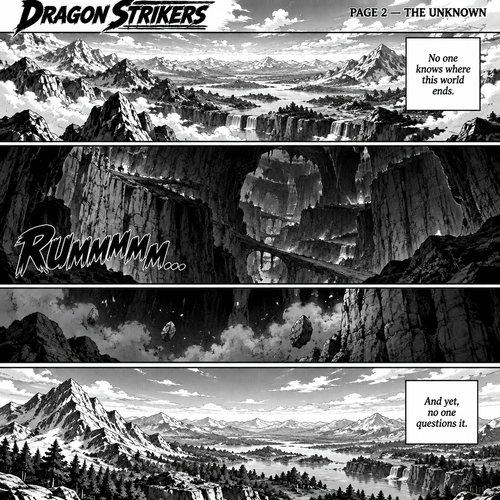
DRAGON STRIKERS

PAGE 2 — THE UNKNOWN

PANEL 1 — THE ENDLESS HORIZON

A wide view of the enormous landscape. Mountain ranges stretch beyond the clouds, and the land disappears into the distance.

NARRATION:
“No one knows where this world ends.”

PANEL 2 — THE WORLD BELOW

A view deep beneath the surface. Enormous layers of rock extend into darkness, with distant passages disappearing into the unknown.

No characters are visible.

SFX: RUMMMMM…

PANEL 3 — SOMETHING UNEXPLAINED

A distant section of the underground landscape appears to shift. Dust drifts through the darkness. The source of the movement remains unseen.

PANEL 4 — SILENCE

Return to the surface. The sky is clear. The mountains are still. The world appears completely normal.

NARRATION:
“And yet, no one questions it.”

DRAGON STRIKERS PAGE 2 — THE UNKNOWN PANEL 1 — THE ENDLESS HORIZON A wide view of the enormous landscape. Mountain ranges stretch beyond the clouds, and the land disappears into the distance. NARRATION: “No one knows where this world ends.” PANEL 2 — THE WORLD BELOW A view deep beneath the surface. Enormous layers of rock extend into darkness, with distant passages disappearing into the unknown. No characters are visible. SFX: RUMMMMM… PANEL 3 — SOMETHING UNEXPLAINED A distant section of the underground landscape appears to shift. Dust drifts through the darkness. The source of the movement remains unseen. PANEL 4 — SILENCE Return to the surface. The sky is clear. The mountains are still. The world appears completely normal. NARRATION: “And yet, no one questions it.”
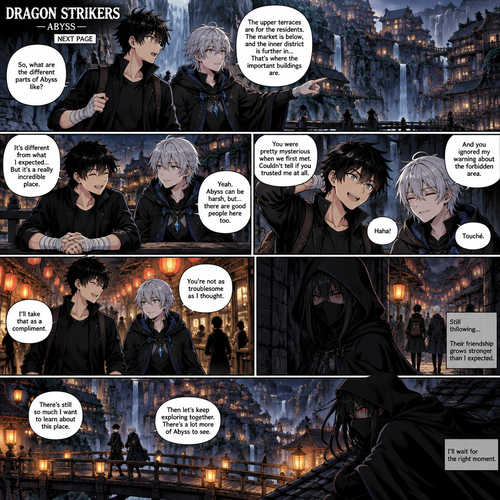
DRAGON STRIKERS — ABYSS — NEXT PAGE

Scene: Sora Amamiya and Rei Mikazuki spend more time together in the Abyss village. Their first meeting has turned into a genuine friendship. They laugh, talk openly, and begin trusting each other. However, the assassin continues following them from a distance, waiting for the right moment.

Sora Amamiya: Age 17, height 178 cm, slim athletic build. Messy layered jet-black hair with sharp irregular spikes and uneven bangs, sharp light-grey eyes with dark pupils, youthful defined face. He wears a fitted black high-collar jacket with silver buttons, a dark shirt, black trousers, a black belt with a rectangular silver buckle, and black lace-up combat boots. White bandages wrap both wrists and partially cover both hands. He carries a dark travel bag. No scars or markings.

Rei Mikazuki: Soft, layered silver hair, cool blue-grey eyes, and a calm, mysterious expression that becomes warmer around Sora. He wears a black hooded cloak with subtle blue accents over dark layered clothing, black trousers, black boots, and a blue crystal pendant on a silver chain.

The assassin: Tall, lean figure with long straight charcoal-black hair, narrow crimson eyes, a black mask covering the lower half of the face, fitted black combat outfit, black gloves, dark trousers, black boots, a long black hooded cloak, and a dark-metal sword at the waist.

Panel 1: Sora and Rei walk beside a beautiful waterfall in the village. Sora asks Rei about the different parts of Abyss, and Rei explains while pointing toward the distant buildings.

Panel 2: They sit together beside a wooden railing overlooking the village. Their conversation becomes more relaxed. Sora smiles naturally, and Rei gives a small, genuine smile in return.

Panel 3: Sora makes a playful comment about how Rei initially acted mysterious when they first met. Rei responds with a slight grin: “And you ignored my warning about the forbidden area.” Both laugh.

Panel 4: The two walk through a lantern-lit market, now clearly comfortable with each other. Rei tells Sora, “You’re not as troublesome as I thought.” Sora replies, “I’ll take that as a compliment.”

Panel 5: Far behind them, the assassin watches from a shadowed alley. The assassin silently follows their route, keeping hidden behind the crowd. The friendship developing between Sora and Rei does not go unnoticed.

Final panel: Sora and Rei walk side by side across a wooden bridge, talking like genuine friends. High above them, the assassin watches from a rooftop, crimson eyes fixed on them. The village lanterns glow below, contrasting with the darkness surrounding the assassin.

Style: Detailed manga artwork, expressive character faces, cinematic panel composition, atmospheric lantern lighting, beautiful Abyss village backgrounds, subtle suspense, and consistent character designs.

Important: The friendship must feel genuine and earned. Keep their established appearances unchanged. The assassin continues following them but does not attack or reveal themselves. Do not introduce new characters, new powers, or new lore.
DRAGON STRIKERS — ABYSS — NEXT PAGE Scene: Sora Amamiya and Rei Mikazuki spend more time together in the Abyss village. Their first meeting has turned into a genuine friendship. They laugh, talk openly, and begin trusting each other. However, the assassin continues following them from a distance, waiting for the right moment. Sora Amamiya: Age 17, height 178 cm, slim athletic build. Messy layered jet-black hair with sharp irregular spikes and uneven bangs, sharp light-grey eyes with dark pupils, youthful defined face. He wears a fitted black high-collar jacket with silver buttons, a dark shirt, black trousers, a black belt with a rectangular silver buckle, and black lace-up combat boots. White bandages wrap both wrists and partially cover both hands. He carries a dark travel bag. No scars or markings. Rei Mikazuki: Soft, layered silver hair, cool blue-grey eyes, and a calm, mysterious expression that becomes warmer around Sora. He wears a black hooded cloak with subtle blue accents over dark layered clothing, black trousers, black boots, and a blue crystal pendant on a silver chain. The assassin: Tall, lean figure with long straight charcoal-black hair, narrow crimson eyes, a black mask covering the lower half of the face, fitted black combat outfit, black gloves, dark trousers, black boots, a long black hooded cloak, and a dark-metal sword at the waist. Panel 1: Sora and Rei walk beside a beautiful waterfall in the village. Sora asks Rei about the different parts of Abyss, and Rei explains while pointing toward the distant buildings. Panel 2: They sit together beside a wooden railing overlooking the village. Their conversation becomes more relaxed. Sora smiles naturally, and Rei gives a small, genuine smile in return. Panel 3: Sora makes a playful comment about how Rei initially acted mysterious when they first met. Rei responds with a slight grin: “And you ignored my warning about the forbidden area.” Both laugh. Panel 4: The two walk through a lantern-lit market, now clearly comfortable with each other. Rei tells Sora, “You’re not as troublesome as I thought.” Sora replies, “I’ll take that as a compliment.” Panel 5: Far behind them, the assassin watches from a shadowed alley. The assassin silently follows their route, keeping hidden behind the crowd. The friendship developing between Sora and Rei does not go unnoticed. Final panel: Sora and Rei walk side by side across a wooden bridge, talking like genuine friends. High above them, the assassin watches from a rooftop, crimson eyes fixed on them. The village lanterns glow below, contrasting with the darkness surrounding the assassin. Style: Detailed manga artwork, expressive character faces, cinematic panel composition, atmospheric lantern lighting, beautiful Abyss village backgrounds, subtle suspense, and consistent character designs. Important: The friendship must feel genuine and earned. Keep their established appearances unchanged. The assassin continues following them but does not attack or reveal themselves. Do not introduce new characters, new powers, or new lore.

DRAGON STRIKERS — ABYSS — NEXT PAGE

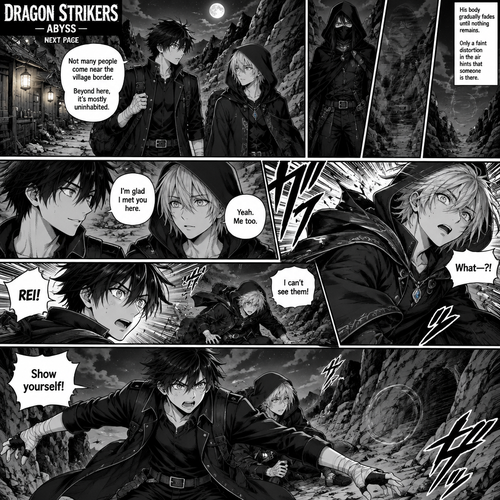
Scene: Sora Amamiya and Rei Mikazuki walk together near the outer border of the Abyss village, where the wooden houses and lanterns gradually disappear into a deserted, rocky path. There are no villagers nearby. The assassin, who has been following them, activates an invisibility ability and prepares a surprise attack against Rei.

Sora Amamiya: Age 17, height 178 cm, slim athletic build. Messy layered jet-black hair with sharp irregular spikes and uneven bangs, sharp light-grey eyes with dark pupils, youthful defined face. He wears a fitted black high-collar jacket with silver buttons, a dark shirt, black trousers, a black belt with a rectangular silver buckle, and black lace-up combat boots. White bandages wrap both wrists and partially cover both hands. He carries a dark travel bag. No scars or markings.

Rei Mikazuki: Soft, layered silver hair, cool blue-grey eyes, calm and mysterious expression. He wears a black hooded cloak with subtle blue accents over dark layered clothing, black trousers, black boots, and a blue crystal pendant on a silver chain.

The assassin: Tall and lean, long straight charcoal-black hair, narrow crimson eyes, black mask covering the lower half of the face, fitted black combat outfit, black gloves, dark trousers, black boots, long black hooded cloak, and a dark-metal sword at the waist. The assassin can become completely invisible.

Panel 1: Sora and Rei walk beyond the final houses of the village. The warm lantern light fades behind them, replaced by cold moonlight, jagged rocks, and an empty path. Rei explains that few people come near the village border.

Panel 2: Behind them, the assassin stands silently between two dark rock formations. The assassin’s body gradually becomes transparent until nothing remains visible. Only a faint distortion in the air hints that someone is there.

Panel 3: Sora and Rei continue walking, unaware. Sora turns toward Rei and says, “I’m glad I met you here.” Rei looks surprised for a moment before replying, “Yeah. Me too.”

Panel 4: Without warning, an invisible attacker strikes from behind Rei. Show a sudden burst of motion and Rei’s shocked expression as he is knocked off balance. Use sharp action lines and dramatic panel angles. Do not show graphic injuries.

Panel 5: Sora spins around, his eyes widening as Rei stumbles away from the unseen attacker. Sora immediately moves toward his friend, trying to understand where the attack came from.

Final panel: Sora stands protectively between Rei and the empty darkness, scanning the rocky surroundings. Rei struggles to regain his footing behind him. A faint distortion in the air appears just beside Sora, hinting that the invisible assassin is preparing another attack.

Dialogue:

* Sora: “REI!”
* Rei: “What—?! I can’t see them!”
* Sora: “Show yourself!”

Style: High-quality black-and-white manga, cinematic action panels, strong contrast between the distant village lights and the dark border, dynamic movement, suspenseful atmosphere, expressive faces.

Important continuity rules: Keep Sora, Rei, and the assassin’s established designs consistent. The assassin uses invisibility to surprise Rei. No villagers are present. Do not reveal the assassin’s identity or introduce new lore. No graphic injuries. End with Sora facing an enemy he cannot see.
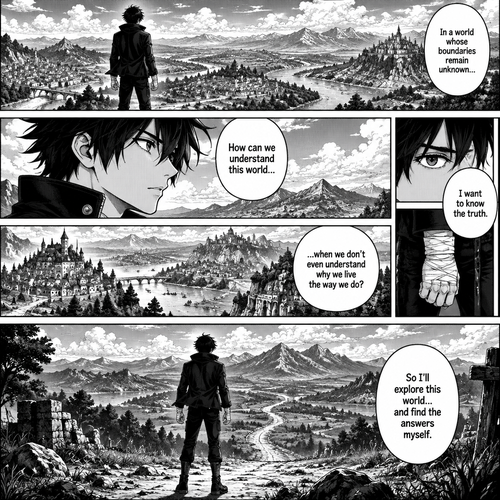
DRAGON STRIKERS — ABYSS — NEXT PAGE Scene: Sora Amamiya and Rei Mikazuki walk together near the outer border of the Abyss village, where the wooden houses and lanterns gradually disappear into a deserted, rocky path. There are no villagers nearby. The assassin, who has been following them, activates an invisibility ability and prepares a surprise attack against Rei. Sora Amamiya: Age 17, height 178 cm, slim athletic build. Messy layered jet-black hair with sharp irregular spikes and uneven bangs, sharp light-grey eyes with dark pupils, youthful defined face. He wears a fitted black high-collar jacket with silver buttons, a dark shirt, black trousers, a black belt with a rectangular silver buckle, and black lace-up combat boots. White bandages wrap both wrists and partially cover both hands. He carries a dark travel bag. No scars or markings. Rei Mikazuki: Soft, layered silver hair, cool blue-grey eyes, calm and mysterious expression. He wears a black hooded cloak with subtle blue accents over dark layered clothing, black trousers, black boots, and a blue crystal pendant on a silver chain. The assassin: Tall and lean, long straight charcoal-black hair, narrow crimson eyes, black mask covering the lower half of the face, fitted black combat outfit, black gloves, dark trousers, black boots, long black hooded cloak, and a dark-metal sword at the waist. The assassin can become completely invisible. Panel 1: Sora and Rei walk beyond the final houses of the village. The warm lantern light fades behind them, replaced by cold moonlight, jagged rocks, and an empty path. Rei explains that few people come near the village border. Panel 2: Behind them, the assassin stands silently between two dark rock formations. The assassin’s body gradually becomes transparent until nothing remains visible. Only a faint distortion in the air hints that someone is there. Panel 3: Sora and Rei continue walking, unaware. Sora turns toward Rei and says, “I’m glad I met you here.” Rei looks surprised for a moment before replying, “Yeah. Me too.” Panel 4: Without warning, an invisible attacker strikes from behind Rei. Show a sudden burst of motion and Rei’s shocked expression as he is knocked off balance. Use sharp action lines and dramatic panel angles. Do not show graphic injuries. Panel 5: Sora spins around, his eyes widening as Rei stumbles away from the unseen attacker. Sora immediately moves toward his friend, trying to understand where the attack came from. Final panel: Sora stands protectively between Rei and the empty darkness, scanning the rocky surroundings. Rei struggles to regain his footing behind him. A faint distortion in the air appears just beside Sora, hinting that the invisible assassin is preparing another attack. Dialogue: * Sora: “REI!” * Rei: “What—?! I can’t see them!” * Sora: “Show yourself!” Style: High-quality black-and-white manga, cinematic action panels, strong contrast between the distant village lights and the dark border, dynamic movement, suspenseful atmosphere, expressive faces. Important continuity rules: Keep Sora, Rei, and the assassin’s established designs consistent. The assassin uses invisibility to surprise Rei. No villagers are present. Do not reveal the assassin’s identity or introduce new lore. No graphic injuries. End with Sora facing an enemy he cannot see.

DRAGON STRIKERS

PAGE 4 — THE QUESTION

FORMAT: Japanese black-and-white manga page, read from right to left. Five panels. Detailed ink work, screentones, cinematic framing, and expressive character art.

CHARACTER CONSISTENCY — SORA AMAMIYA

Use the supplied Sora Amamiya reference sheet as the definitive visual reference.

* Age: 17.
* Height: 178 cm.
* Build: slim and athletic.
* Hair: messy, layered jet-black hair with sharp, irregular spikes and uneven bangs.
* Eyes: sharp, light-grey eyes with dark pupils.
* Face: youthful, defined features and sharp eyebrows.
* Outfit: fitted black high-collar jacket with silver buttons, dark shirt, black trousers, black belt with a rectangular silver buckle, and black lace-up combat boots.
* Hands: white bandages wrapped around both wrists and partially over the hands.

Maintain his exact hairstyle, facial structure, clothing, proportions, and wrist wraps in every panel. Do not add weapons, powers, clan symbols, or accessories.

PANEL 1 — THE LONE FIGURE

Layout: Wide horizontal panel across the top.

Camera: Rear three-quarter view, medium-wide shot.

Scene: Sora stands at a high overlook above an enormous landscape. Mountain ranges stretch toward the horizon, rivers wind through distant valleys, and clouds cast shadows over the land.

His black jacket and spiky hair are clearly recognizable. His hands rest naturally by his sides.

Narration:
“In a world whose boundaries remain unknown…”

PANEL 2 — THE QUESTION

Layout: Medium close-up.

Camera: Side profile of Sora, looking toward the distant horizon.

His light-grey eyes are visible beneath his uneven bangs. His expression is serious and thoughtful, without exaggerated emotion.

Sora’s dialogue:
“How can we understand this world…”

PANEL 3 — THE CLANS

Layout: Wide panel.

Camera: A distant view of several different settlements separated by mountains, rivers, and enormous stretches of land.

Do not depict named clans, clan emblems, specific leaders, or invented customs. Show only the vastness and variety of civilization.

Sora’s dialogue:
”…when we don’t even understand why we live the way we do?”

PANEL 4 — THE DECISION

Layout: Narrow vertical panel.

Camera: Close-up of Sora’s eyes, followed by a small view of his bandaged hand resting beside his jacket.

His gaze becomes more focused. Keep the expression subtle and believable.

Sora’s dialogue:
“I want to know the truth.”

PANEL 5 — THE JOURNEY

Layout: Large bottom panel with dramatic perspective.

Camera: Rear view of Sora facing a long road that disappears into the distant mountains.

His silhouette stands against the enormous landscape. Use strong black shadows in the foreground and lighter screentones toward the horizon.

Do not show Hugurumi, chains, supernatural effects, or any other characters.

Sora’s dialogue:
“So I’ll explore this world… and find the answers myself.”

FINAL ART DIRECTION

The page should feel quiet, serious, and mysterious. Sora is not posing heroically or fighting anyone. This is the moment the reader understands why he wants to explore.

Keep every line of dialogue exactly as written. Use clear, legible lettering and traditional black-and-white manga shading. Preserve Sora’s reference design throughout.
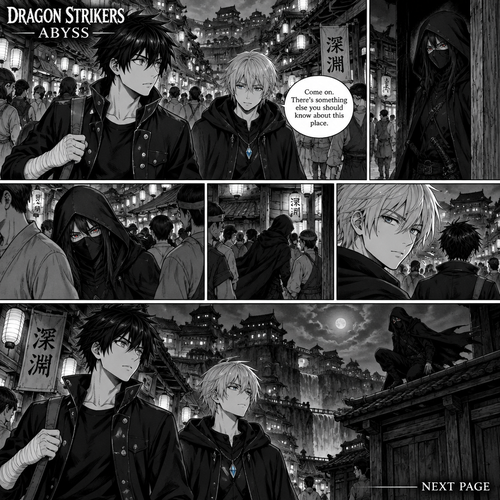
DRAGON STRIKERS PAGE 4 — THE QUESTION FORMAT: Japanese black-and-white manga page, read from right to left. Five panels. Detailed ink work, screentones, cinematic framing, and expressive character art. CHARACTER CONSISTENCY — SORA AMAMIYA Use the supplied Sora Amamiya reference sheet as the definitive visual reference. * Age: 17. * Height: 178 cm. * Build: slim and athletic. * Hair: messy, layered jet-black hair with sharp, irregular spikes and uneven bangs. * Eyes: sharp, light-grey eyes with dark pupils. * Face: youthful, defined features and sharp eyebrows. * Outfit: fitted black high-collar jacket with silver buttons, dark shirt, black trousers, black belt with a rectangular silver buckle, and black lace-up combat boots. * Hands: white bandages wrapped around both wrists and partially over the hands. Maintain his exact hairstyle, facial structure, clothing, proportions, and wrist wraps in every panel. Do not add weapons, powers, clan symbols, or accessories. PANEL 1 — THE LONE FIGURE Layout: Wide horizontal panel across the top. Camera: Rear three-quarter view, medium-wide shot. Scene: Sora stands at a high overlook above an enormous landscape. Mountain ranges stretch toward the horizon, rivers wind through distant valleys, and clouds cast shadows over the land. His black jacket and spiky hair are clearly recognizable. His hands rest naturally by his sides. Narration: “In a world whose boundaries remain unknown…” PANEL 2 — THE QUESTION Layout: Medium close-up. Camera: Side profile of Sora, looking toward the distant horizon. His light-grey eyes are visible beneath his uneven bangs. His expression is serious and thoughtful, without exaggerated emotion. Sora’s dialogue: “How can we understand this world…” PANEL 3 — THE CLANS Layout: Wide panel. Camera: A distant view of several different settlements separated by mountains, rivers, and enormous stretches of land. Do not depict named clans, clan emblems, specific leaders, or invented customs. Show only the vastness and variety of civilization. Sora’s dialogue: ”…when we don’t even understand why we live the way we do?” PANEL 4 — THE DECISION Layout: Narrow vertical panel. Camera: Close-up of Sora’s eyes, followed by a small view of his bandaged hand resting beside his jacket. His gaze becomes more focused. Keep the expression subtle and believable. Sora’s dialogue: “I want to know the truth.” PANEL 5 — THE JOURNEY Layout: Large bottom panel with dramatic perspective. Camera: Rear view of Sora facing a long road that disappears into the distant mountains. His silhouette stands against the enormous landscape. Use strong black shadows in the foreground and lighter screentones toward the horizon. Do not show Hugurumi, chains, supernatural effects, or any other characters. Sora’s dialogue: “So I’ll explore this world… and find the answers myself.” FINAL ART DIRECTION The page should feel quiet, serious, and mysterious. Sora is not posing heroically or fighting anyone. This is the moment the reader understands why he wants to explore. Keep every line of dialogue exactly as written. Use clear, legible lettering and traditional black-and-white manga shading. Preserve Sora’s reference design throughout.

DRAGON STRIKERS — ABYSS — NEXT PAGE

Scene: The assassin silently follows Sora and Rei through the crowded streets of the Abyss village. The page should build suspense without starting a fight yet. Fast pacing, cinematic manga panels, detailed backgrounds, dramatic shadows, and strong character consistency.

Sora Amamiya (17, 178 cm): Slim athletic build, messy layered jet-black hair with sharp irregular spikes and uneven bangs, sharp light-grey eyes with dark pupils, youthful defined face. He wears a fitted black high-collar jacket with silver buttons, a dark shirt, black trousers, a black belt with a rectangular silver buckle, and black lace-up combat boots. White bandages wrap both wrists and partially cover both hands. He carries a dark travel bag. No scars or markings.

Rei Mikazuki: Soft, layered silver hair, cool blue-grey eyes, calm but mysterious expression. He wears a black hooded cloak with subtle blue accents over dark layered clothing, black trousers, black boots, and a blue crystal pendant on a silver chain.

The assassin: Tall and lean, long straight charcoal-black hair, narrow crimson eyes, a black mask covering the lower half of the face, fitted black combat outfit, black gloves, dark trousers, black boots, and a long black hooded cloak. A dark-metal sword hangs at the waist.

Panel 1: Sora and Rei walk through the busy village marketplace, passing wooden stalls, hanging lanterns, and villagers. Sora is listening to Rei while looking around.

Panel 2: Far behind them, the assassin emerges from the shadow of a wooden building, keeping a careful distance. The assassin watches their movements without attracting attention.

Panel 3: The assassin moves through the crowd, using stalls and passing villagers as cover. Show the crimson eyes watching Sora and Rei from beneath the hood.

Panel 4: Rei briefly turns his head as though he senses something unusual, but the assassin has already disappeared behind a building. Sora continues walking, unaware.

Final panel: Sora and Rei walk away in the foreground. On a distant rooftop behind them, the assassin crouches in shadow, one hand resting near the sword. A dark, ominous atmosphere fills the panel.

Dialogue: Keep dialogue minimal. Rei says, “Come on. There’s something else you should know about this place.” No fight begins on this page. End with suspense, showing that the assassin is still following them.

Important: Keep all three characters visually consistent across every panel. Do not change their outfits, hair, eye colours, or accessories. Preserve the Abyss village setting. Do not introduce new characters or reveal new lore.
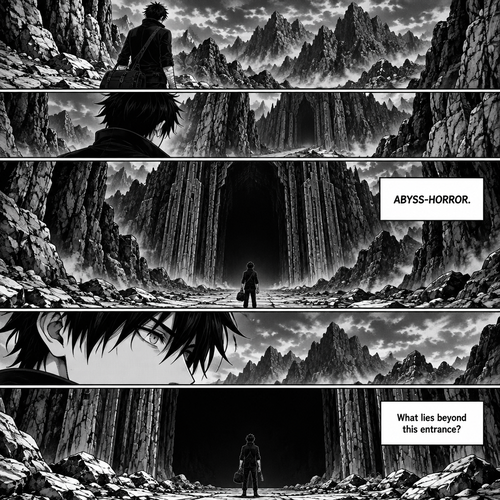
DRAGON STRIKERS — ABYSS — NEXT PAGE Scene: The assassin silently follows Sora and Rei through the crowded streets of the Abyss village. The page should build suspense without starting a fight yet. Fast pacing, cinematic manga panels, detailed backgrounds, dramatic shadows, and strong character consistency. Sora Amamiya (17, 178 cm): Slim athletic build, messy layered jet-black hair with sharp irregular spikes and uneven bangs, sharp light-grey eyes with dark pupils, youthful defined face. He wears a fitted black high-collar jacket with silver buttons, a dark shirt, black trousers, a black belt with a rectangular silver buckle, and black lace-up combat boots. White bandages wrap both wrists and partially cover both hands. He carries a dark travel bag. No scars or markings. Rei Mikazuki: Soft, layered silver hair, cool blue-grey eyes, calm but mysterious expression. He wears a black hooded cloak with subtle blue accents over dark layered clothing, black trousers, black boots, and a blue crystal pendant on a silver chain. The assassin: Tall and lean, long straight charcoal-black hair, narrow crimson eyes, a black mask covering the lower half of the face, fitted black combat outfit, black gloves, dark trousers, black boots, and a long black hooded cloak. A dark-metal sword hangs at the waist. Panel 1: Sora and Rei walk through the busy village marketplace, passing wooden stalls, hanging lanterns, and villagers. Sora is listening to Rei while looking around. Panel 2: Far behind them, the assassin emerges from the shadow of a wooden building, keeping a careful distance. The assassin watches their movements without attracting attention. Panel 3: The assassin moves through the crowd, using stalls and passing villagers as cover. Show the crimson eyes watching Sora and Rei from beneath the hood. Panel 4: Rei briefly turns his head as though he senses something unusual, but the assassin has already disappeared behind a building. Sora continues walking, unaware. Final panel: Sora and Rei walk away in the foreground. On a distant rooftop behind them, the assassin crouches in shadow, one hand resting near the sword. A dark, ominous atmosphere fills the panel. Dialogue: Keep dialogue minimal. Rei says, “Come on. There’s something else you should know about this place.” No fight begins on this page. End with suspense, showing that the assassin is still following them. Important: Keep all three characters visually consistent across every panel. Do not change their outfits, hair, eye colours, or accessories. Preserve the Abyss village setting. Do not introduce new characters or reveal new lore.

DRAGON STRIKERS

PAGE 7 — THE ENTRANCE OF ABYSS-HORROR

FORMAT: One complete portrait-oriented Japanese manga page, black-and-white, dark fantasy atmosphere, detailed ink work, dramatic shadows, screentones, and cinematic environmental art. Use five clearly separated panels with readable text.

CHARACTER CONSISTENCY — SORA AMAMIYA

Use the supplied Sora Amamiya character reference sheet as the definitive visual reference.

* Age: 17.
* Height: 178 cm.
* Build: Slim and athletic.
* Hair: Messy, layered jet-black hair with sharp, irregular spikes and uneven bangs.
* Eyes: Sharp, light-grey eyes with dark pupils.
* Face: Youthful, defined facial features and sharp eyebrows.
* Outfit: Fitted black high-collar jacket with silver buttons, dark shirt, black trousers, black belt with a rectangular silver buckle, and black lace-up combat boots.
* Wrists: White bandages wrapped around both wrists and partially over both hands.
* Bag: One dark travel bag carried by Sora.

Keep his hairstyle, eyes, face, proportions, clothing, wrist wraps, and bag consistent in every panel. Do not change his outfit or add weapons, clan symbols, or accessories.

PANEL 1 — THE ROAD ENDS

Layout: Wide horizontal panel across the top.

Camera: Rear view of Sora standing on a rocky path.

Scene: The winding road has led Sora into a remote, rugged landscape. Jagged cliffs rise on either side, and dark clouds gather above distant mountains. The familiar open scenery from the previous pages gradually gives way to harsher terrain.

Sora stands in the foreground, holding his travel bag and looking ahead.

No other characters are present.

PANEL 2 — SOMETHING AHEAD

Layout: Narrow horizontal panel.

Camera: Over-the-shoulder view from behind Sora.

Scene: Far ahead, between towering dark rock formations, an enormous entrance is visible. It appears carved into the landscape, surrounded by steep cliffs and deep shadows.

The entrance is so distant that its inner details cannot be seen. Do not show anything living inside it.

Sora is looking directly toward the entrance.

PANEL 3 — THE ENTRANCE OF ABYSS-HORROR

Layout: Large central panel occupying the middle of the page.

Camera: Extreme wide shot from behind Sora, emphasizing the scale of the entrance.

Scene: A colossal, ominous gateway stands between immense rock walls. The ground leading toward it is uneven and barren. Dense black shadows fill the opening, concealing whatever lies beyond.

Use sharp rock textures, heavy ink blacks, and thin white highlights along the edges of the cliffs. The entrance should feel ancient, imposing, and deeply unsettling.

Sora appears small in the foreground, making the gateway look enormous.

NARRATION BOX:
“ABYSS-HORROR.”

Make the name clear and correctly spelled.

PANEL 4 — SORA’S REACTION

Layout: Close-up panel.

Camera: Side profile of Sora’s face.

Scene: His sharp, light-grey eyes remain fixed on the entrance. His black bangs fall naturally across his forehead. His expression is serious and attentive.

Do not give him an exaggerated terrified expression. He is observing the entrance, and his exact emotions beyond that are left open.

No dialogue.

PANEL 5 — BEYOND THE GATE

Layout: Wide final panel across the bottom of the page.

Camera: Distant rear view of Sora facing the enormous entrance.

Scene: Sora stands before the dark opening, his travel bag at his side. The towering rock walls rise around him, and the entrance disappears into complete darkness.

The darkness must conceal the interior. Show no monsters, silhouettes, chains, supernatural beings, or hidden characters.

Use a strong contrast between Sora’s black silhouette, the pale rock highlights, and the pitch-black entrance.

NARRATION BOX:
“What lies beyond this entrance?”

FINAL ART DIRECTION

Maintain continuity with Page 6. Use the same Sora reference design and the same black-and-white manga style as all previous pages.

The scene should establish the entrance of Abyss-Horror as a mysterious destination. Do not invent its inhabitants, history, powers, traps, symbols, or internal geography.

Do not show Hugurumi.

Keep all narration legible and correctly spelled. Do not add any extra dialogue or text.

DRAGON STRIKERS PAGE 7 — THE ENTRANCE OF ABYSS-HORROR FORMAT: One complete portrait-oriented Japanese manga page, black-and-white, dark fantasy atmosphere, detailed ink work, dramatic shadows, screentones, and cinematic environmental art. Use five clearly separated panels with readable text. CHARACTER CONSISTENCY — SORA AMAMIYA Use the supplied Sora Amamiya character reference sheet as the definitive visual reference. * Age: 17. * Height: 178 cm. * Build: Slim and athletic. * Hair: Messy, layered jet-black hair with sharp, irregular spikes and uneven bangs. * Eyes: Sharp, light-grey eyes with dark pupils. * Face: Youthful, defined facial features and sharp eyebrows. * Outfit: Fitted black high-collar jacket with silver buttons, dark shirt, black trousers, black belt with a rectangular silver buckle, and black lace-up combat boots. * Wrists: White bandages wrapped around both wrists and partially over both hands. * Bag: One dark travel bag carried by Sora. Keep his hairstyle, eyes, face, proportions, clothing, wrist wraps, and bag consistent in every panel. Do not change his outfit or add weapons, clan symbols, or accessories. PANEL 1 — THE ROAD ENDS Layout: Wide horizontal panel across the top. Camera: Rear view of Sora standing on a rocky path. Scene: The winding road has led Sora into a remote, rugged landscape. Jagged cliffs rise on either side, and dark clouds gather above distant mountains. The familiar open scenery from the previous pages gradually gives way to harsher terrain. Sora stands in the foreground, holding his travel bag and looking ahead. No other characters are present. PANEL 2 — SOMETHING AHEAD Layout: Narrow horizontal panel. Camera: Over-the-shoulder view from behind Sora. Scene: Far ahead, between towering dark rock formations, an enormous entrance is visible. It appears carved into the landscape, surrounded by steep cliffs and deep shadows. The entrance is so distant that its inner details cannot be seen. Do not show anything living inside it. Sora is looking directly toward the entrance. PANEL 3 — THE ENTRANCE OF ABYSS-HORROR Layout: Large central panel occupying the middle of the page. Camera: Extreme wide shot from behind Sora, emphasizing the scale of the entrance. Scene: A colossal, ominous gateway stands between immense rock walls. The ground leading toward it is uneven and barren. Dense black shadows fill the opening, concealing whatever lies beyond. Use sharp rock textures, heavy ink blacks, and thin white highlights along the edges of the cliffs. The entrance should feel ancient, imposing, and deeply unsettling. Sora appears small in the foreground, making the gateway look enormous. NARRATION BOX: “ABYSS-HORROR.” Make the name clear and correctly spelled. PANEL 4 — SORA’S REACTION Layout: Close-up panel. Camera: Side profile of Sora’s face. Scene: His sharp, light-grey eyes remain fixed on the entrance. His black bangs fall naturally across his forehead. His expression is serious and attentive. Do not give him an exaggerated terrified expression. He is observing the entrance, and his exact emotions beyond that are left open. No dialogue. PANEL 5 — BEYOND THE GATE Layout: Wide final panel across the bottom of the page. Camera: Distant rear view of Sora facing the enormous entrance. Scene: Sora stands before the dark opening, his travel bag at his side. The towering rock walls rise around him, and the entrance disappears into complete darkness. The darkness must conceal the interior. Show no monsters, silhouettes, chains, supernatural beings, or hidden characters. Use a strong contrast between Sora’s black silhouette, the pale rock highlights, and the pitch-black entrance. NARRATION BOX: “What lies beyond this entrance?” FINAL ART DIRECTION Maintain continuity with Page 6. Use the same Sora reference design and the same black-and-white manga style as all previous pages. The scene should establish the entrance of Abyss-Horror as a mysterious destination. Do not invent its inhabitants, history, powers, traps, symbols, or internal geography. Do not show Hugurumi. Keep all narration legible and correctly spelled. Do not add any extra dialogue or text.
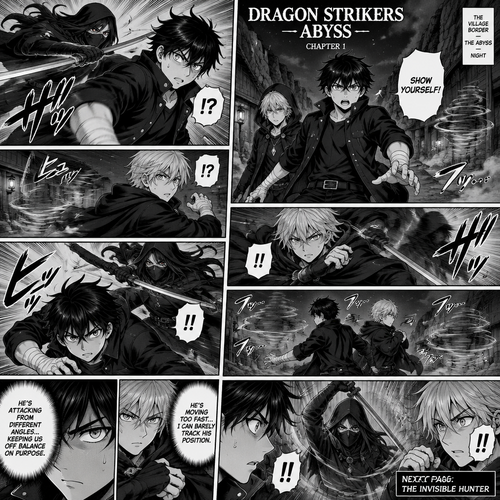
DRAGON STRIKERS — ABYSS — CHAPTER 1
NEXT PAGE: THE INVISIBLE HUNTER

Create a dramatic black-and-white Japanese manga page with dynamic panel layouts, sharp ink lines, detailed shadows, cinematic perspective, and intense action. Keep character designs perfectly consistent across every panel. Read right to left.

SORA AMAMIYA: 17-year-old Japanese boy, slim athletic build, messy layered jet-black hair with sharp spikes and uneven bangs, sharp light-grey eyes, black high-collar jacket with silver buttons over a dark shirt, black trousers, black belt with rectangular silver buckle, black combat boots, white bandages around both wrists and partially over both hands, dark travel bag. No scars, no clan symbols.

REI MIKAZUKI: Japanese boy with soft layered silver hair, cool blue-grey eyes, black hooded cloak with subtle blue accents over dark layered clothing, black trousers and boots, blue crystal pendant on a silver chain.

THE ASSASSIN: Tall, lean figure with long straight charcoal-black hair, narrow crimson eyes, black mask covering the lower half of the face, fitted black combat outfit, black gloves, dark trousers, black boots, long black hooded cloak, dark-metal sword at the waist. Has the ability to turn invisible.

SETTING: An almost deserted village border in the Abyss at night. Rocky ground, towering cliffs, wooden buildings, dim lanterns, deep shadows, and drifting mist. No crowds.

PANEL 1: Sora stands in front of Rei, scanning the darkness after shouting, “SHOW YOURSELF!” A faint distortion ripples through the air behind them.

PANEL 2: The assassin suddenly becomes visible for a split second on Sora’s left and launches a fast sword strike. Sora twists away just in time, startled by how quickly the attacker appeared.

PANEL 3: Before Sora can counterattack, the assassin vanishes. A sharp gust of air passes behind Rei. Rei turns abruptly, raising his arm to defend himself.

PANEL 4: Rei narrowly evades another surprise strike from the opposite direction. The assassin’s dark silhouette flickers at the edge of the panel before disappearing again. Rei’s expression changes from shock to intense concentration.

PANEL 5: Sora rushes to help Rei, but the assassin reappears behind Sora. Sora senses the movement at the last instant and ducks. The dark-metal blade cuts through empty air above him.

PANEL 6: Sora and Rei stand back-to-back, trying to watch every direction. The assassin is nowhere to be seen. Show several faint distortions in the air around them, suggesting the attacker is moving too quickly for them to track.

PANEL 7: Close-up of Sora’s narrowed eyes as he realizes their opponent is deliberately attacking from different angles to keep them off balance. Rei grips his cloak and watches the surrounding shadows.

PANEL 8 — CLIFFHANGER: A barely visible distortion forms directly between Sora and Rei. Both begin turning toward it, but the assassin is already emerging with their sword raised. Sora’s eyes widen as he realizes they may not react in time.

ART DIRECTION: Pure black-and-white manga, strong contrast, speed lines, varied panel sizes, dramatic close-ups, realistic movement, atmospheric shadows, clear character anatomy, consistent clothing and faces. Make the assassin’s invisibility readable through subtle air distortions and brief silhouette glimpses. Intense action without graphic injuries. No extra characters, no colour, no unrelated scenes.
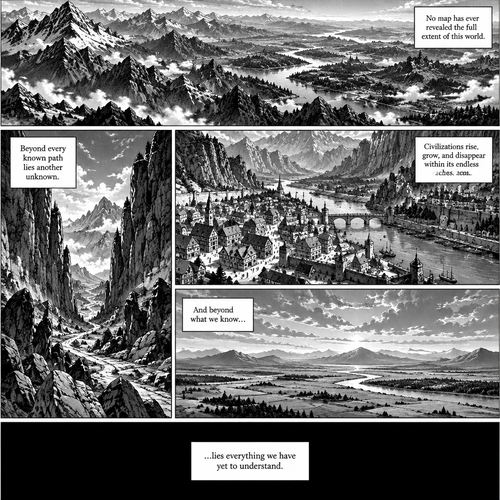
DRAGON STRIKERS — ABYSS — CHAPTER 1 NEXT PAGE: THE INVISIBLE HUNTER Create a dramatic black-and-white Japanese manga page with dynamic panel layouts, sharp ink lines, detailed shadows, cinematic perspective, and intense action. Keep character designs perfectly consistent across every panel. Read right to left. SORA AMAMIYA: 17-year-old Japanese boy, slim athletic build, messy layered jet-black hair with sharp spikes and uneven bangs, sharp light-grey eyes, black high-collar jacket with silver buttons over a dark shirt, black trousers, black belt with rectangular silver buckle, black combat boots, white bandages around both wrists and partially over both hands, dark travel bag. No scars, no clan symbols. REI MIKAZUKI: Japanese boy with soft layered silver hair, cool blue-grey eyes, black hooded cloak with subtle blue accents over dark layered clothing, black trousers and boots, blue crystal pendant on a silver chain. THE ASSASSIN: Tall, lean figure with long straight charcoal-black hair, narrow crimson eyes, black mask covering the lower half of the face, fitted black combat outfit, black gloves, dark trousers, black boots, long black hooded cloak, dark-metal sword at the waist. Has the ability to turn invisible. SETTING: An almost deserted village border in the Abyss at night. Rocky ground, towering cliffs, wooden buildings, dim lanterns, deep shadows, and drifting mist. No crowds. PANEL 1: Sora stands in front of Rei, scanning the darkness after shouting, “SHOW YOURSELF!” A faint distortion ripples through the air behind them. PANEL 2: The assassin suddenly becomes visible for a split second on Sora’s left and launches a fast sword strike. Sora twists away just in time, startled by how quickly the attacker appeared. PANEL 3: Before Sora can counterattack, the assassin vanishes. A sharp gust of air passes behind Rei. Rei turns abruptly, raising his arm to defend himself. PANEL 4: Rei narrowly evades another surprise strike from the opposite direction. The assassin’s dark silhouette flickers at the edge of the panel before disappearing again. Rei’s expression changes from shock to intense concentration. PANEL 5: Sora rushes to help Rei, but the assassin reappears behind Sora. Sora senses the movement at the last instant and ducks. The dark-metal blade cuts through empty air above him. PANEL 6: Sora and Rei stand back-to-back, trying to watch every direction. The assassin is nowhere to be seen. Show several faint distortions in the air around them, suggesting the attacker is moving too quickly for them to track. PANEL 7: Close-up of Sora’s narrowed eyes as he realizes their opponent is deliberately attacking from different angles to keep them off balance. Rei grips his cloak and watches the surrounding shadows. PANEL 8 — CLIFFHANGER: A barely visible distortion forms directly between Sora and Rei. Both begin turning toward it, but the assassin is already emerging with their sword raised. Sora’s eyes widen as he realizes they may not react in time. ART DIRECTION: Pure black-and-white manga, strong contrast, speed lines, varied panel sizes, dramatic close-ups, realistic movement, atmospheric shadows, clear character anatomy, consistent clothing and faces. Make the assassin’s invisibility readable through subtle air distortions and brief silhouette glimpses. Intense action without graphic injuries. No extra characters, no colour, no unrelated scenes.

DRAGON STRIKERS

PAGE 3 — A WORLD WITHOUT END

STYLE: Black-and-white manga, cinematic landscapes, high-contrast ink shading, detailed screentones, dramatic perspective.

PANEL 1 — THE SCALE OF THE WORLD

Shape: Large horizontal panel occupying the top quarter of the page.

Camera: Extreme wide shot from high above a mountain range.

Drawing description:
Enormous mountains stretch across the background, their sharp peaks piercing through layers of clouds. Rivers wind through deep valleys, connecting vast lakes and distant forests. Tiny settlements are scattered across the landscape, almost invisible compared with the immense natural world surrounding them.

Use thin white highlights along the mountain peaks to create the impression of sunlight. Dark screentones should fill the valleys, making them appear deep and mysterious.

The horizon should be so distant that the landscape seems to continue beyond the panel itself.

NARRATION BOX:
“No map has ever revealed the full extent of this world.”

PANEL 2 — CIVILIZATION

Shape: Medium horizontal panel.

Camera: High-angle view of a settlement.

Drawing description:
A settlement lies between enormous mountains and a broad river. Buildings of different sizes line narrow roads. Bridges cross the river, and tiny figures move through the streets.

In the background, show enormous walls of rock surrounding the valley. Their scale should make the settlement look almost insignificant.

Keep the buildings and people detailed in black ink, with lighter screentones in the distant scenery.

There should be no visible signs of destruction or panic. Everything appears ordinary.

NARRATION BOX:
“Civilizations rise, grow, and disappear within its endless reaches.”

PANEL 3 — THE DISTANT FRONTIER

Shape: Tall vertical panel extending down the left side of the page.

Camera: Low-angle shot looking toward a distant mountain pass.

Drawing description:
Two immense rock formations stand on opposite sides of a narrow passage. A winding road disappears between them and continues toward an unknown landscape.

Jagged rocks fill the foreground. Fine lines and dense shadows emphasize their rough surfaces. Clouds gather behind the mountains, partially hiding the peaks.

The road should look small against the surrounding terrain, drawing the reader’s attention toward the unknown beyond it.

No characters need to appear in this panel.

NARRATION BOX:
“Beyond every known path lies another unknown.”

PANEL 4 — THE SILENT WORLD

Shape: Wide horizontal panel.

Camera: Extreme wide shot of the distant horizon.

Drawing description:
A vast plain stretches beneath a sky filled with layered clouds. A river cuts through the land, disappearing behind distant hills. Mountains form several overlapping silhouettes, each lighter than the one before it.

Use a large amount of open space. Avoid filling every part of the panel with detail; the emptiness should make the world feel even larger.

The scene should feel quiet, almost as though the landscape is waiting for something.

NARRATION BOX:
“And beyond what we know…”

PANEL 5 — THE TURNING POINT

Shape: Small, completely black panel at the bottom of the page, with a single white narration box in the centre.

DRAWING:
No visible characters. No explanation. Just darkness.

NARRATION:
”…lies everything we have yet to understand.”

DRAGON STRIKERS PAGE 3 — A WORLD WITHOUT END STYLE: Black-and-white manga, cinematic landscapes, high-contrast ink shading, detailed screentones, dramatic perspective. PANEL 1 — THE SCALE OF THE WORLD Shape: Large horizontal panel occupying the top quarter of the page. Camera: Extreme wide shot from high above a mountain range. Drawing description: Enormous mountains stretch across the background, their sharp peaks piercing through layers of clouds. Rivers wind through deep valleys, connecting vast lakes and distant forests. Tiny settlements are scattered across the landscape, almost invisible compared with the immense natural world surrounding them. Use thin white highlights along the mountain peaks to create the impression of sunlight. Dark screentones should fill the valleys, making them appear deep and mysterious. The horizon should be so distant that the landscape seems to continue beyond the panel itself. NARRATION BOX: “No map has ever revealed the full extent of this world.” PANEL 2 — CIVILIZATION Shape: Medium horizontal panel. Camera: High-angle view of a settlement. Drawing description: A settlement lies between enormous mountains and a broad river. Buildings of different sizes line narrow roads. Bridges cross the river, and tiny figures move through the streets. In the background, show enormous walls of rock surrounding the valley. Their scale should make the settlement look almost insignificant. Keep the buildings and people detailed in black ink, with lighter screentones in the distant scenery. There should be no visible signs of destruction or panic. Everything appears ordinary. NARRATION BOX: “Civilizations rise, grow, and disappear within its endless reaches.” PANEL 3 — THE DISTANT FRONTIER Shape: Tall vertical panel extending down the left side of the page. Camera: Low-angle shot looking toward a distant mountain pass. Drawing description: Two immense rock formations stand on opposite sides of a narrow passage. A winding road disappears between them and continues toward an unknown landscape. Jagged rocks fill the foreground. Fine lines and dense shadows emphasize their rough surfaces. Clouds gather behind the mountains, partially hiding the peaks. The road should look small against the surrounding terrain, drawing the reader’s attention toward the unknown beyond it. No characters need to appear in this panel. NARRATION BOX: “Beyond every known path lies another unknown.” PANEL 4 — THE SILENT WORLD Shape: Wide horizontal panel. Camera: Extreme wide shot of the distant horizon. Drawing description: A vast plain stretches beneath a sky filled with layered clouds. A river cuts through the land, disappearing behind distant hills. Mountains form several overlapping silhouettes, each lighter than the one before it. Use a large amount of open space. Avoid filling every part of the panel with detail; the emptiness should make the world feel even larger. The scene should feel quiet, almost as though the landscape is waiting for something. NARRATION BOX: “And beyond what we know…” PANEL 5 — THE TURNING POINT Shape: Small, completely black panel at the bottom of the page, with a single white narration box in the centre. DRAWING: No visible characters. No explanation. Just darkness. NARRATION: ”…lies everything we have yet to understand.”
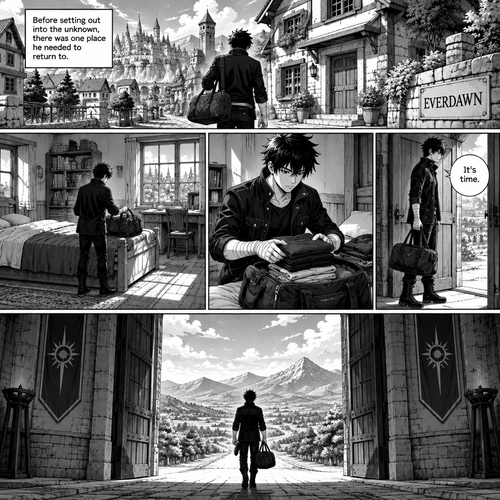
DRAGON STRIKERS

PAGE 5 — DEPARTURE FROM EVERDAWN

FORMAT: One complete black-and-white Japanese manga page, portrait orientation, cinematic panel layout, detailed backgrounds, clean ink lines, high-contrast shadows, and screentones.

CHARACTER CONSISTENCY — SORA AMAMIYA

Use the previously supplied Sora Amamiya character reference sheet as the definitive reference.

* Age: 17
* Height: 178 cm
* Build: Slim and athletic
* Hair: Messy, layered jet-black hair with sharp, irregular spikes and uneven bangs.
* Eyes: Sharp, light-grey eyes with dark pupils.
* Face: Youthful, defined features and serious eyebrows.
* Outfit: Fitted black high-collar jacket with silver buttons, dark shirt, black trousers, black belt with rectangular silver buckle, and black lace-up combat boots.
* Wrists: White bandages wrapped around both wrists and partially over his hands.

Keep his face, hairstyle, proportions, outfit, and wrist wraps consistent in every panel.

PANEL 1 — RETURNING HOME

Layout: Wide horizontal panel at the top.

Camera: Rear three-quarter view of Sora walking toward his home.

Scene: Show Everdawn as a peaceful settlement beneath an expansive sky. Buildings line the streets, and warm sunlight falls across rooftops and stone pathways. The architecture should feel distinct and memorable, with detailed windows, rooftops, balconies, and distant towers.

Sora walks toward a modest-looking home. His black jacket, spiky hair, and bandaged wrists should match the reference sheet.

NARRATION:
“Before setting out into the unknown, there was one place he needed to return to.”

PANEL 2 — INSIDE HIS HOME

Layout: Medium rectangular panel.

Camera: Interior view from a corner of Sora’s room.

Scene: Show a tidy, lived-in room with a bed, a desk, shelves, and a window overlooking Everdawn. Sunlight enters through the window, casting long shadows across the floor.

Sora stands beside an open travel bag, preparing to pack.

Keep the room detailed but uncluttered. Do not introduce photographs, letters, family members, weapons, or personal mementos unless specifically requested.

PANEL 3 — PACKING

Layout: Medium close-up.

Camera: Three-quarter view of Sora placing folded clothes into his travel bag.

Scene: The open bag rests on the bed. Several neatly folded garments are visible inside. Sora’s bandaged hands handle the clothes carefully.

Show the black jacket, trousers, and wrist wraps consistently. His expression is calm and focused.

No supernatural effects or weapons.

PANEL 4 — READY TO LEAVE

Layout: Narrow vertical panel.

Camera: Full-body side view.

Scene: Sora stands near the doorway with his packed travel bag. His black high-collar jacket, dark trousers, boots, and white wrist wraps are clearly visible.

He glances toward the open doorway, where the light from outside illuminates part of his face.

His expression conveys quiet determination.

SORA:
“It’s time.”

PANEL 5 — THE GATE OF EVERDAWN

Layout: The largest panel on the page, occupying the entire bottom section.

Camera: Dramatic wide shot from behind Sora, looking outward through the enormous gate.

Scene: Sora has reached the grand gate of Everdawn. Tall stone pillars and elaborate architectural details frame the entrance. Beyond the gate, a vast road stretches into the distant landscape, surrounded by hills and mountains.

Sora stands at the threshold with his travel bag, facing the world beyond Everdawn.

The settlement remains behind him. The open road lies ahead.

Use heavy black shadows around the gate’s inner walls, contrasting with the lighter landscape outside. Make Sora’s silhouette unmistakable.

No Hugurumi. No other characters. No action scene. No supernatural effects.

The final panel must clearly show Sora leaving Everdawn through its gate, beginning his journey into the unknown.

FINAL ART DIRECTION

Maintain the same black-and-white manga style as Pages 1–4. Use clear panel borders, readable lettering, detailed environments, and consistent character proportions.

The page should communicate one simple event: Sora returns home, packs clothes, prepares himself, and leaves Everdawn.

Do not add new lore, characters, family details, or plot events beyond this description.

DRAGON STRIKERS PAGE 5 — DEPARTURE FROM EVERDAWN FORMAT: One complete black-and-white Japanese manga page, portrait orientation, cinematic panel layout, detailed backgrounds, clean ink lines, high-contrast shadows, and screentones. CHARACTER CONSISTENCY — SORA AMAMIYA Use the previously supplied Sora Amamiya character reference sheet as the definitive reference. * Age: 17 * Height: 178 cm * Build: Slim and athletic * Hair: Messy, layered jet-black hair with sharp, irregular spikes and uneven bangs. * Eyes: Sharp, light-grey eyes with dark pupils. * Face: Youthful, defined features and serious eyebrows. * Outfit: Fitted black high-collar jacket with silver buttons, dark shirt, black trousers, black belt with rectangular silver buckle, and black lace-up combat boots. * Wrists: White bandages wrapped around both wrists and partially over his hands. Keep his face, hairstyle, proportions, outfit, and wrist wraps consistent in every panel. PANEL 1 — RETURNING HOME Layout: Wide horizontal panel at the top. Camera: Rear three-quarter view of Sora walking toward his home. Scene: Show Everdawn as a peaceful settlement beneath an expansive sky. Buildings line the streets, and warm sunlight falls across rooftops and stone pathways. The architecture should feel distinct and memorable, with detailed windows, rooftops, balconies, and distant towers. Sora walks toward a modest-looking home. His black jacket, spiky hair, and bandaged wrists should match the reference sheet. NARRATION: “Before setting out into the unknown, there was one place he needed to return to.” PANEL 2 — INSIDE HIS HOME Layout: Medium rectangular panel. Camera: Interior view from a corner of Sora’s room. Scene: Show a tidy, lived-in room with a bed, a desk, shelves, and a window overlooking Everdawn. Sunlight enters through the window, casting long shadows across the floor. Sora stands beside an open travel bag, preparing to pack. Keep the room detailed but uncluttered. Do not introduce photographs, letters, family members, weapons, or personal mementos unless specifically requested. PANEL 3 — PACKING Layout: Medium close-up. Camera: Three-quarter view of Sora placing folded clothes into his travel bag. Scene: The open bag rests on the bed. Several neatly folded garments are visible inside. Sora’s bandaged hands handle the clothes carefully. Show the black jacket, trousers, and wrist wraps consistently. His expression is calm and focused. No supernatural effects or weapons. PANEL 4 — READY TO LEAVE Layout: Narrow vertical panel. Camera: Full-body side view. Scene: Sora stands near the doorway with his packed travel bag. His black high-collar jacket, dark trousers, boots, and white wrist wraps are clearly visible. He glances toward the open doorway, where the light from outside illuminates part of his face. His expression conveys quiet determination. SORA: “It’s time.” PANEL 5 — THE GATE OF EVERDAWN Layout: The largest panel on the page, occupying the entire bottom section. Camera: Dramatic wide shot from behind Sora, looking outward through the enormous gate. Scene: Sora has reached the grand gate of Everdawn. Tall stone pillars and elaborate architectural details frame the entrance. Beyond the gate, a vast road stretches into the distant landscape, surrounded by hills and mountains. Sora stands at the threshold with his travel bag, facing the world beyond Everdawn. The settlement remains behind him. The open road lies ahead. Use heavy black shadows around the gate’s inner walls, contrasting with the lighter landscape outside. Make Sora’s silhouette unmistakable. No Hugurumi. No other characters. No action scene. No supernatural effects. The final panel must clearly show Sora leaving Everdawn through its gate, beginning his journey into the unknown. FINAL ART DIRECTION Maintain the same black-and-white manga style as Pages 1–4. Use clear panel borders, readable lettering, detailed environments, and consistent character proportions. The page should communicate one simple event: Sora returns home, packs clothes, prepares himself, and leaves Everdawn. Do not add new lore, characters, family details, or plot events beyond this description.
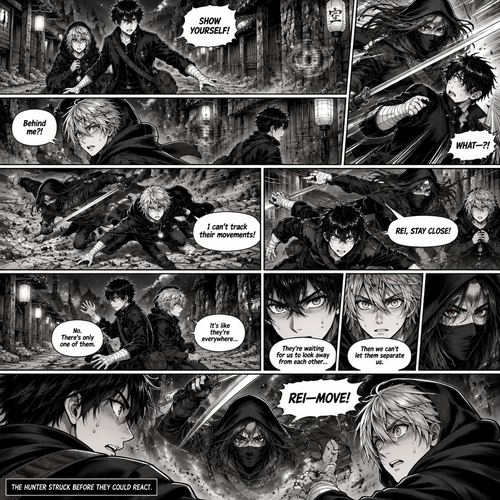
DRAGON STRIKERS

ABYSS — CHAPTER 1

NEXT PAGE: THE INVISIBLE HUNTER

PAGE FORMAT AND ART STYLE

Create one extremely detailed Japanese manga page with 8 clearly separated panels. Use traditional black-and-white manga artwork with professional ink work, dense cross-hatching, dramatic blacks, sharp highlights, detailed anatomy, cinematic compositions, expressive faces, and intense action choreography. Use right-to-left manga reading order. The page should feel like a tense, high-quality dark fantasy action manga chapter.

Every panel must continue the same fight in chronological order. Keep the characters’ faces, hairstyles, outfits, body proportions, accessories, and surroundings consistent. Use varied panel sizes: wide establishing panels, narrow vertical action panels, extreme close-ups, and one large final cliffhanger panel. Make all speech bubbles readable and keep them away from the characters’ faces.

CHARACTER DESIGN — STRICT CONSISTENCY

SORA AMAMIYA — PROTAGONIST

Sora is a 17-year-old Japanese boy, 178 cm tall, with a slim athletic build and youthful but defined facial features. He has messy, layered jet-black hair, sharply pointed irregular spikes, uneven bangs falling over his forehead, and intense light-grey eyes with dark pupils. His expression is usually observant, but he becomes fiercely determined when his friend is threatened.

He wears a fitted black high-collar jacket with silver buttons, a dark shirt underneath, black trousers, a black belt with a rectangular silver buckle, and black lace-up combat boots. White bandages wrap around both wrists and partially cover both hands. He carries a dark travel bag with a visible shoulder strap.

Preserve his exact hairstyle, eye shape, jacket design, bandages, belt, boots, and travel bag in every panel. His jacket and hair should react naturally to sudden movements. Do not give him a sword, new powers, glowing eyes, scars, tattoos, or clan symbols.

REI MIKAZUKI — SORA’S FIRST FRIEND IN THE ABYSS

Rei is a young Japanese boy with soft, layered silver hair, loose strands framing his face, cool blue-grey eyes, and a calm, intelligent appearance. His current expression shifts from confusion to fear, concentration, and determination as the fight escalates.

He wears a black hooded cloak with subtle blue accents over dark layered clothing, black trousers, and black boots. A blue crystal pendant hangs from a silver chain around his neck. In black-and-white artwork, represent the crystal with a distinctive bright highlight and tonal contrast.

Preserve his silver hairstyle, face, hood, cloak, pendant, and clothing throughout the entire page. His cloak should flow with his movements, but the pendant must remain attached to its chain.

THE ASSASSIN — THE INVISIBLE HUNTER

The assassin is tall and lean, with long, straight charcoal-black hair, narrow crimson eyes, a black mask covering the lower half of the face, a fitted black combat outfit, black gloves, dark trousers, black boots, and a long black hooded cloak. A dark-metal sword hangs at the waist.

The assassin can turn completely invisible. When visible, the assassin has a cold, calculating stare and controlled body language. Do not give the assassin glowing supernatural effects, extra weapons, or a different costume.

Show invisibility through faint ripples in the air, slight background distortion, displaced mist, disturbed dust, and brief glimpses of the assassin’s outline. The assassin must remain physically consistent whenever visible.

SETTING AND ATMOSPHERE

The fight takes place near the deserted outer border of the Abyss village at night. The path is uneven and rocky, with fractured stone, loose gravel, patches of dirt, and a few weeds growing between cracks. Tall, weathered wooden buildings stand farther behind the characters. Traditional hanging lanterns illuminate sections of the path, creating alternating pools of light and deep shadow.

Towering cliffs rise beyond the village border. Narrow trails disappear between the rocks. Thin mist drifts close to the ground. Wooden beams, roof edges, hanging ropes, and distant lanterns create strong depth in the background.

Keep the setting consistent in all eight panels. As the assassin moves, the lantern light should reveal tiny disturbances in the mist, while shadows make it difficult for Sora and Rei to locate the attacker.

The environment should feel quiet and abandoned. There are no villagers nearby to help them.

⸻

PANEL 1 — THE MOMENT BEFORE THE ATTACK

Wide horizontal establishing panel.

Sora stands slightly in front of Rei on the rocky path, his feet planted apart and his shoulders tense. His right hand is extended slightly outward to protect Rei, while his left hand remains close to his body. His dark travel bag hangs from his shoulder.

Sora’s messy black hair shifts in the cold night breeze. His light-grey eyes scan the surrounding buildings, rooftops, cliffs, and dark gaps between the lanterns.

Rei stands half a step behind Sora, his silver hair partially framed by his hood. One hand is raised defensively near his chest, and his blue crystal pendant rests against his dark clothing. His eyes move cautiously across the deserted path.

Neither character can see the assassin.

Near a wooden building behind them, show an extremely subtle ripple in the air. A thin section of mist bends unnaturally around an invisible shape. Most readers should notice it only after looking carefully.

Dialogue — Sora, shouting into the darkness:

“SHOW YOURSELF!”

Use a bold, jagged speech bubble for the shout. Keep the background dark and the two characters sharply outlined by the distant lantern light.

PANEL 2 — THE FIRST UNPREDICTABLE STRIKE

Tall vertical action panel with a sharply tilted camera angle.

The assassin suddenly becomes visible on Sora’s left side, emerging from the edge of a deep shadow. The assassin’s long black hair trails behind the movement, the hooded cloak flares outward, and the dark-metal sword is already swinging toward Sora.

Show the attack diagonally across the panel. The assassin’s body is low and balanced, with the front foot driving forward and the sword arm extending through a fast, controlled strike.

Sora’s eyes widen as he realizes the attacker has appeared almost beside him. He twists his upper body backward and bends his knees, narrowly avoiding the blade. His right hand rises instinctively to protect his head. The white bandages around his wrist and hand should be clearly visible.

His jacket pulls sharply across his shoulders, his hair whips away from his face, and his travel-bag strap shifts from the sudden movement.

The sword passes through empty air just above his shoulder. Use dense speed lines behind the blade and small streaks of reflected lantern light along the dark metal.

The assassin’s crimson eyes remain fixed on Sora.

Dialogue — Sora:

“WHAT—?!”

Make the speech bubble small and jagged, showing that the attack caught him off guard.

Do not show a wound. The danger comes from how narrowly Sora avoids the strike.

PANEL 3 — THE ATTACKER DISAPPEARS

Narrow horizontal panel, focused on Rei’s reaction.

Before Sora can turn to counterattack, the assassin vanishes completely.

The assassin’s silhouette breaks apart into a faint distortion, leaving only disturbed mist and a few tiny pieces of dust suspended in the lantern light. Do not depict teleportation magic or a portal; the assassin simply becomes invisible.

Rei immediately notices a disturbance behind his right shoulder. His silver hair shifts as he turns sharply, his eyes widening and his cloak beginning to swing around his body.

In the background, Sora is still recovering from his evasive movement. He turns his head toward Rei, realizing that the attacker has changed targets.

Show a faint curved distortion behind Rei’s cloak, barely visible against the dark wooden wall.

Dialogue — Rei:

“Behind me?!”

His expression should show surprise and growing alarm, but he is still trying to react intelligently.

PANEL 4 — REI’S NARROW ESCAPE

Dynamic diagonal action panel with a low camera angle near the rocky ground.

The assassin briefly reappears behind Rei, striking from a different direction than before.

Rei drops his center of gravity and throws his upper body sideways, his left boot scraping across the gravel. His cloak swings outward in a broad arc, revealing the dark layered clothing underneath. The silver chain of his pendant shifts with the movement, and the crystal catches a small flash of lantern light.

The assassin’s sword cuts through the space where Rei had been standing a fraction of a second earlier. The blade passes beside his cloak without making contact.

Show small stones scattering beneath Rei’s boot and a trail of dust rising from the ground. The assassin’s long black hair crosses part of the masked face, while the narrow crimson eyes remain visible.

The assassin’s body language should look economical and precise, as if every movement is calculated to exploit the moment when Rei looks elsewhere.

Rei lands awkwardly but stays on his feet. His face now shows focused concentration rather than simple surprise.

Dialogue — Rei:

“I can’t track their movements!”

Use speed lines to emphasize the sudden change of direction, but keep both characters’ bodies and the sword clearly readable.

PANEL 5 — SORA TRIES TO INTERVENE

Wide action panel with strong foreground and background separation.

Sora immediately rushes toward Rei after seeing him attacked. His expression changes from surprise to fierce determination. His eyebrows draw down, his jaw tightens, and his light-grey eyes lock onto the space beside Rei.

Show Sora sprinting across the uneven ground, one arm extended for balance and the other drawn close to his body. His jacket flares behind him, his travel bag bounces against his back, and the white bandages on his hands contrast against the dark clothing.

For a moment, the assassin appears to be nowhere nearby.

Then a subtle distortion forms directly behind Sora’s shoulder.

The assassin becomes visible at the last instant, emerging from invisibility with the sword raised for another fast strike. The assassin’s cloak streams backward and the blade catches a thin highlight from a lantern.

Sora notices the movement at the edge of his vision and drops into a sudden crouch. The sword passes above him, missing by a narrow margin.

Rei turns toward Sora, startled by the attack coming from yet another direction.

Dialogue — Sora:

“REI, STAY CLOSE!”

The bubble should be bold and urgent, positioned near Sora without covering the sword or his face.

PANEL 6 — TWO FRIENDS AGAINST ONE HUNTER

Large horizontal panel with a slightly elevated camera angle.

Sora and Rei finally retreat toward each other until they stand back-to-back in the center of the rocky path.

Sora faces the village buildings and the dark rooftops. His knees are slightly bent, his shoulders squared, and his bandaged hands raised defensively. His eyes move from one shadow to another, searching for any sign of movement.

Rei faces the cliffs and the narrow path behind them. His cloak settles around his legs, but his posture remains tense. His cool blue-grey eyes follow the faintest movements in the drifting mist.

Neither boy speaks for a moment.

The empty space around them becomes the focus of the composition. Several subtle distortions appear in different parts of the background: one beside a wooden post, another near a rooftop edge, and another close to the ground near the cliffs.

These distortions must not look like multiple clones or multiple assassins. They are visual suggestions of the same assassin moving unpredictably and becoming invisible between attacks.

Lantern light falls across the boys’ faces while the rest of the path sinks into heavy black shadows.

Dialogue — Rei, quietly:

“It’s like they’re everywhere…”

Dialogue — Sora:

“No. There’s only one of them.”

Sora is trying to reason through the fight, even though he does not yet know how to predict the assassin’s movements.

PANEL 7 — THE ASSASSIN’S REAL ADVANTAGE

Three connected close-up compositions within one panel.

First close-up: Sora’s light-grey eyes narrow. A small reflection of a lantern appears in one pupil. His eyebrows are drawn together, and a slight bead of sweat is visible near his temple. His expression shows that he is beginning to understand the strategy behind the attacks.

Second close-up: Rei’s cool blue-grey eyes move toward a faint distortion near the edge of the panel. A loose strand of silver hair falls across his forehead. His lips are pressed together, and one hand is clenched near the blue crystal pendant.

Third close-up: The assassin’s crimson eyes emerge from complete darkness. The upper half of the masked face is visible for an instant, framed by long charcoal-black hair and the shadow of the hood. The expression is cold and patient.

The assassin is not attacking randomly. Every strike comes from a direction that forces one boy to turn away from the other, preventing them from defending each other effectively.

Dialogue — Sora:

“They’re waiting for us to look away from each other…”

Dialogue — Rei:

“Then we can’t let them separate us.”

Their words should sound serious and natural. They are beginning to adapt, but they have not solved the problem.

PANEL 8 — THE CLIFFHANGER

The largest panel on the page, occupying the entire bottom section.

Show Sora and Rei standing close together on the rocky path, both beginning to turn toward a sudden distortion in the air directly between them.

The camera is positioned slightly behind and below the boys, making the emerging assassin appear threatening without obscuring the characters.

The assassin is becoming visible in the narrow gap between them. First the outline of the hood appears, then strands of charcoal-black hair, the black mask, and the crimson eyes. The dark-metal sword is already raised in preparation for another attack.

The assassin’s cloak fills part of the dark background. The mist bends around the figure, and tiny pieces of gravel near the assassin’s boots are displaced by the sudden movement.

Sora’s eyes widen as he recognizes the threat. His right shoulder begins to turn, and his bandaged hand moves instinctively toward Rei.

Rei’s expression changes from concentration to shock. His silver hair and hood shift as he starts to react.

Neither character has fully moved out of the attack’s path yet.

The sword should be clearly visible, but it must not make contact with either character. This is a suspenseful cliffhanger, not a completed injury.

Dialogue — Sora:

“REI—MOVE!”

Place the speech bubble near the top of the panel, with the sword and the assassin’s face remaining unobstructed.

At the bottom edge, add a small black rectangular caption:

“THE HUNTER STRUCK BEFORE THEY COULD REACT.”

End the page at this exact moment. Do not show the outcome of the attack.

FINAL QUALITY REQUIREMENTS

* Exactly eight panels in chronological order.
* Consistent character faces, hairstyles, clothing, accessories, and body proportions.
* Accurate sword positioning and physically readable action.
* Clearly distinguish the assassin’s visible and invisible states.
* Show only one assassin.
* Use dynamic perspective without confusing the reader about where the characters are standing.
* Keep the village border, cliffs, wooden buildings, rocky path, and lanterns consistent.
* Use detailed black-and-white inks, cross-hatching, speed lines, environmental shadows, and dramatic lighting.
* Keep every speech bubble readable and preserve the specified dialogue exactly.
* Do not introduce new powers, weapons, characters, backstory, or unexpected plot revelations.
* No graphic injuries, gore, colour, or unrelated scenes.
* The final panel must create suspense and lead directly into the next page of the fight.

DRAGON STRIKERS ABYSS — CHAPTER 1 NEXT PAGE: THE INVISIBLE HUNTER PAGE FORMAT AND ART STYLE Create one extremely detailed Japanese manga page with 8 clearly separated panels. Use traditional black-and-white manga artwork with professional ink work, dense cross-hatching, dramatic blacks, sharp highlights, detailed anatomy, cinematic compositions, expressive faces, and intense action choreography. Use right-to-left manga reading order. The page should feel like a tense, high-quality dark fantasy action manga chapter. Every panel must continue the same fight in chronological order. Keep the characters’ faces, hairstyles, outfits, body proportions, accessories, and surroundings consistent. Use varied panel sizes: wide establishing panels, narrow vertical action panels, extreme close-ups, and one large final cliffhanger panel. Make all speech bubbles readable and keep them away from the characters’ faces. CHARACTER DESIGN — STRICT CONSISTENCY SORA AMAMIYA — PROTAGONIST Sora is a 17-year-old Japanese boy, 178 cm tall, with a slim athletic build and youthful but defined facial features. He has messy, layered jet-black hair, sharply pointed irregular spikes, uneven bangs falling over his forehead, and intense light-grey eyes with dark pupils. His expression is usually observant, but he becomes fiercely determined when his friend is threatened. He wears a fitted black high-collar jacket with silver buttons, a dark shirt underneath, black trousers, a black belt with a rectangular silver buckle, and black lace-up combat boots. White bandages wrap around both wrists and partially cover both hands. He carries a dark travel bag with a visible shoulder strap. Preserve his exact hairstyle, eye shape, jacket design, bandages, belt, boots, and travel bag in every panel. His jacket and hair should react naturally to sudden movements. Do not give him a sword, new powers, glowing eyes, scars, tattoos, or clan symbols. REI MIKAZUKI — SORA’S FIRST FRIEND IN THE ABYSS Rei is a young Japanese boy with soft, layered silver hair, loose strands framing his face, cool blue-grey eyes, and a calm, intelligent appearance. His current expression shifts from confusion to fear, concentration, and determination as the fight escalates. He wears a black hooded cloak with subtle blue accents over dark layered clothing, black trousers, and black boots. A blue crystal pendant hangs from a silver chain around his neck. In black-and-white artwork, represent the crystal with a distinctive bright highlight and tonal contrast. Preserve his silver hairstyle, face, hood, cloak, pendant, and clothing throughout the entire page. His cloak should flow with his movements, but the pendant must remain attached to its chain. THE ASSASSIN — THE INVISIBLE HUNTER The assassin is tall and lean, with long, straight charcoal-black hair, narrow crimson eyes, a black mask covering the lower half of the face, a fitted black combat outfit, black gloves, dark trousers, black boots, and a long black hooded cloak. A dark-metal sword hangs at the waist. The assassin can turn completely invisible. When visible, the assassin has a cold, calculating stare and controlled body language. Do not give the assassin glowing supernatural effects, extra weapons, or a different costume. Show invisibility through faint ripples in the air, slight background distortion, displaced mist, disturbed dust, and brief glimpses of the assassin’s outline. The assassin must remain physically consistent whenever visible. SETTING AND ATMOSPHERE The fight takes place near the deserted outer border of the Abyss village at night. The path is uneven and rocky, with fractured stone, loose gravel, patches of dirt, and a few weeds growing between cracks. Tall, weathered wooden buildings stand farther behind the characters. Traditional hanging lanterns illuminate sections of the path, creating alternating pools of light and deep shadow. Towering cliffs rise beyond the village border. Narrow trails disappear between the rocks. Thin mist drifts close to the ground. Wooden beams, roof edges, hanging ropes, and distant lanterns create strong depth in the background. Keep the setting consistent in all eight panels. As the assassin moves, the lantern light should reveal tiny disturbances in the mist, while shadows make it difficult for Sora and Rei to locate the attacker. The environment should feel quiet and abandoned. There are no villagers nearby to help them. ⸻ PANEL 1 — THE MOMENT BEFORE THE ATTACK Wide horizontal establishing panel. Sora stands slightly in front of Rei on the rocky path, his feet planted apart and his shoulders tense. His right hand is extended slightly outward to protect Rei, while his left hand remains close to his body. His dark travel bag hangs from his shoulder. Sora’s messy black hair shifts in the cold night breeze. His light-grey eyes scan the surrounding buildings, rooftops, cliffs, and dark gaps between the lanterns. Rei stands half a step behind Sora, his silver hair partially framed by his hood. One hand is raised defensively near his chest, and his blue crystal pendant rests against his dark clothing. His eyes move cautiously across the deserted path. Neither character can see the assassin. Near a wooden building behind them, show an extremely subtle ripple in the air. A thin section of mist bends unnaturally around an invisible shape. Most readers should notice it only after looking carefully. Dialogue — Sora, shouting into the darkness: “SHOW YOURSELF!” Use a bold, jagged speech bubble for the shout. Keep the background dark and the two characters sharply outlined by the distant lantern light. PANEL 2 — THE FIRST UNPREDICTABLE STRIKE Tall vertical action panel with a sharply tilted camera angle. The assassin suddenly becomes visible on Sora’s left side, emerging from the edge of a deep shadow. The assassin’s long black hair trails behind the movement, the hooded cloak flares outward, and the dark-metal sword is already swinging toward Sora. Show the attack diagonally across the panel. The assassin’s body is low and balanced, with the front foot driving forward and the sword arm extending through a fast, controlled strike. Sora’s eyes widen as he realizes the attacker has appeared almost beside him. He twists his upper body backward and bends his knees, narrowly avoiding the blade. His right hand rises instinctively to protect his head. The white bandages around his wrist and hand should be clearly visible. His jacket pulls sharply across his shoulders, his hair whips away from his face, and his travel-bag strap shifts from the sudden movement. The sword passes through empty air just above his shoulder. Use dense speed lines behind the blade and small streaks of reflected lantern light along the dark metal. The assassin’s crimson eyes remain fixed on Sora. Dialogue — Sora: “WHAT—?!” Make the speech bubble small and jagged, showing that the attack caught him off guard. Do not show a wound. The danger comes from how narrowly Sora avoids the strike. PANEL 3 — THE ATTACKER DISAPPEARS Narrow horizontal panel, focused on Rei’s reaction. Before Sora can turn to counterattack, the assassin vanishes completely. The assassin’s silhouette breaks apart into a faint distortion, leaving only disturbed mist and a few tiny pieces of dust suspended in the lantern light. Do not depict teleportation magic or a portal; the assassin simply becomes invisible. Rei immediately notices a disturbance behind his right shoulder. His silver hair shifts as he turns sharply, his eyes widening and his cloak beginning to swing around his body. In the background, Sora is still recovering from his evasive movement. He turns his head toward Rei, realizing that the attacker has changed targets. Show a faint curved distortion behind Rei’s cloak, barely visible against the dark wooden wall. Dialogue — Rei: “Behind me?!” His expression should show surprise and growing alarm, but he is still trying to react intelligently. PANEL 4 — REI’S NARROW ESCAPE Dynamic diagonal action panel with a low camera angle near the rocky ground. The assassin briefly reappears behind Rei, striking from a different direction than before. Rei drops his center of gravity and throws his upper body sideways, his left boot scraping across the gravel. His cloak swings outward in a broad arc, revealing the dark layered clothing underneath. The silver chain of his pendant shifts with the movement, and the crystal catches a small flash of lantern light. The assassin’s sword cuts through the space where Rei had been standing a fraction of a second earlier. The blade passes beside his cloak without making contact. Show small stones scattering beneath Rei’s boot and a trail of dust rising from the ground. The assassin’s long black hair crosses part of the masked face, while the narrow crimson eyes remain visible. The assassin’s body language should look economical and precise, as if every movement is calculated to exploit the moment when Rei looks elsewhere. Rei lands awkwardly but stays on his feet. His face now shows focused concentration rather than simple surprise. Dialogue — Rei: “I can’t track their movements!” Use speed lines to emphasize the sudden change of direction, but keep both characters’ bodies and the sword clearly readable. PANEL 5 — SORA TRIES TO INTERVENE Wide action panel with strong foreground and background separation. Sora immediately rushes toward Rei after seeing him attacked. His expression changes from surprise to fierce determination. His eyebrows draw down, his jaw tightens, and his light-grey eyes lock onto the space beside Rei. Show Sora sprinting across the uneven ground, one arm extended for balance and the other drawn close to his body. His jacket flares behind him, his travel bag bounces against his back, and the white bandages on his hands contrast against the dark clothing. For a moment, the assassin appears to be nowhere nearby. Then a subtle distortion forms directly behind Sora’s shoulder. The assassin becomes visible at the last instant, emerging from invisibility with the sword raised for another fast strike. The assassin’s cloak streams backward and the blade catches a thin highlight from a lantern. Sora notices the movement at the edge of his vision and drops into a sudden crouch. The sword passes above him, missing by a narrow margin. Rei turns toward Sora, startled by the attack coming from yet another direction. Dialogue — Sora: “REI, STAY CLOSE!” The bubble should be bold and urgent, positioned near Sora without covering the sword or his face. PANEL 6 — TWO FRIENDS AGAINST ONE HUNTER Large horizontal panel with a slightly elevated camera angle. Sora and Rei finally retreat toward each other until they stand back-to-back in the center of the rocky path. Sora faces the village buildings and the dark rooftops. His knees are slightly bent, his shoulders squared, and his bandaged hands raised defensively. His eyes move from one shadow to another, searching for any sign of movement. Rei faces the cliffs and the narrow path behind them. His cloak settles around his legs, but his posture remains tense. His cool blue-grey eyes follow the faintest movements in the drifting mist. Neither boy speaks for a moment. The empty space around them becomes the focus of the composition. Several subtle distortions appear in different parts of the background: one beside a wooden post, another near a rooftop edge, and another close to the ground near the cliffs. These distortions must not look like multiple clones or multiple assassins. They are visual suggestions of the same assassin moving unpredictably and becoming invisible between attacks. Lantern light falls across the boys’ faces while the rest of the path sinks into heavy black shadows. Dialogue — Rei, quietly: “It’s like they’re everywhere…” Dialogue — Sora: “No. There’s only one of them.” Sora is trying to reason through the fight, even though he does not yet know how to predict the assassin’s movements. PANEL 7 — THE ASSASSIN’S REAL ADVANTAGE Three connected close-up compositions within one panel. First close-up: Sora’s light-grey eyes narrow. A small reflection of a lantern appears in one pupil. His eyebrows are drawn together, and a slight bead of sweat is visible near his temple. His expression shows that he is beginning to understand the strategy behind the attacks. Second close-up: Rei’s cool blue-grey eyes move toward a faint distortion near the edge of the panel. A loose strand of silver hair falls across his forehead. His lips are pressed together, and one hand is clenched near the blue crystal pendant. Third close-up: The assassin’s crimson eyes emerge from complete darkness. The upper half of the masked face is visible for an instant, framed by long charcoal-black hair and the shadow of the hood. The expression is cold and patient. The assassin is not attacking randomly. Every strike comes from a direction that forces one boy to turn away from the other, preventing them from defending each other effectively. Dialogue — Sora: “They’re waiting for us to look away from each other…” Dialogue — Rei: “Then we can’t let them separate us.” Their words should sound serious and natural. They are beginning to adapt, but they have not solved the problem. PANEL 8 — THE CLIFFHANGER The largest panel on the page, occupying the entire bottom section. Show Sora and Rei standing close together on the rocky path, both beginning to turn toward a sudden distortion in the air directly between them. The camera is positioned slightly behind and below the boys, making the emerging assassin appear threatening without obscuring the characters. The assassin is becoming visible in the narrow gap between them. First the outline of the hood appears, then strands of charcoal-black hair, the black mask, and the crimson eyes. The dark-metal sword is already raised in preparation for another attack. The assassin’s cloak fills part of the dark background. The mist bends around the figure, and tiny pieces of gravel near the assassin’s boots are displaced by the sudden movement. Sora’s eyes widen as he recognizes the threat. His right shoulder begins to turn, and his bandaged hand moves instinctively toward Rei. Rei’s expression changes from concentration to shock. His silver hair and hood shift as he starts to react. Neither character has fully moved out of the attack’s path yet. The sword should be clearly visible, but it must not make contact with either character. This is a suspenseful cliffhanger, not a completed injury. Dialogue — Sora: “REI—MOVE!” Place the speech bubble near the top of the panel, with the sword and the assassin’s face remaining unobstructed. At the bottom edge, add a small black rectangular caption: “THE HUNTER STRUCK BEFORE THEY COULD REACT.” End the page at this exact moment. Do not show the outcome of the attack. FINAL QUALITY REQUIREMENTS * Exactly eight panels in chronological order. * Consistent character faces, hairstyles, clothing, accessories, and body proportions. * Accurate sword positioning and physically readable action. * Clearly distinguish the assassin’s visible and invisible states. * Show only one assassin. * Use dynamic perspective without confusing the reader about where the characters are standing. * Keep the village border, cliffs, wooden buildings, rocky path, and lanterns consistent. * Use detailed black-and-white inks, cross-hatching, speed lines, environmental shadows, and dramatic lighting. * Keep every speech bubble readable and preserve the specified dialogue exactly. * Do not introduce new powers, weapons, characters, backstory, or unexpected plot revelations. * No graphic injuries, gore, colour, or unrelated scenes. * The final panel must create suspense and lead directly into the next page of the fight.
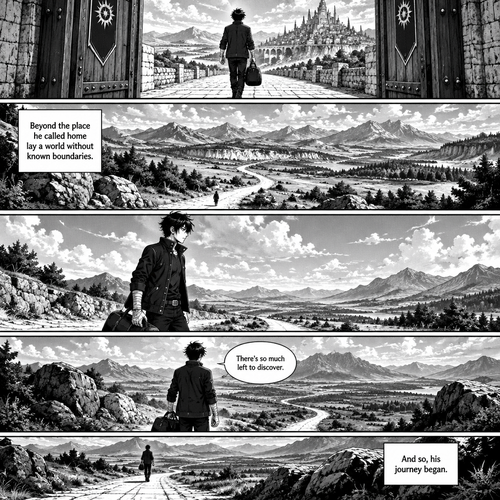
DRAGON STRIKERS

PAGE 6 — BEYOND EVERDAWN

FORMAT: Full-page, black-and-white Japanese manga. Portrait layout, cinematic scenery, detailed ink work, cross-hatching, and screentones.

CHARACTER CONSISTENCY — SORA AMAMIYA

Use the original Sora Amamiya character reference sheet as the visual reference in every panel.

* Age: 17; height: 178 cm; slim, athletic build.
* Hair: Messy, layered jet-black hair with sharp spikes and uneven bangs.
* Eyes: Sharp, light-grey eyes with dark pupils.
* Face: Youthful, defined features and serious eyebrows.
* Outfit: Fitted black high-collar jacket with silver buttons, dark shirt, black trousers, black belt with a rectangular silver buckle, and black lace-up combat boots.
* Wrists: White bandages wrapped around both wrists and partially over both hands.
* Prop: One dark travel bag carried by Sora.

Keep his face, hair, outfit, proportions, and wrist wraps consistent. Do not add weapons, powers, clan emblems, or extra accessories.

PANEL 1 — THE ROAD OUT

Layout: Wide horizontal panel at the top.

Camera: Rear view of Sora walking away from Everdawn’s enormous open gate.

Scene: The gate stands behind him, while a broad stone road extends ahead into a vast landscape. The buildings of Everdawn remain visible in the distance.

Sora carries his travel bag in one hand. His silhouette and clothing must match the reference sheet.

No other characters appear.

PANEL 2 — THE VAST LAND

Layout: Large horizontal panel.

Camera: Extreme wide shot from a high viewpoint.

Scene: The road passes through rolling hills, rocky slopes, and patches of woodland. Distant mountains rise beneath layered clouds. The landscape continues far beyond what the eye can see.

Sora appears as a small figure on the road, emphasizing the enormous scale of the world.

NARRATION:
“Beyond the place he called home lay a world without known boundaries.”

PANEL 3 — ONE TRAVELLER

Layout: Medium panel.

Camera: Side view of Sora walking along the road.

His black hair moves slightly in the breeze. His travel bag hangs beside his leg, and his bandaged hand holds its handle.

His expression is calm and focused. The background shows the road stretching onward.

No dialogue.

PANEL 4 — THE DISTANT HORIZON

Layout: Wide panel near the bottom.

Camera: View from behind Sora, looking toward distant mountains and an immense open landscape.

The road bends into the distance and disappears behind a hill. Use strong foreground shadows and lighter screentones in the background.

Sora pauses briefly to look toward the horizon.

SORA:
“There’s so much left to discover.”

PANEL 5 — CONTINUING FORWARD

Layout: Small final panel with a dark lower border.

Camera: Distant view of Sora continuing along the winding road, his figure becoming smaller against the vast landscape.

NARRATION:
“And so, his journey began.”

FINAL ART DIRECTION

Continue directly from Page 5. Preserve the black-and-white manga style and Sora’s exact reference design. Keep the travel bag consistent in every panel where it appears.

Do not introduce new characters, creatures, conflicts, clan symbols, or supernatural events. The page focuses only on Sora travelling beyond Everdawn.

DRAGON STRIKERS PAGE 6 — BEYOND EVERDAWN FORMAT: Full-page, black-and-white Japanese manga. Portrait layout, cinematic scenery, detailed ink work, cross-hatching, and screentones. CHARACTER CONSISTENCY — SORA AMAMIYA Use the original Sora Amamiya character reference sheet as the visual reference in every panel. * Age: 17; height: 178 cm; slim, athletic build. * Hair: Messy, layered jet-black hair with sharp spikes and uneven bangs. * Eyes: Sharp, light-grey eyes with dark pupils. * Face: Youthful, defined features and serious eyebrows. * Outfit: Fitted black high-collar jacket with silver buttons, dark shirt, black trousers, black belt with a rectangular silver buckle, and black lace-up combat boots. * Wrists: White bandages wrapped around both wrists and partially over both hands. * Prop: One dark travel bag carried by Sora. Keep his face, hair, outfit, proportions, and wrist wraps consistent. Do not add weapons, powers, clan emblems, or extra accessories. PANEL 1 — THE ROAD OUT Layout: Wide horizontal panel at the top. Camera: Rear view of Sora walking away from Everdawn’s enormous open gate. Scene: The gate stands behind him, while a broad stone road extends ahead into a vast landscape. The buildings of Everdawn remain visible in the distance. Sora carries his travel bag in one hand. His silhouette and clothing must match the reference sheet. No other characters appear. PANEL 2 — THE VAST LAND Layout: Large horizontal panel. Camera: Extreme wide shot from a high viewpoint. Scene: The road passes through rolling hills, rocky slopes, and patches of woodland. Distant mountains rise beneath layered clouds. The landscape continues far beyond what the eye can see. Sora appears as a small figure on the road, emphasizing the enormous scale of the world. NARRATION: “Beyond the place he called home lay a world without known boundaries.” PANEL 3 — ONE TRAVELLER Layout: Medium panel. Camera: Side view of Sora walking along the road. His black hair moves slightly in the breeze. His travel bag hangs beside his leg, and his bandaged hand holds its handle. His expression is calm and focused. The background shows the road stretching onward. No dialogue. PANEL 4 — THE DISTANT HORIZON Layout: Wide panel near the bottom. Camera: View from behind Sora, looking toward distant mountains and an immense open landscape. The road bends into the distance and disappears behind a hill. Use strong foreground shadows and lighter screentones in the background. Sora pauses briefly to look toward the horizon. SORA: “There’s so much left to discover.” PANEL 5 — CONTINUING FORWARD Layout: Small final panel with a dark lower border. Camera: Distant view of Sora continuing along the winding road, his figure becoming smaller against the vast landscape. NARRATION: “And so, his journey began.” FINAL ART DIRECTION Continue directly from Page 5. Preserve the black-and-white manga style and Sora’s exact reference design. Keep the travel bag consistent in every panel where it appears. Do not introduce new characters, creatures, conflicts, clan symbols, or supernatural events. The page focuses only on Sora travelling beyond Everdawn.