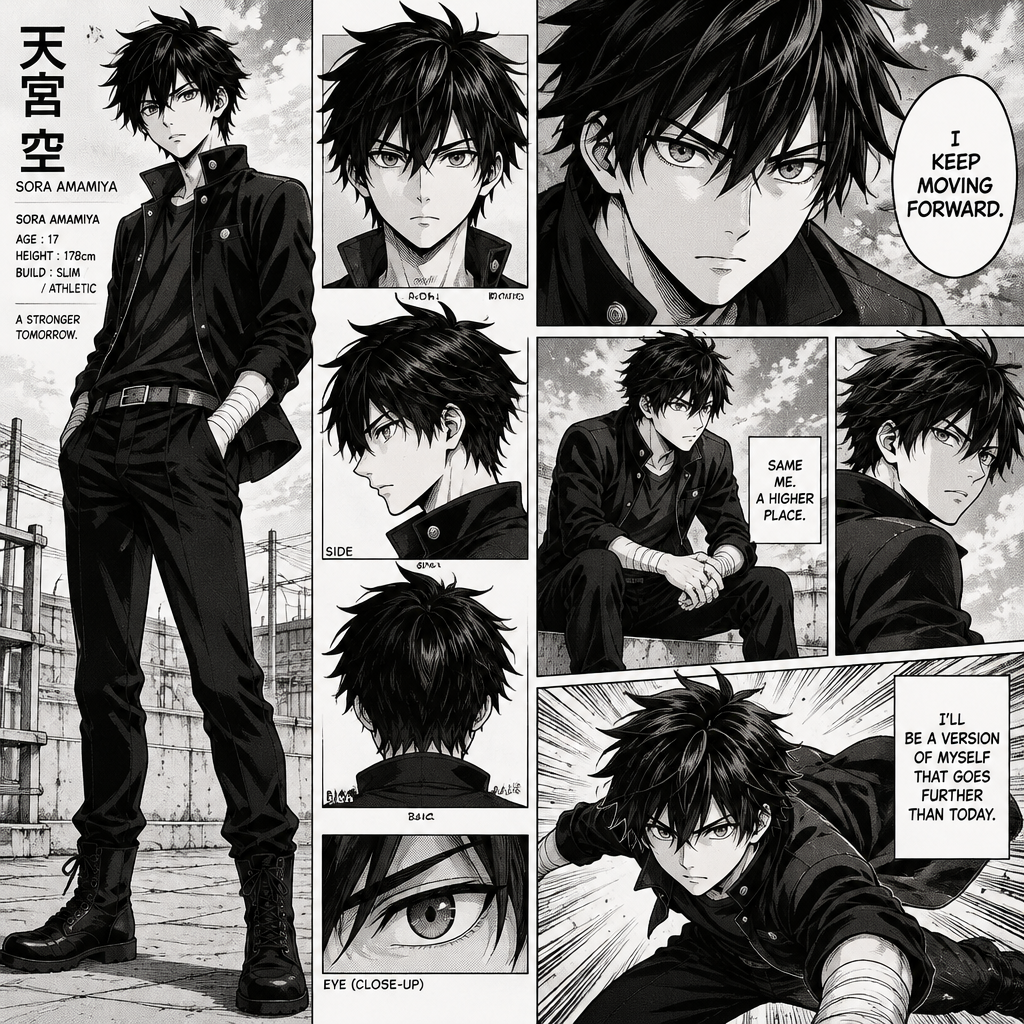
CHARACTER REFERENCE — SORA AMAMIYA

Create an original male shonen manga protagonist named Sora Amamiya. Use a consistent black-and-white Japanese manga art style with clean ink lines, detailed cross-hatching, and dramatic screentones.

HAIR: Messy, layered jet-black hair with distinctive pointed strands and uneven bangs falling over his forehead. Keep the hairstyle identical in every appearance.

EYES: Sharp, deep-grey eyes with dark pupils and clear outlines. Keep their shape consistent between panels.

FACE: Youthful facial structure, defined eyebrows, straight nose, and a serious but natural expression. No facial scars, tattoos, or markings.

OUTFIT: A fitted black high-collar jacket with silver buttons, a plain dark shirt, black trousers, a narrow belt, sturdy lace-up boots, and simple wrist wraps. No clan symbols, badges, or logos.

SILHOUETTE: A recognizable slim, athletic shonen protagonist design. Keep the hairstyle, facial features, proportions, and clothing identical across all illustrations.

ART STYLE: Traditional black-and-white manga, high-contrast ink shading, screentones, expressive eyes, crisp line art, and cinematic panel composition.

IMPORTANT: This is the same character in every image. Do not change his hair, eyes, outfit, or facial structure. Do not add weapons, supernatural effects, accessories, or powers unless explicitly requested.

CHARACTER REFERENCE — SORA AMAMIYA Create an original male shonen manga protagonist named Sora Amamiya. Use a consistent black-and-white Japanese manga art st…

@sharpkraken196

More from the community
CHARACTER REFERENCE — SORA AMAMIYA

Create an original male shonen manga protagonist named Sora Amamiya. Use a consistent black-and-white Japanese manga art style with clean ink lines, detailed cross-hatching, and dramatic screentones.

HAIR: Messy, layered jet-black hair with distinctive pointed strands and uneven bangs falling over his forehead. Keep the hairstyle identical in every appearance.

EYES: Sharp, deep-grey eyes with dark pupils and clear outlines. Keep their shape consistent between panels.

FACE: Youthful facial structure, defined eyebrows, straight nose, and a serious but natural expression. No facial scars, tattoos, or markings.

OUTFIT: A fitted black high-collar jacket with silver buttons, a plain dark shirt, black trousers, a narrow belt, sturdy lace-up boots, and simple wrist wraps. No clan symbols, badges, or logos.

SILHOUETTE: A recognizable slim, athletic shonen protagonist design. Keep the hairstyle, facial features, proportions, and clothing identical across all illustrations.

ART STYLE: Traditional black-and-white manga, high-contrast ink shading, screentones, expressive eyes, crisp line art, and cinematic panel composition.

IMPORTANT: This is the same character in every image. Do not change his hair, eyes, outfit, or facial structure. Do not add weapons, supernatural effects, accessories, or powers unless explicitly requested.
CHARACTER REFERENCE — SORA AMAMIYA Create an original male shonen manga protagonist named Sora Amamiya. Use a consistent black-and-white Japanese manga art style with clean ink lines, detailed cross-hatching, and dramatic screentones. HAIR: Messy, layered jet-black hair with distinctive pointed strands and uneven bangs falling over his forehead. Keep the hairstyle identical in every appearance. EYES: Sharp, deep-grey eyes with dark pupils and clear outlines. Keep their shape consistent between panels. FACE: Youthful facial structure, defined eyebrows, straight nose, and a serious but natural expression. No facial scars, tattoos, or markings. OUTFIT: A fitted black high-collar jacket with silver buttons, a plain dark shirt, black trousers, a narrow belt, sturdy lace-up boots, and simple wrist wraps. No clan symbols, badges, or logos. SILHOUETTE: A recognizable slim, athletic shonen protagonist design. Keep the hairstyle, facial features, proportions, and clothing identical across all illustrations. ART STYLE: Traditional black-and-white manga, high-contrast ink shading, screentones, expressive eyes, crisp line art, and cinematic panel composition. IMPORTANT: This is the same character in every image. Do not change his hair, eyes, outfit, or facial structure. Do not add weapons, supernatural effects, accessories, or powers unless explicitly requested.

DRAGON STRIKERS

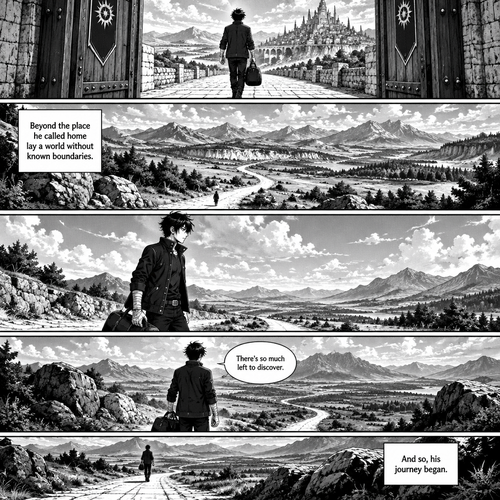
PAGE 6 — BEYOND EVERDAWN

FORMAT: Full-page, black-and-white Japanese manga. Portrait layout, cinematic scenery, detailed ink work, cross-hatching, and screentones.

CHARACTER CONSISTENCY — SORA AMAMIYA

Use the original Sora Amamiya character reference sheet as the visual reference in every panel.

* Age: 17; height: 178 cm; slim, athletic build.
* Hair: Messy, layered jet-black hair with sharp spikes and uneven bangs.
* Eyes: Sharp, light-grey eyes with dark pupils.
* Face: Youthful, defined features and serious eyebrows.
* Outfit: Fitted black high-collar jacket with silver buttons, dark shirt, black trousers, black belt with a rectangular silver buckle, and black lace-up combat boots.
* Wrists: White bandages wrapped around both wrists and partially over both hands.
* Prop: One dark travel bag carried by Sora.

Keep his face, hair, outfit, proportions, and wrist wraps consistent. Do not add weapons, powers, clan emblems, or extra accessories.

PANEL 1 — THE ROAD OUT

Layout: Wide horizontal panel at the top.

Camera: Rear view of Sora walking away from Everdawn’s enormous open gate.

Scene: The gate stands behind him, while a broad stone road extends ahead into a vast landscape. The buildings of Everdawn remain visible in the distance.

Sora carries his travel bag in one hand. His silhouette and clothing must match the reference sheet.

No other characters appear.

PANEL 2 — THE VAST LAND

Layout: Large horizontal panel.

Camera: Extreme wide shot from a high viewpoint.

Scene: The road passes through rolling hills, rocky slopes, and patches of woodland. Distant mountains rise beneath layered clouds. The landscape continues far beyond what the eye can see.

Sora appears as a small figure on the road, emphasizing the enormous scale of the world.

NARRATION:
“Beyond the place he called home lay a world without known boundaries.”

PANEL 3 — ONE TRAVELLER

Layout: Medium panel.

Camera: Side view of Sora walking along the road.

His black hair moves slightly in the breeze. His travel bag hangs beside his leg, and his bandaged hand holds its handle.

His expression is calm and focused. The background shows the road stretching onward.

No dialogue.

PANEL 4 — THE DISTANT HORIZON

Layout: Wide panel near the bottom.

Camera: View from behind Sora, looking toward distant mountains and an immense open landscape.

The road bends into the distance and disappears behind a hill. Use strong foreground shadows and lighter screentones in the background.

Sora pauses briefly to look toward the horizon.

SORA:
“There’s so much left to discover.”

PANEL 5 — CONTINUING FORWARD

Layout: Small final panel with a dark lower border.

Camera: Distant view of Sora continuing along the winding road, his figure becoming smaller against the vast landscape.

NARRATION:
“And so, his journey began.”

FINAL ART DIRECTION

Continue directly from Page 5. Preserve the black-and-white manga style and Sora’s exact reference design. Keep the travel bag consistent in every panel where it appears.

Do not introduce new characters, creatures, conflicts, clan symbols, or supernatural events. The page focuses only on Sora travelling beyond Everdawn.
DRAGON STRIKERS PAGE 6 — BEYOND EVERDAWN FORMAT: Full-page, black-and-white Japanese manga. Portrait layout, cinematic scenery, detailed ink work, cross-hatching, and screentones. CHARACTER CONSISTENCY — SORA AMAMIYA Use the original Sora Amamiya character reference sheet as the visual reference in every panel. * Age: 17; height: 178 cm; slim, athletic build. * Hair: Messy, layered jet-black hair with sharp spikes and uneven bangs. * Eyes: Sharp, light-grey eyes with dark pupils. * Face: Youthful, defined features and serious eyebrows. * Outfit: Fitted black high-collar jacket with silver buttons, dark shirt, black trousers, black belt with a rectangular silver buckle, and black lace-up combat boots. * Wrists: White bandages wrapped around both wrists and partially over both hands. * Prop: One dark travel bag carried by Sora. Keep his face, hair, outfit, proportions, and wrist wraps consistent. Do not add weapons, powers, clan emblems, or extra accessories. PANEL 1 — THE ROAD OUT Layout: Wide horizontal panel at the top. Camera: Rear view of Sora walking away from Everdawn’s enormous open gate. Scene: The gate stands behind him, while a broad stone road extends ahead into a vast landscape. The buildings of Everdawn remain visible in the distance. Sora carries his travel bag in one hand. His silhouette and clothing must match the reference sheet. No other characters appear. PANEL 2 — THE VAST LAND Layout: Large horizontal panel. Camera: Extreme wide shot from a high viewpoint. Scene: The road passes through rolling hills, rocky slopes, and patches of woodland. Distant mountains rise beneath layered clouds. The landscape continues far beyond what the eye can see. Sora appears as a small figure on the road, emphasizing the enormous scale of the world. NARRATION: “Beyond the place he called home lay a world without known boundaries.” PANEL 3 — ONE TRAVELLER Layout: Medium panel. Camera: Side view of Sora walking along the road. His black hair moves slightly in the breeze. His travel bag hangs beside his leg, and his bandaged hand holds its handle. His expression is calm and focused. The background shows the road stretching onward. No dialogue. PANEL 4 — THE DISTANT HORIZON Layout: Wide panel near the bottom. Camera: View from behind Sora, looking toward distant mountains and an immense open landscape. The road bends into the distance and disappears behind a hill. Use strong foreground shadows and lighter screentones in the background. Sora pauses briefly to look toward the horizon. SORA: “There’s so much left to discover.” PANEL 5 — CONTINUING FORWARD Layout: Small final panel with a dark lower border. Camera: Distant view of Sora continuing along the winding road, his figure becoming smaller against the vast landscape. NARRATION: “And so, his journey began.” FINAL ART DIRECTION Continue directly from Page 5. Preserve the black-and-white manga style and Sora’s exact reference design. Keep the travel bag consistent in every panel where it appears. Do not introduce new characters, creatures, conflicts, clan symbols, or supernatural events. The page focuses only on Sora travelling beyond Everdawn.

DRAGON STRIKERS

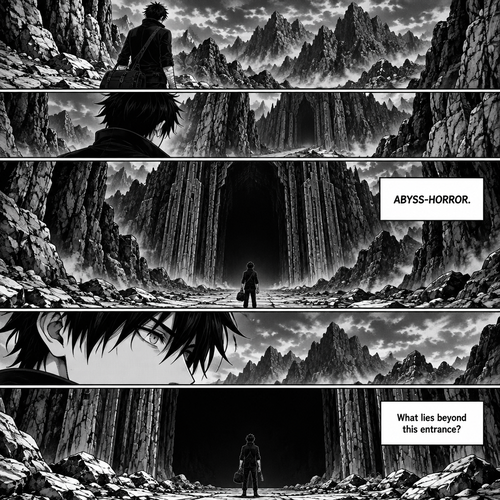
PAGE 7 — THE ENTRANCE OF ABYSS-HORROR

FORMAT: One complete portrait-oriented Japanese manga page, black-and-white, dark fantasy atmosphere, detailed ink work, dramatic shadows, screentones, and cinematic environmental art. Use five clearly separated panels with readable text.

CHARACTER CONSISTENCY — SORA AMAMIYA

Use the supplied Sora Amamiya character reference sheet as the definitive visual reference.

* Age: 17.
* Height: 178 cm.
* Build: Slim and athletic.
* Hair: Messy, layered jet-black hair with sharp, irregular spikes and uneven bangs.
* Eyes: Sharp, light-grey eyes with dark pupils.
* Face: Youthful, defined facial features and sharp eyebrows.
* Outfit: Fitted black high-collar jacket with silver buttons, dark shirt, black trousers, black belt with a rectangular silver buckle, and black lace-up combat boots.
* Wrists: White bandages wrapped around both wrists and partially over both hands.
* Bag: One dark travel bag carried by Sora.

Keep his hairstyle, eyes, face, proportions, clothing, wrist wraps, and bag consistent in every panel. Do not change his outfit or add weapons, clan symbols, or accessories.

PANEL 1 — THE ROAD ENDS

Layout: Wide horizontal panel across the top.

Camera: Rear view of Sora standing on a rocky path.

Scene: The winding road has led Sora into a remote, rugged landscape. Jagged cliffs rise on either side, and dark clouds gather above distant mountains. The familiar open scenery from the previous pages gradually gives way to harsher terrain.

Sora stands in the foreground, holding his travel bag and looking ahead.

No other characters are present.

PANEL 2 — SOMETHING AHEAD

Layout: Narrow horizontal panel.

Camera: Over-the-shoulder view from behind Sora.

Scene: Far ahead, between towering dark rock formations, an enormous entrance is visible. It appears carved into the landscape, surrounded by steep cliffs and deep shadows.

The entrance is so distant that its inner details cannot be seen. Do not show anything living inside it.

Sora is looking directly toward the entrance.

PANEL 3 — THE ENTRANCE OF ABYSS-HORROR

Layout: Large central panel occupying the middle of the page.

Camera: Extreme wide shot from behind Sora, emphasizing the scale of the entrance.

Scene: A colossal, ominous gateway stands between immense rock walls. The ground leading toward it is uneven and barren. Dense black shadows fill the opening, concealing whatever lies beyond.

Use sharp rock textures, heavy ink blacks, and thin white highlights along the edges of the cliffs. The entrance should feel ancient, imposing, and deeply unsettling.

Sora appears small in the foreground, making the gateway look enormous.

NARRATION BOX:
“ABYSS-HORROR.”

Make the name clear and correctly spelled.

PANEL 4 — SORA’S REACTION

Layout: Close-up panel.

Camera: Side profile of Sora’s face.

Scene: His sharp, light-grey eyes remain fixed on the entrance. His black bangs fall naturally across his forehead. His expression is serious and attentive.

Do not give him an exaggerated terrified expression. He is observing the entrance, and his exact emotions beyond that are left open.

No dialogue.

PANEL 5 — BEYOND THE GATE

Layout: Wide final panel across the bottom of the page.

Camera: Distant rear view of Sora facing the enormous entrance.

Scene: Sora stands before the dark opening, his travel bag at his side. The towering rock walls rise around him, and the entrance disappears into complete darkness.

The darkness must conceal the interior. Show no monsters, silhouettes, chains, supernatural beings, or hidden characters.

Use a strong contrast between Sora’s black silhouette, the pale rock highlights, and the pitch-black entrance.

NARRATION BOX:
“What lies beyond this entrance?”

FINAL ART DIRECTION

Maintain continuity with Page 6. Use the same Sora reference design and the same black-and-white manga style as all previous pages.

The scene should establish the entrance of Abyss-Horror as a mysterious destination. Do not invent its inhabitants, history, powers, traps, symbols, or internal geography.

Do not show Hugurumi.

Keep all narration legible and correctly spelled. Do not add any extra dialogue or text.

DRAGON STRIKERS PAGE 7 — THE ENTRANCE OF ABYSS-HORROR FORMAT: One complete portrait-oriented Japanese manga page, black-and-white, dark fantasy atmosphere, detailed ink work, dramatic shadows, screentones, and cinematic environmental art. Use five clearly separated panels with readable text. CHARACTER CONSISTENCY — SORA AMAMIYA Use the supplied Sora Amamiya character reference sheet as the definitive visual reference. * Age: 17. * Height: 178 cm. * Build: Slim and athletic. * Hair: Messy, layered jet-black hair with sharp, irregular spikes and uneven bangs. * Eyes: Sharp, light-grey eyes with dark pupils. * Face: Youthful, defined facial features and sharp eyebrows. * Outfit: Fitted black high-collar jacket with silver buttons, dark shirt, black trousers, black belt with a rectangular silver buckle, and black lace-up combat boots. * Wrists: White bandages wrapped around both wrists and partially over both hands. * Bag: One dark travel bag carried by Sora. Keep his hairstyle, eyes, face, proportions, clothing, wrist wraps, and bag consistent in every panel. Do not change his outfit or add weapons, clan symbols, or accessories. PANEL 1 — THE ROAD ENDS Layout: Wide horizontal panel across the top. Camera: Rear view of Sora standing on a rocky path. Scene: The winding road has led Sora into a remote, rugged landscape. Jagged cliffs rise on either side, and dark clouds gather above distant mountains. The familiar open scenery from the previous pages gradually gives way to harsher terrain. Sora stands in the foreground, holding his travel bag and looking ahead. No other characters are present. PANEL 2 — SOMETHING AHEAD Layout: Narrow horizontal panel. Camera: Over-the-shoulder view from behind Sora. Scene: Far ahead, between towering dark rock formations, an enormous entrance is visible. It appears carved into the landscape, surrounded by steep cliffs and deep shadows. The entrance is so distant that its inner details cannot be seen. Do not show anything living inside it. Sora is looking directly toward the entrance. PANEL 3 — THE ENTRANCE OF ABYSS-HORROR Layout: Large central panel occupying the middle of the page. Camera: Extreme wide shot from behind Sora, emphasizing the scale of the entrance. Scene: A colossal, ominous gateway stands between immense rock walls. The ground leading toward it is uneven and barren. Dense black shadows fill the opening, concealing whatever lies beyond. Use sharp rock textures, heavy ink blacks, and thin white highlights along the edges of the cliffs. The entrance should feel ancient, imposing, and deeply unsettling. Sora appears small in the foreground, making the gateway look enormous. NARRATION BOX: “ABYSS-HORROR.” Make the name clear and correctly spelled. PANEL 4 — SORA’S REACTION Layout: Close-up panel. Camera: Side profile of Sora’s face. Scene: His sharp, light-grey eyes remain fixed on the entrance. His black bangs fall naturally across his forehead. His expression is serious and attentive. Do not give him an exaggerated terrified expression. He is observing the entrance, and his exact emotions beyond that are left open. No dialogue. PANEL 5 — BEYOND THE GATE Layout: Wide final panel across the bottom of the page. Camera: Distant rear view of Sora facing the enormous entrance. Scene: Sora stands before the dark opening, his travel bag at his side. The towering rock walls rise around him, and the entrance disappears into complete darkness. The darkness must conceal the interior. Show no monsters, silhouettes, chains, supernatural beings, or hidden characters. Use a strong contrast between Sora’s black silhouette, the pale rock highlights, and the pitch-black entrance. NARRATION BOX: “What lies beyond this entrance?” FINAL ART DIRECTION Maintain continuity with Page 6. Use the same Sora reference design and the same black-and-white manga style as all previous pages. The scene should establish the entrance of Abyss-Horror as a mysterious destination. Do not invent its inhabitants, history, powers, traps, symbols, or internal geography. Do not show Hugurumi. Keep all narration legible and correctly spelled. Do not add any extra dialogue or text.
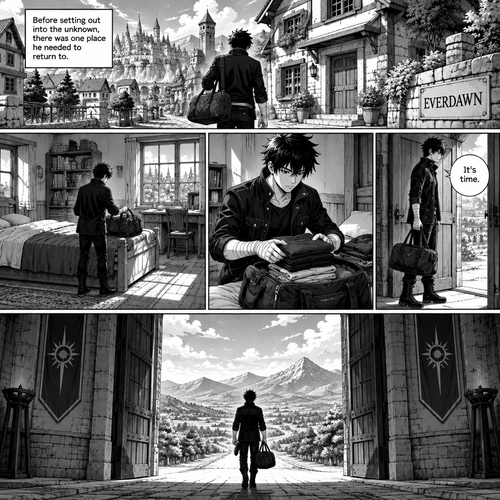
DRAGON STRIKERS

PAGE 5 — DEPARTURE FROM EVERDAWN

FORMAT: One complete black-and-white Japanese manga page, portrait orientation, cinematic panel layout, detailed backgrounds, clean ink lines, high-contrast shadows, and screentones.

CHARACTER CONSISTENCY — SORA AMAMIYA

Use the previously supplied Sora Amamiya character reference sheet as the definitive reference.

* Age: 17
* Height: 178 cm
* Build: Slim and athletic
* Hair: Messy, layered jet-black hair with sharp, irregular spikes and uneven bangs.
* Eyes: Sharp, light-grey eyes with dark pupils.
* Face: Youthful, defined features and serious eyebrows.
* Outfit: Fitted black high-collar jacket with silver buttons, dark shirt, black trousers, black belt with rectangular silver buckle, and black lace-up combat boots.
* Wrists: White bandages wrapped around both wrists and partially over his hands.

Keep his face, hairstyle, proportions, outfit, and wrist wraps consistent in every panel.

PANEL 1 — RETURNING HOME

Layout: Wide horizontal panel at the top.

Camera: Rear three-quarter view of Sora walking toward his home.

Scene: Show Everdawn as a peaceful settlement beneath an expansive sky. Buildings line the streets, and warm sunlight falls across rooftops and stone pathways. The architecture should feel distinct and memorable, with detailed windows, rooftops, balconies, and distant towers.

Sora walks toward a modest-looking home. His black jacket, spiky hair, and bandaged wrists should match the reference sheet.

NARRATION:
“Before setting out into the unknown, there was one place he needed to return to.”

PANEL 2 — INSIDE HIS HOME

Layout: Medium rectangular panel.

Camera: Interior view from a corner of Sora’s room.

Scene: Show a tidy, lived-in room with a bed, a desk, shelves, and a window overlooking Everdawn. Sunlight enters through the window, casting long shadows across the floor.

Sora stands beside an open travel bag, preparing to pack.

Keep the room detailed but uncluttered. Do not introduce photographs, letters, family members, weapons, or personal mementos unless specifically requested.

PANEL 3 — PACKING

Layout: Medium close-up.

Camera: Three-quarter view of Sora placing folded clothes into his travel bag.

Scene: The open bag rests on the bed. Several neatly folded garments are visible inside. Sora’s bandaged hands handle the clothes carefully.

Show the black jacket, trousers, and wrist wraps consistently. His expression is calm and focused.

No supernatural effects or weapons.

PANEL 4 — READY TO LEAVE

Layout: Narrow vertical panel.

Camera: Full-body side view.

Scene: Sora stands near the doorway with his packed travel bag. His black high-collar jacket, dark trousers, boots, and white wrist wraps are clearly visible.

He glances toward the open doorway, where the light from outside illuminates part of his face.

His expression conveys quiet determination.

SORA:
“It’s time.”

PANEL 5 — THE GATE OF EVERDAWN

Layout: The largest panel on the page, occupying the entire bottom section.

Camera: Dramatic wide shot from behind Sora, looking outward through the enormous gate.

Scene: Sora has reached the grand gate of Everdawn. Tall stone pillars and elaborate architectural details frame the entrance. Beyond the gate, a vast road stretches into the distant landscape, surrounded by hills and mountains.

Sora stands at the threshold with his travel bag, facing the world beyond Everdawn.

The settlement remains behind him. The open road lies ahead.

Use heavy black shadows around the gate’s inner walls, contrasting with the lighter landscape outside. Make Sora’s silhouette unmistakable.

No Hugurumi. No other characters. No action scene. No supernatural effects.

The final panel must clearly show Sora leaving Everdawn through its gate, beginning his journey into the unknown.

FINAL ART DIRECTION

Maintain the same black-and-white manga style as Pages 1–4. Use clear panel borders, readable lettering, detailed environments, and consistent character proportions.

The page should communicate one simple event: Sora returns home, packs clothes, prepares himself, and leaves Everdawn.

Do not add new lore, characters, family details, or plot events beyond this description.

DRAGON STRIKERS PAGE 5 — DEPARTURE FROM EVERDAWN FORMAT: One complete black-and-white Japanese manga page, portrait orientation, cinematic panel layout, detailed backgrounds, clean ink lines, high-contrast shadows, and screentones. CHARACTER CONSISTENCY — SORA AMAMIYA Use the previously supplied Sora Amamiya character reference sheet as the definitive reference. * Age: 17 * Height: 178 cm * Build: Slim and athletic * Hair: Messy, layered jet-black hair with sharp, irregular spikes and uneven bangs. * Eyes: Sharp, light-grey eyes with dark pupils. * Face: Youthful, defined features and serious eyebrows. * Outfit: Fitted black high-collar jacket with silver buttons, dark shirt, black trousers, black belt with rectangular silver buckle, and black lace-up combat boots. * Wrists: White bandages wrapped around both wrists and partially over his hands. Keep his face, hairstyle, proportions, outfit, and wrist wraps consistent in every panel. PANEL 1 — RETURNING HOME Layout: Wide horizontal panel at the top. Camera: Rear three-quarter view of Sora walking toward his home. Scene: Show Everdawn as a peaceful settlement beneath an expansive sky. Buildings line the streets, and warm sunlight falls across rooftops and stone pathways. The architecture should feel distinct and memorable, with detailed windows, rooftops, balconies, and distant towers. Sora walks toward a modest-looking home. His black jacket, spiky hair, and bandaged wrists should match the reference sheet. NARRATION: “Before setting out into the unknown, there was one place he needed to return to.” PANEL 2 — INSIDE HIS HOME Layout: Medium rectangular panel. Camera: Interior view from a corner of Sora’s room. Scene: Show a tidy, lived-in room with a bed, a desk, shelves, and a window overlooking Everdawn. Sunlight enters through the window, casting long shadows across the floor. Sora stands beside an open travel bag, preparing to pack. Keep the room detailed but uncluttered. Do not introduce photographs, letters, family members, weapons, or personal mementos unless specifically requested. PANEL 3 — PACKING Layout: Medium close-up. Camera: Three-quarter view of Sora placing folded clothes into his travel bag. Scene: The open bag rests on the bed. Several neatly folded garments are visible inside. Sora’s bandaged hands handle the clothes carefully. Show the black jacket, trousers, and wrist wraps consistently. His expression is calm and focused. No supernatural effects or weapons. PANEL 4 — READY TO LEAVE Layout: Narrow vertical panel. Camera: Full-body side view. Scene: Sora stands near the doorway with his packed travel bag. His black high-collar jacket, dark trousers, boots, and white wrist wraps are clearly visible. He glances toward the open doorway, where the light from outside illuminates part of his face. His expression conveys quiet determination. SORA: “It’s time.” PANEL 5 — THE GATE OF EVERDAWN Layout: The largest panel on the page, occupying the entire bottom section. Camera: Dramatic wide shot from behind Sora, looking outward through the enormous gate. Scene: Sora has reached the grand gate of Everdawn. Tall stone pillars and elaborate architectural details frame the entrance. Beyond the gate, a vast road stretches into the distant landscape, surrounded by hills and mountains. Sora stands at the threshold with his travel bag, facing the world beyond Everdawn. The settlement remains behind him. The open road lies ahead. Use heavy black shadows around the gate’s inner walls, contrasting with the lighter landscape outside. Make Sora’s silhouette unmistakable. No Hugurumi. No other characters. No action scene. No supernatural effects. The final panel must clearly show Sora leaving Everdawn through its gate, beginning his journey into the unknown. FINAL ART DIRECTION Maintain the same black-and-white manga style as Pages 1–4. Use clear panel borders, readable lettering, detailed environments, and consistent character proportions. The page should communicate one simple event: Sora returns home, packs clothes, prepares himself, and leaves Everdawn. Do not add new lore, characters, family details, or plot events beyond this description.

Create a humorous rap album concept for HASH BLINK that revolves around the themes of gold and silver. Include playful song titles, witty lyrics, and light-hearted commentary on the obsession with wealth. Each track should explore different aspects of gold and silver, from the bling lifestyle to the quirks of chasing riches, all while maintaining a fun, comedic tone. Think of clever metaphors, amusing anecdotes, and tongue-in-cheek references that would make listeners laugh while enjoying the beats.

Create a humorous rap album concept for HASH BLINK that revolves around the themes of gold and silver. Include playful song titles, witty lyrics, and light-hearted commentary on the obsession with wealth. Each track should explore different aspects of gold and silver, from the bling lifestyle to the quirks of chasing riches, all while maintaining a fun, comedic tone. Think of clever metaphors, amusing anecdotes, and tongue-in-cheek references that would make listeners laugh while enjoying the beats.

Design a formal album cover for Hash Blink's boom-bap rap musical project titled "THE NEW RAP COMMISSIONER." The artwork should capture the essence of classic hip-hop culture, incorporating elements such as vinyl records, graffiti, and urban landscapes. Use a color palette that reflects the gritty yet vibrant atmosphere of the genre. The title should be prominently displayed in bold, stylized typography that conveys authority and innovation. Consider including subtle nods to the evolution of rap, such as iconic symbols or references to legendary artists, while maintaining a clean and sophisticated aesthetic suitable for a formal presentation.
Design a formal album cover for Hash Blink's boom-bap rap musical project titled "THE NEW RAP COMMISSIONER." The artwork should capture the essence of classic hip-hop culture, incorporating elements such as vinyl records, graffiti, and urban landscapes. Use a color palette that reflects the gritty yet vibrant atmosphere of the genre. The title should be prominently displayed in bold, stylized typography that conveys authority and innovation. Consider including subtle nods to the evolution of rap, such as iconic symbols or references to legendary artists, while maintaining a clean and sophisticated aesthetic suitable for a formal presentation.

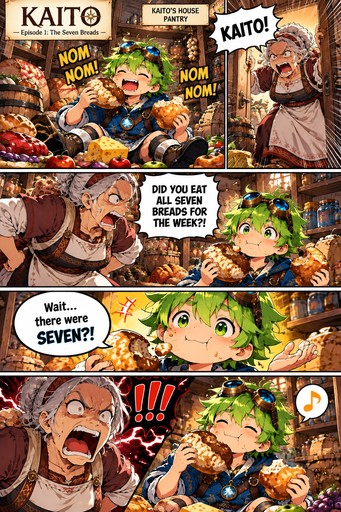
Colorful manga panels show people eating food with comic speech bubbles and expressive action lines.

Colorful manga panels show people eating food with comic speech bubbles and expressive action lines.

Design a formal album cover for Hash Blink's boom-bap rap musical project titled "THE NEW RAP COMMISSIONER." The artwork should capture the essence of classic hip-hop culture, incorporating elements such as vinyl records, graffiti, and urban landscapes. Use a color palette that reflects the gritty yet vibrant atmosphere of the genre. The title should be prominently displayed in bold, stylized typography that conveys authority and innovation. Consider including subtle nods to the evolution of rap, such as iconic symbols or references to legendary artists, while maintaining a clean and sophisticated aesthetic suitable for a formal presentation.
Design a formal album cover for Hash Blink's boom-bap rap musical project titled "THE NEW RAP COMMISSIONER." The artwork should capture the essence of classic hip-hop culture, incorporating elements such as vinyl records, graffiti, and urban landscapes. Use a color palette that reflects the gritty yet vibrant atmosphere of the genre. The title should be prominently displayed in bold, stylized typography that conveys authority and innovation. Consider including subtle nods to the evolution of rap, such as iconic symbols or references to legendary artists, while maintaining a clean and sophisticated aesthetic suitable for a formal presentation.

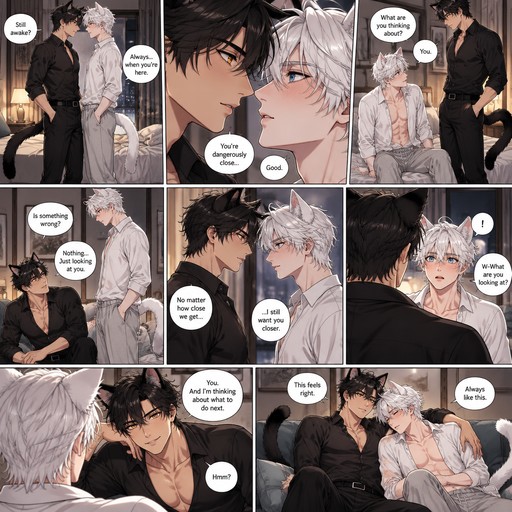
Create a high-quality full-color manga/manhwa sequence featuring TWO ADULT MALE CHARACTERS, both clearly over 18 years old.

Use my two uploaded images ONLY as visual references for the overall illustration approach: character proportions, expressive faces, detailed anime-style hair, cat ears, clean linework, polished cel shading, vivid colors, dramatic close-ups, manga panel composition, and expressive reaction shots.

IMPORTANT:
Both characters are adults.
Keep the same two characters recognizable and visually consistent throughout every image.
Maintain identical hairstyles, facial features, eye colors, body proportions, cat ears, and clothing design from scene to scene.

Create AT LEAST 10 separate images/panels with DIFFERENT poses, camera angles, expressions, and compositions.

SCENE / PANEL PLAN:

1. Full-body establishing shot:
Both adult characters standing close together, facing each other, strong eye contact, detailed room background, cinematic manga lighting.

2. Face-to-face close-up:
Very close framing of their faces, intense eye contact, slightly flushed cheeks, detailed eyes and hair, dramatic manga composition.

3. Character A sitting:
Character A sits on the edge of a bed while Character B stands nearby. Use a three-quarter camera angle and natural body language.

4. Character B sitting:
Reverse the previous composition. Character B sits while Character A stands beside him. Use a different camera angle.

5. Side-profile composition:
Both characters shown from the side, standing very close together. Emphasize silhouettes, facial expressions, hair, cat ears and clothing folds.

6. Over-the-shoulder shot:
Camera positioned behind Character A looking toward Character B. Character B has a surprised and embarrassed expression.

7. Reverse over-the-shoulder shot:
Camera positioned behind Character B looking toward Character A. Character A has a playful confident expression.

8. Dynamic seated pose:
Both characters sitting together on a sofa or bed, leaning

Create a high-quality full-color manga/manhwa sequence featuring TWO ADULT MALE CHARACTERS, both clearly over 18 years old. Use my two uploaded images ONLY as visual references for the overall illustration approach: character proportions, expressive faces, detailed anime-style hair, cat ears, clean linework, polished cel shading, vivid colors, dramatic close-ups, manga panel composition, and expressive reaction shots. IMPORTANT: Both characters are adults. Keep the same two characters recognizable and visually consistent throughout every image. Maintain identical hairstyles, facial features, eye colors, body proportions, cat ears, and clothing design from scene to scene. Create AT LEAST 10 separate images/panels with DIFFERENT poses, camera angles, expressions, and compositions. SCENE / PANEL PLAN: 1. Full-body establishing shot: Both adult characters standing close together, facing each other, strong eye contact, detailed room background, cinematic manga lighting. 2. Face-to-face close-up: Very close framing of their faces, intense eye contact, slightly flushed cheeks, detailed eyes and hair, dramatic manga composition. 3. Character A sitting: Character A sits on the edge of a bed while Character B stands nearby. Use a three-quarter camera angle and natural body language. 4. Character B sitting: Reverse the previous composition. Character B sits while Character A stands beside him. Use a different camera angle. 5. Side-profile composition: Both characters shown from the side, standing very close together. Emphasize silhouettes, facial expressions, hair, cat ears and clothing folds. 6. Over-the-shoulder shot: Camera positioned behind Character A looking toward Character B. Character B has a surprised and embarrassed expression. 7. Reverse over-the-shoulder shot: Camera positioned behind Character B looking toward Character A. Character A has a playful confident expression. 8. Dynamic seated pose: Both characters sitting together on a sofa or bed, leaning
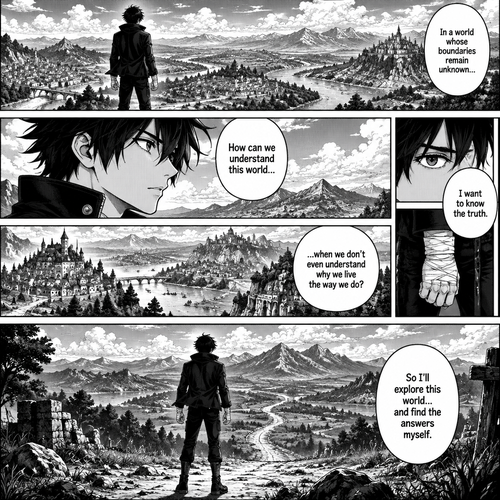
DRAGON STRIKERS

PAGE 4 — THE QUESTION

FORMAT: Japanese black-and-white manga page, read from right to left. Five panels. Detailed ink work, screentones, cinematic framing, and expressive character art.

CHARACTER CONSISTENCY — SORA AMAMIYA

Use the supplied Sora Amamiya reference sheet as the definitive visual reference.

* Age: 17.
* Height: 178 cm.
* Build: slim and athletic.
* Hair: messy, layered jet-black hair with sharp, irregular spikes and uneven bangs.
* Eyes: sharp, light-grey eyes with dark pupils.
* Face: youthful, defined features and sharp eyebrows.
* Outfit: fitted black high-collar jacket with silver buttons, dark shirt, black trousers, black belt with a rectangular silver buckle, and black lace-up combat boots.
* Hands: white bandages wrapped around both wrists and partially over the hands.

Maintain his exact hairstyle, facial structure, clothing, proportions, and wrist wraps in every panel. Do not add weapons, powers, clan symbols, or accessories.

PANEL 1 — THE LONE FIGURE

Layout: Wide horizontal panel across the top.

Camera: Rear three-quarter view, medium-wide shot.

Scene: Sora stands at a high overlook above an enormous landscape. Mountain ranges stretch toward the horizon, rivers wind through distant valleys, and clouds cast shadows over the land.

His black jacket and spiky hair are clearly recognizable. His hands rest naturally by his sides.

Narration:
“In a world whose boundaries remain unknown…”

PANEL 2 — THE QUESTION

Layout: Medium close-up.

Camera: Side profile of Sora, looking toward the distant horizon.

His light-grey eyes are visible beneath his uneven bangs. His expression is serious and thoughtful, without exaggerated emotion.

Sora’s dialogue:
“How can we understand this world…”

PANEL 3 — THE CLANS

Layout: Wide panel.

Camera: A distant view of several different settlements separated by mountains, rivers, and enormous stretches of land.

Do not depict named clans, clan emblems, specific leaders, or invented customs. Show only the vastness and variety of civilization.

Sora’s dialogue:
”…when we don’t even understand why we live the way we do?”

PANEL 4 — THE DECISION

Layout: Narrow vertical panel.

Camera: Close-up of Sora’s eyes, followed by a small view of his bandaged hand resting beside his jacket.

His gaze becomes more focused. Keep the expression subtle and believable.

Sora’s dialogue:
“I want to know the truth.”

PANEL 5 — THE JOURNEY

Layout: Large bottom panel with dramatic perspective.

Camera: Rear view of Sora facing a long road that disappears into the distant mountains.

His silhouette stands against the enormous landscape. Use strong black shadows in the foreground and lighter screentones toward the horizon.

Do not show Hugurumi, chains, supernatural effects, or any other characters.

Sora’s dialogue:
“So I’ll explore this world… and find the answers myself.”

FINAL ART DIRECTION

The page should feel quiet, serious, and mysterious. Sora is not posing heroically or fighting anyone. This is the moment the reader understands why he wants to explore.

Keep every line of dialogue exactly as written. Use clear, legible lettering and traditional black-and-white manga shading. Preserve Sora’s reference design throughout.
DRAGON STRIKERS PAGE 4 — THE QUESTION FORMAT: Japanese black-and-white manga page, read from right to left. Five panels. Detailed ink work, screentones, cinematic framing, and expressive character art. CHARACTER CONSISTENCY — SORA AMAMIYA Use the supplied Sora Amamiya reference sheet as the definitive visual reference. * Age: 17. * Height: 178 cm. * Build: slim and athletic. * Hair: messy, layered jet-black hair with sharp, irregular spikes and uneven bangs. * Eyes: sharp, light-grey eyes with dark pupils. * Face: youthful, defined features and sharp eyebrows. * Outfit: fitted black high-collar jacket with silver buttons, dark shirt, black trousers, black belt with a rectangular silver buckle, and black lace-up combat boots. * Hands: white bandages wrapped around both wrists and partially over the hands. Maintain his exact hairstyle, facial structure, clothing, proportions, and wrist wraps in every panel. Do not add weapons, powers, clan symbols, or accessories. PANEL 1 — THE LONE FIGURE Layout: Wide horizontal panel across the top. Camera: Rear three-quarter view, medium-wide shot. Scene: Sora stands at a high overlook above an enormous landscape. Mountain ranges stretch toward the horizon, rivers wind through distant valleys, and clouds cast shadows over the land. His black jacket and spiky hair are clearly recognizable. His hands rest naturally by his sides. Narration: “In a world whose boundaries remain unknown…” PANEL 2 — THE QUESTION Layout: Medium close-up. Camera: Side profile of Sora, looking toward the distant horizon. His light-grey eyes are visible beneath his uneven bangs. His expression is serious and thoughtful, without exaggerated emotion. Sora’s dialogue: “How can we understand this world…” PANEL 3 — THE CLANS Layout: Wide panel. Camera: A distant view of several different settlements separated by mountains, rivers, and enormous stretches of land. Do not depict named clans, clan emblems, specific leaders, or invented customs. Show only the vastness and variety of civilization. Sora’s dialogue: ”…when we don’t even understand why we live the way we do?” PANEL 4 — THE DECISION Layout: Narrow vertical panel. Camera: Close-up of Sora’s eyes, followed by a small view of his bandaged hand resting beside his jacket. His gaze becomes more focused. Keep the expression subtle and believable. Sora’s dialogue: “I want to know the truth.” PANEL 5 — THE JOURNEY Layout: Large bottom panel with dramatic perspective. Camera: Rear view of Sora facing a long road that disappears into the distant mountains. His silhouette stands against the enormous landscape. Use strong black shadows in the foreground and lighter screentones toward the horizon. Do not show Hugurumi, chains, supernatural effects, or any other characters. Sora’s dialogue: “So I’ll explore this world… and find the answers myself.” FINAL ART DIRECTION The page should feel quiet, serious, and mysterious. Sora is not posing heroically or fighting anyone. This is the moment the reader understands why he wants to explore. Keep every line of dialogue exactly as written. Use clear, legible lettering and traditional black-and-white manga shading. Preserve Sora’s reference design throughout.

Create a black-and-white, portrait-oriented manga illustration in a realistic anime teenage drawing style, with natural high-school student proportions, expressive but subtle facial features, detailed hairstyles, and clean, confident pencil linework. Avoid chibi, cartoon, exaggerated facial expressions, or childish proportions.

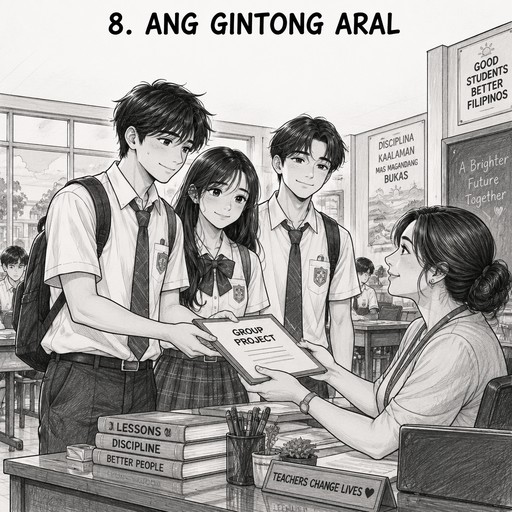
The scene takes place in a realistic Filipino high-school classroom. Miguel, a teenage boy in a school uniform, respectfully hands their completed group project to their female teacher across her desk. Ana and Carlo stand beside him, looking relieved and quietly proud after working together to finish it. Miguel has a sincere, slightly nervous smile; Ana has a gentle smile; Carlo looks relieved and confident. The teacher accepts their project with a warm, approving expression.

Use careful manga shading, realistic folds in their uniforms, detailed hands holding the project folder, and a lightly sketched classroom background with desks and windows. Compose the characters vertically so all four are visible without overcrowding. Leave clear space at the top for the title “8. ANG GINTONG ARAL” and a little room for speech bubbles. Keep the illustration monochrome, neat, mature, and detailed enough to look like a teenage manga artist drew it, but simple enough for a Grade 10 student to use as a hand-drawing reference.
Create a black-and-white, portrait-oriented manga illustration in a realistic anime teenage drawing style, with natural high-school student proportions, expressive but subtle facial features, detailed hairstyles, and clean, confident pencil linework. Avoid chibi, cartoon, exaggerated facial expressions, or childish proportions. The scene takes place in a realistic Filipino high-school classroom. Miguel, a teenage boy in a school uniform, respectfully hands their completed group project to their female teacher across her desk. Ana and Carlo stand beside him, looking relieved and quietly proud after working together to finish it. Miguel has a sincere, slightly nervous smile; Ana has a gentle smile; Carlo looks relieved and confident. The teacher accepts their project with a warm, approving expression. Use careful manga shading, realistic folds in their uniforms, detailed hands holding the project folder, and a lightly sketched classroom background with desks and windows. Compose the characters vertically so all four are visible without overcrowding. Leave clear space at the top for the title “8. ANG GINTONG ARAL” and a little room for speech bubbles. Keep the illustration monochrome, neat, mature, and detailed enough to look like a teenage manga artist drew it, but simple enough for a Grade 10 student to use as a hand-drawing reference.

Create a black-and-white, portrait-oriented manga illustration in a realistic anime teenage drawing style, with natural high-school student proportions, expressive but subtle facial features, detailed hairstyles, and clean, confident pencil linework. Avoid chibi, cartoon, exaggerated facial expressions, or childish proportions.

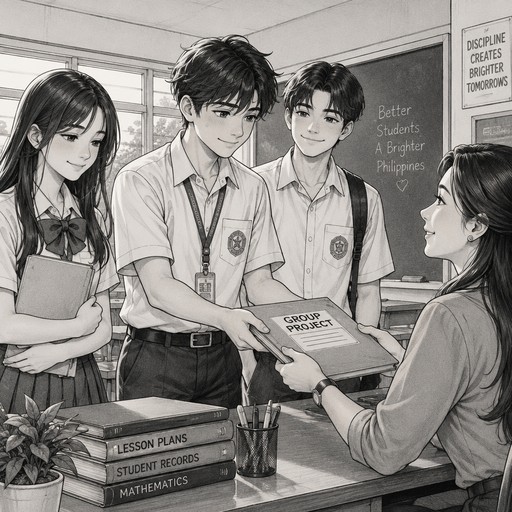
The scene takes place in a realistic Filipino high-school classroom. Miguel, a teenage boy in a school uniform, respectfully hands their completed group project to their female teacher across her desk. Ana and Carlo stand beside him, looking relieved and quietly proud after working together to finish it. Miguel has a sincere, slightly nervous smile; Ana has a gentle smile; Carlo looks relieved and confident. The teacher accepts their project with a warm, approving expression.

Use careful manga shading, realistic folds in their uniforms, detailed hands holding the project folder, and a lightly sketched classroom background with desks and windows. Compose the characters vertically so all four are visible without overcrowding. Leave clear space at the top for the title “8. ANG GINTONG ARAL” and a little room for speech bubbles. Keep the illustration monochrome, neat, mature, and detailed enough to look like a teenage manga artist drew it, but simple enough for a Grade 10 student to use as a hand-drawing reference. closer perspective into the teacher and students, dont zoom out too much, too much space

Create a black-and-white, portrait-oriented manga illustration in a realistic anime teenage drawing style, with natural high-school student proportions, expressive but subtle facial features, detailed hairstyles, and clean, confident pencil linework. Avoid chibi, cartoon, exaggerated facial expressions, or childish proportions. The scene takes place in a realistic Filipino high-school classroom. Miguel, a teenage boy in a school uniform, respectfully hands their completed group project to their female teacher across her desk. Ana and Carlo stand beside him, looking relieved and quietly proud after working together to finish it. Miguel has a sincere, slightly nervous smile; Ana has a gentle smile; Carlo looks relieved and confident. The teacher accepts their project with a warm, approving expression. Use careful manga shading, realistic folds in their uniforms, detailed hands holding the project folder, and a lightly sketched classroom background with desks and windows. Compose the characters vertically so all four are visible without overcrowding. Leave clear space at the top for the title “8. ANG GINTONG ARAL” and a little room for speech bubbles. Keep the illustration monochrome, neat, mature, and detailed enough to look like a teenage manga artist drew it, but simple enough for a Grade 10 student to use as a hand-drawing reference. closer perspective into the teacher and students, dont zoom out too much, too much space